
Anime drawing style feels easy to recognize—and weirdly difficult to pin down when you try to create it yourself. You can tell when something looks anime, but getting your own work to land there is another challenge.
This guide gives you a clear way to think about it. No rigid rules, no step-by-step instructions—just a practical mental model of how anime style works, why it looks the way it does, and how to build it into your drawings without guessing.
What defines an anime drawing style (really)?
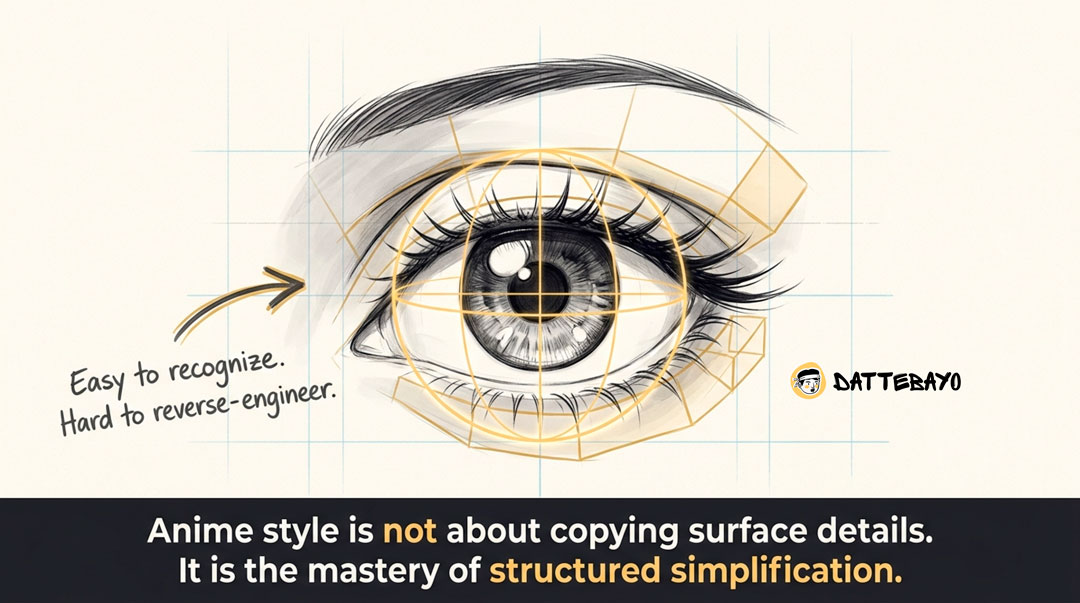
Anime drawing style is stylization—simplifying real anatomy while exaggerating key features to improve clarity, expression, and impact.
It’s not sloppy realism, and it’s definitely not random. Every choice—what to simplify, what to push, what to leave out—is intentional.
In anime and manga, those choices usually prioritize:
- Clear, readable expressions
- Strong, recognizable silhouettes
- Clean and deliberate linework
- Proportions that reflect personality
There’s also a small but useful distinction:
- Anime style often relates to animation (movement, color, lighting)
- Manga style focuses more on linework and storytelling on the page
In practice, though, they overlap a lot—especially when you’re learning.
The goal isn’t to copy how it looks. It’s to understand why it looks that way.
Why exaggeration exists (and why it works)
Exaggeration makes emotion easier to read at a glance.
Big eyes give you more room to show subtle feelings. Simplified noses and mouths keep attention where it matters. Hair is grouped into shapes instead of individual strands to avoid clutter.
All of this supports visual storytelling. You should be able to understand a character’s mood almost instantly.
Is there just one anime style?
No—there are many, and they can look very different.
Think about:
- Soft, rounded shojo designs
- Sharp, high-contrast shonen characters
- More grounded, film-style anime
They all fall under the same umbrella, but their proportions, detail levels, and linework vary a lot.
If you chase one “perfect” style too early, you’ll get stuck. It’s more useful to understand the shared structure underneath all of them.
Anime vs realism vs cartoons: what actually changes?
Anime sits between realism and cartoons—it simplifies, but doesn’t lose structure.
A simple way to frame it:
- Realism: accuracy and detail
- Cartoons (Western): heavy simplification and abstraction
- Anime: structured simplification with believable form
Anime keeps enough anatomy to feel grounded, while staying clean and expressive.
Is anime easier than realistic drawing?
It’s easier to start, but not easier to master.
You can sketch a convincing anime face quickly—but making it consistent, clean, and flexible (from different angles, from memory) still depends on fundamentals.
If you’ve ever copied a face successfully but couldn’t redraw it later, you’ve run into this already. That’s not a style issue—it’s a structure gap.
Why switching styles feels confusing
Each style follows its own internal rules.
When you jump between:
- realistic studies
- chibi proportions
- semi-realistic anime
…your brain has to constantly adjust things like:
- eye size
- facial spacing
- level of detail
Until those rules feel natural, switching will feel messy. That’s completely normal.
The core fundamentals anime still depends on
Anime style still relies on fundamentals—it just hides them under clean shapes.
There’s a common misconception that you can skip anatomy or construction. In reality, anime simplifies them, but doesn’t remove them.
The key pieces are:
- Gesture: flow and movement
- Basic anatomy: simplified, but present
- Construction: building forms in 3D
- Proportions: chosen deliberately
If something feels “off,” it usually traces back to one of these.
What fundamentals do you actually need to start?
You only need a small, focused foundation.
That includes:
- Basic head structure
- Simple body proportions
- Intentional (not perfect) line control
If you’ve seen structured lessons like drawing anime and manga from scratch, you’ve probably noticed how much easier things get once these basics are organized clearly.
Why skipping fundamentals slows you down
Copying without understanding creates fragile results.
You might get a good-looking drawing once—but you won’t be able to repeat it, adjust it, or fix mistakes reliably.
That’s why two drawings can look similar at first glance, but feel very different in quality.
What actually makes a drawing look “anime”?
It’s consistency—not a single feature—that creates the anime look.
You don’t get there just by drawing big eyes. Everything has to work together:
- Eyes: shape, placement, expression
- Hair: clear, grouped forms
- Proportions: especially in the face
- Line art: confident and readable
- Silhouette: clear even without detail
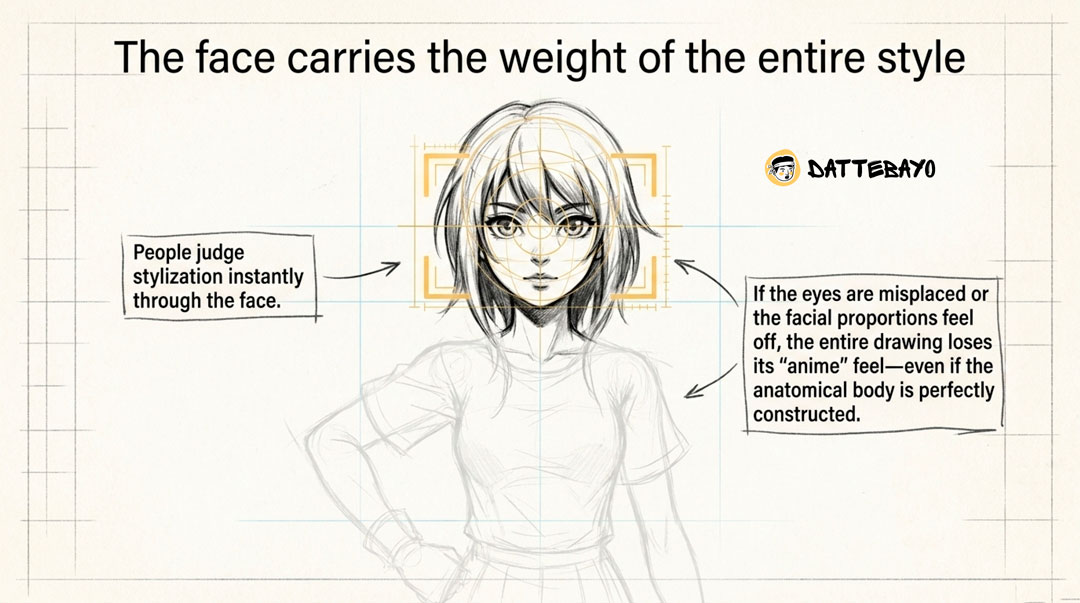
Why the face carries most of the style
People judge the style instantly through the face.
If the eyes or proportions feel off, the whole drawing loses its “anime” feel—even if the rest is solid.
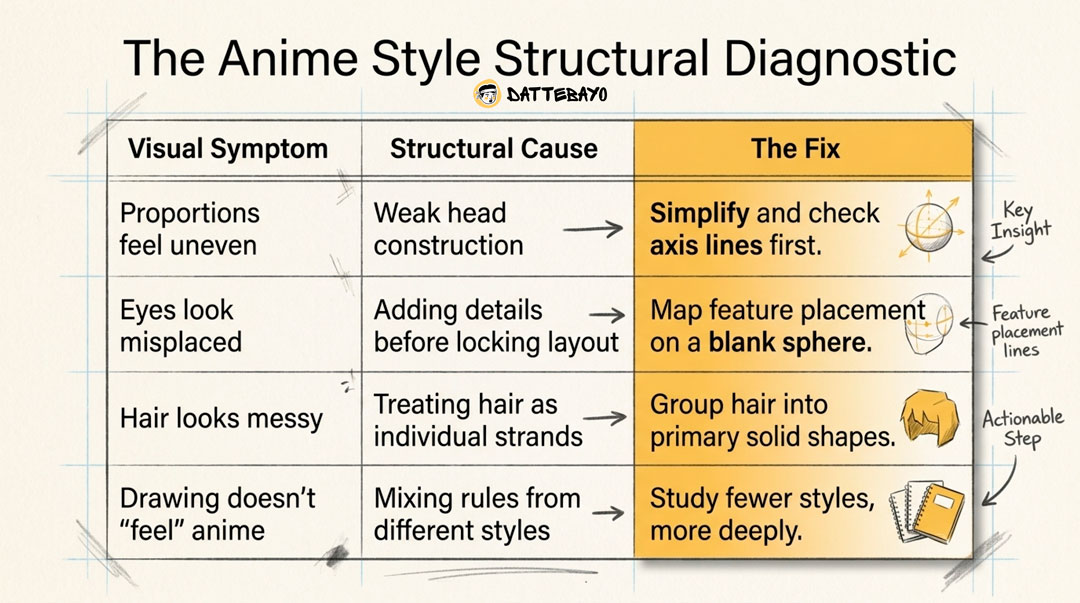
Common mistakes that break the illusion
- Inconsistent head structure
- Adding details too early
- Scratchy or hesitant lines
- Treating hair as strands instead of shapes
- Misaligned features
Here’s a quick way to check your work:
Types of anime styles (and which one beginners should start with)
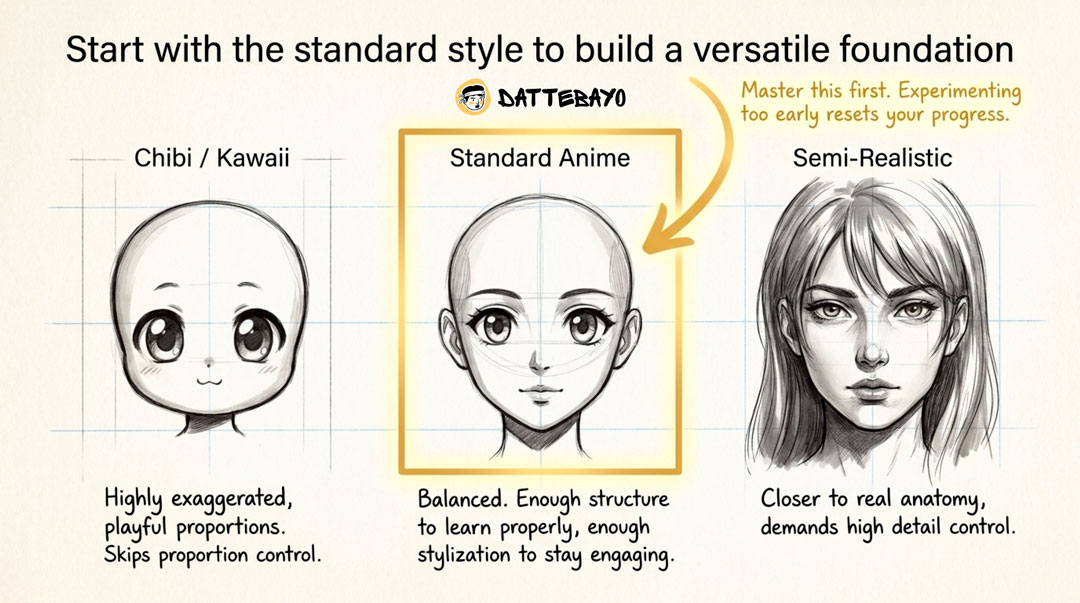
Anime styles range from simple to complex—but starting balanced makes learning easier.
Common categories include:
- Chibi / kawaii: highly exaggerated, playful proportions
- Standard anime: balanced and versatile
- Semi-realistic anime: closer to real anatomy, more detail
Which style should you start with?
The standard anime style is your best entry point.
It gives you:
- Enough structure to learn properly
- Enough stylization to stay engaging
Chibi is fun, but it skips proportion control. That can slow your progress later.
When should you explore other styles?
Once your basics are stable.
You’re ready when:
- You can draw faces from multiple angles
- Your proportions stay consistent
- Your lines feel more deliberate
At that point, experimenting actually builds your skill instead of resetting it.
How do you study anime without just copying?
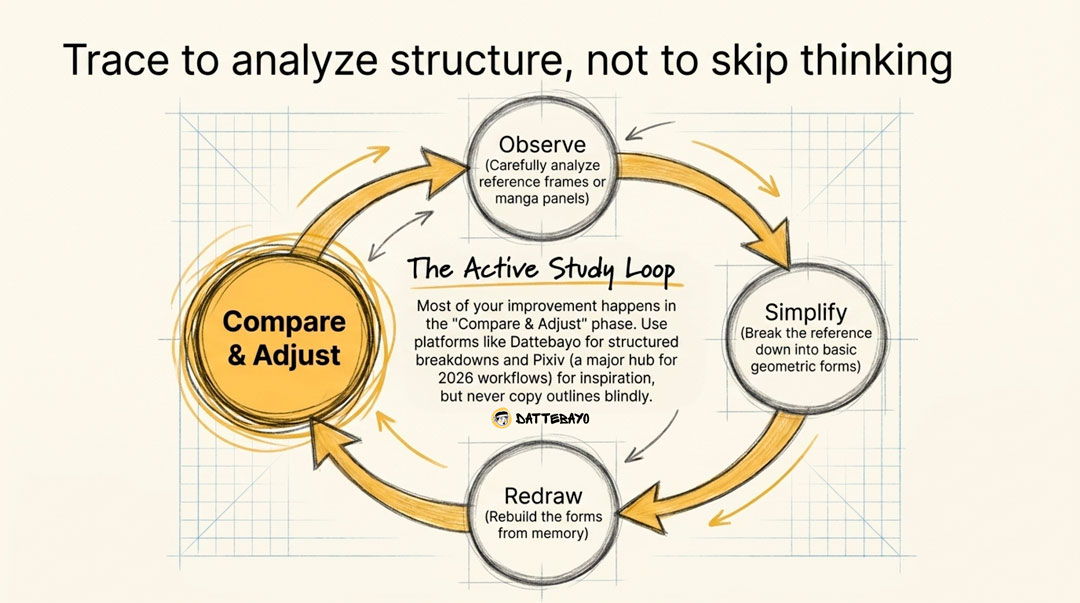
You improve by breaking things down and rebuilding them—not by tracing outlines.
Good references include:
- Anime frames
- Manga panels
- Character sheets
You’ll find structured breakdowns on platforms like Dattebayo and inspiration-heavy collections on sites like Pixiv, which remains a major hub for anime artists in 2026.
What’s a simple way to study effectively?
Focus on understanding, not replication.
A solid approach:
- Observe carefully
- Simplify into basic forms
- Redraw from memory
- Compare and adjust
That last step is where most of your improvement happens.
Is tracing helpful?
It can be—but only if you use it analytically.
Tracing to understand structure? Useful.
Tracing to skip thinking? Not helpful.
A simple anime drawing process (beginner-friendly)
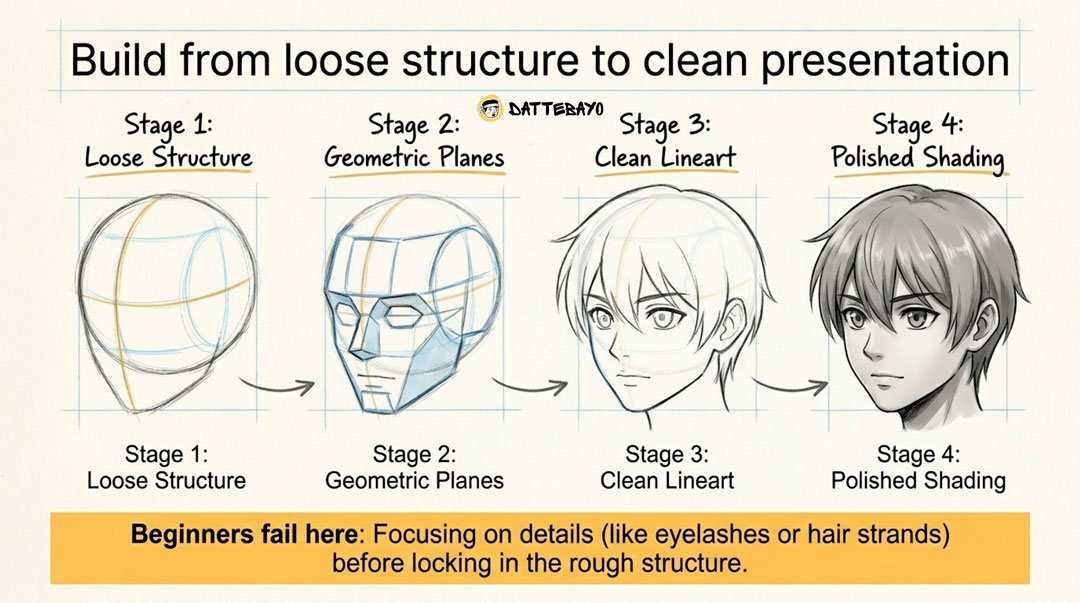
Most drawings move from rough structure to clean presentation—but what matters is how you think, not the stages themselves.
The general flow goes from:
- Loose structure
- Refined shapes
- Clean linework
- Optional color or shading
Where do beginners usually struggle?
They focus on details too early.
If the base is off, clean linework won’t fix it—it’ll highlight the problem.
Should you start with digital or traditional drawing?
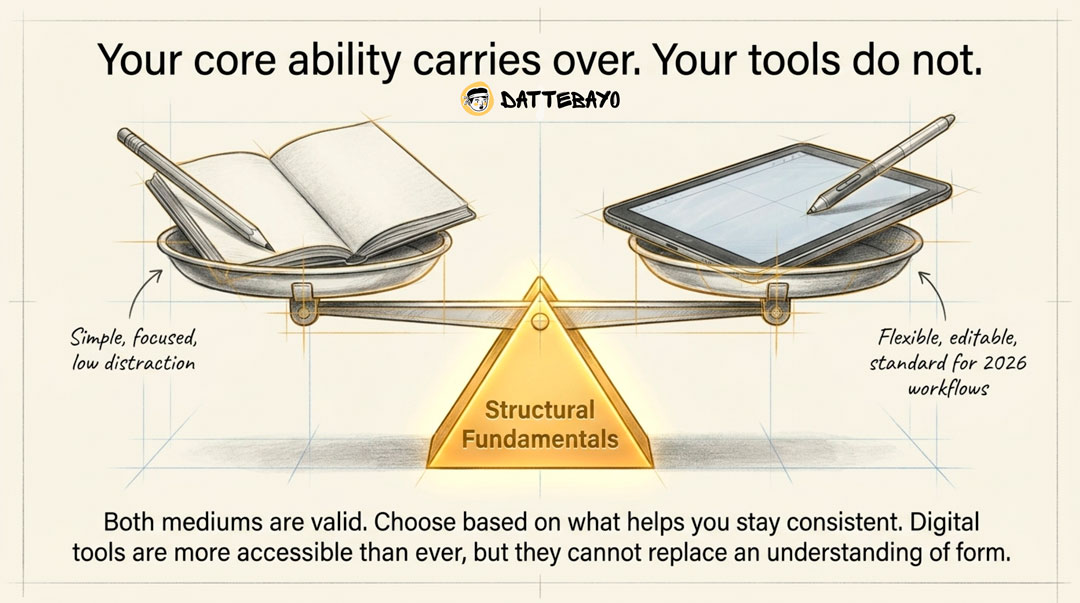
Both are valid—choose based on what helps you stay consistent.
- Traditional: simple, focused, low distraction
- Digital: flexible, editable, widely used in 2026 workflows
Digital tools are more accessible than ever, but they don’t replace core skills.
Your ability carries over. Your tools don’t.
Why your drawings don’t look anime yet (and how to fix it)
Most problems come from structure—not style.
“It looks off but I don’t know why”
Usually:
- Misaligned features
- Weak head construction
Fix: simplify and check proportions first.
“It looks messy or amateur”
Usually:
- Hesitant lines
- Too many unnecessary strokes
Fix: aim for clearer, more intentional lines (you can explore basics like line art fundamentals).
“It doesn’t feel like anime”
Usually:
- Inconsistent proportions
- Mixed style rules
Fix: study fewer styles, more deeply.
Can you develop your own anime style?
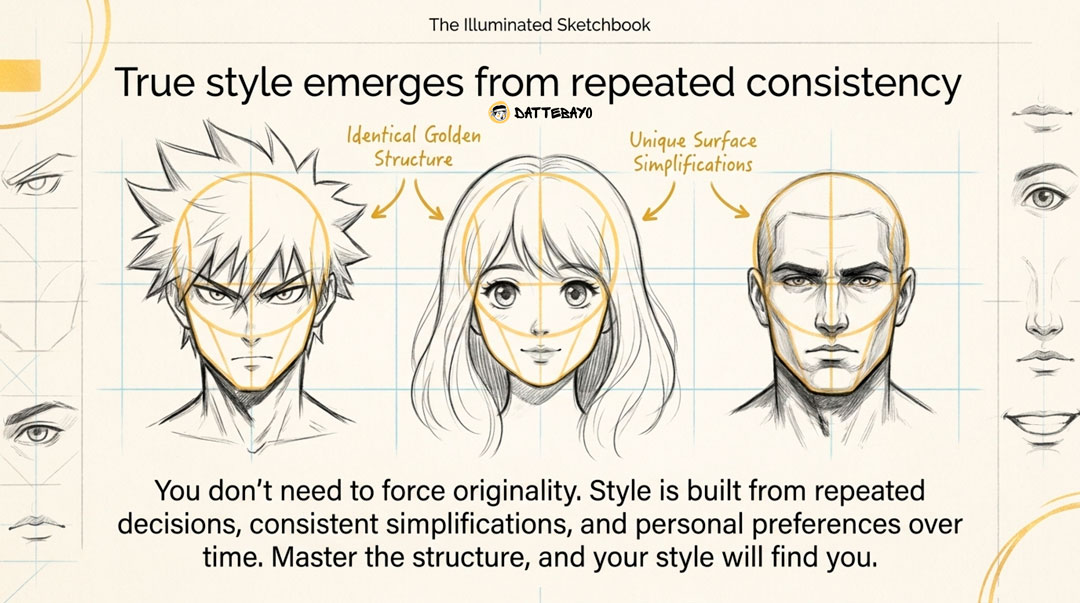
Yes—but it comes from consistency, not forcing originality.
Style is built from:
- Repeated decisions
- Consistent simplifications
- Personal preferences over time
How do you start shaping your style?
- Pick a few influences
- Simplify them in your own way
- Stay consistent across drawings
If you constantly switch styles, your progress resets each time.
How long does it take to learn anime drawing style?
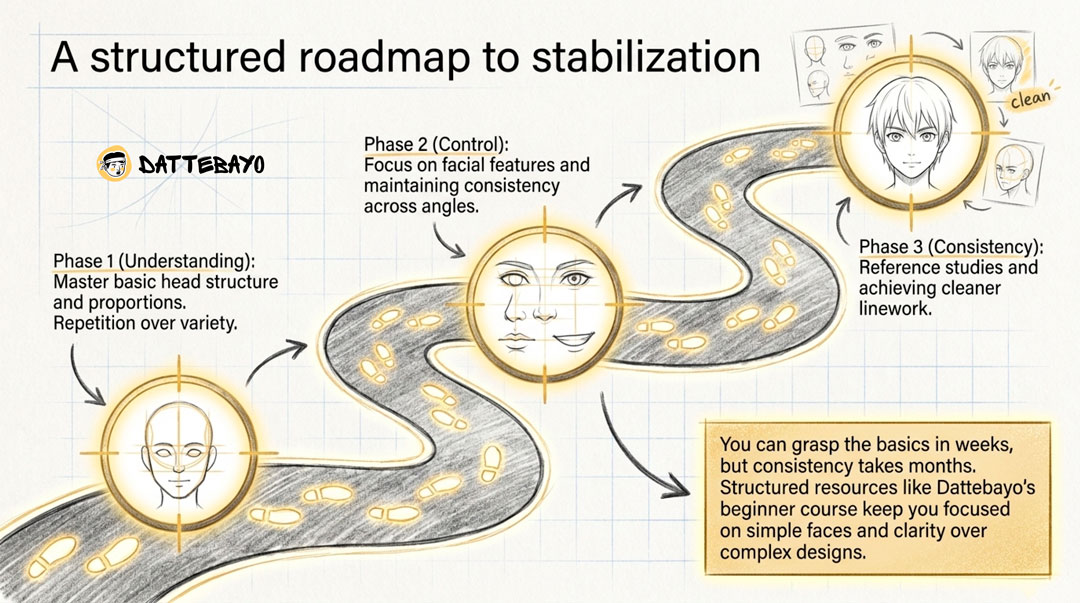
You can grasp the basics in weeks—but consistency takes months.
Most people move through:
- Understanding (things start to click)
- Control (you can repeat results)
- Consistency (your work stabilizes)
Structured learning speeds this up a lot. That’s where Dattebayo helps—it gives you a clear path so you’re not guessing what to practice next.
How to start learning anime drawing today (simple roadmap)
Start simple, stay consistent, and focus on structure first.
A realistic path:
- Early stage: head structure and proportions
- Next: facial features and consistency
- Ongoing: reference study and cleaner linework
If you want that path laid out clearly, Dattebayo’s beginner course keeps things focused without overwhelming you.
What should you focus on in your first 30 days?
- Repetition over variety
- Simple faces over complex designs
- Clarity over detail
What habits speed up progress?
- Short, focused sessions
- Reviewing your own mistakes
- Using structured resources instead of random tutorials
FAQ: Common beginner questions about anime drawing style
Why doesn’t my drawing look like anime even when I copy?
Because you’re copying surface details, not structure.
Do I need to learn anatomy first?
You need basic anatomy—not full realism.
What should I practice daily?
Heads, facial features, proportions, and line control.
Is tracing a good learning method?
Only if you’re analyzing, not shortcutting.
What tools do anime artists use?
Everything from pencil and paper to digital tablets.
Why do my drawings feel inconsistent?
Because skill development isn’t linear.
Is anime easier than realism?
Easier to start, just as challenging to master.
Can I build my own style without copying?
Yes—but understanding comes before originality.