
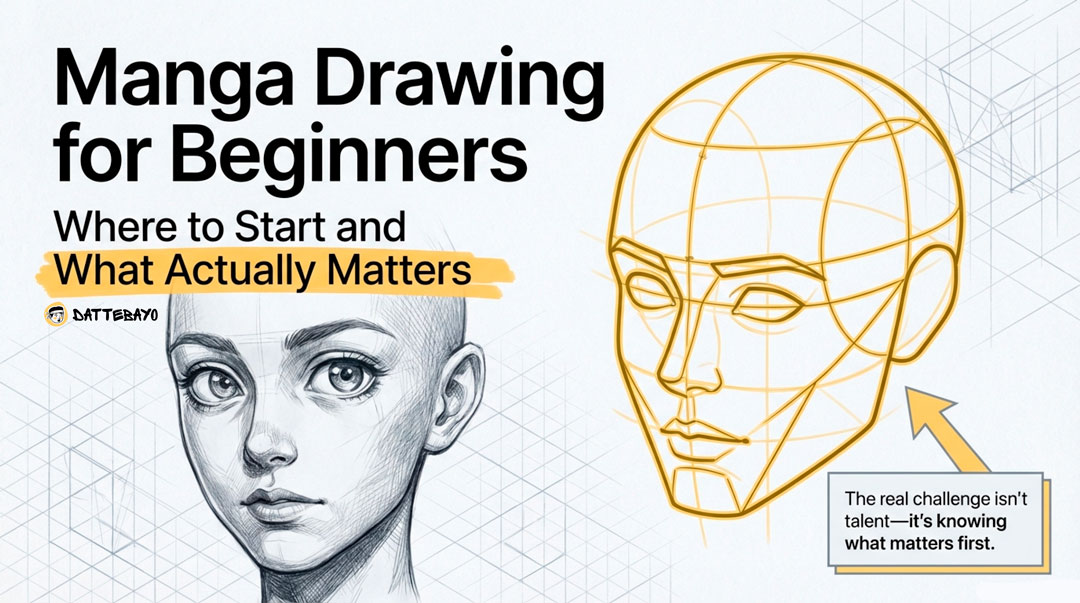
If you’re starting out with manga drawing, the real challenge isn’t talent—it’s knowing what actually matters first. There’s a lot of noise: complex tutorials, deep anatomy breakdowns, endless tool recommendations. Most beginners don’t need more information—they need clear direction.
This guide keeps things simple and focused on what genuinely helps you improve early: structure, smart practice, and understanding why your drawings look the way they do.
What is the best way to start manga drawing as a beginner?
Start with simple shapes, basic proportions, and clean structure—not detailed characters.
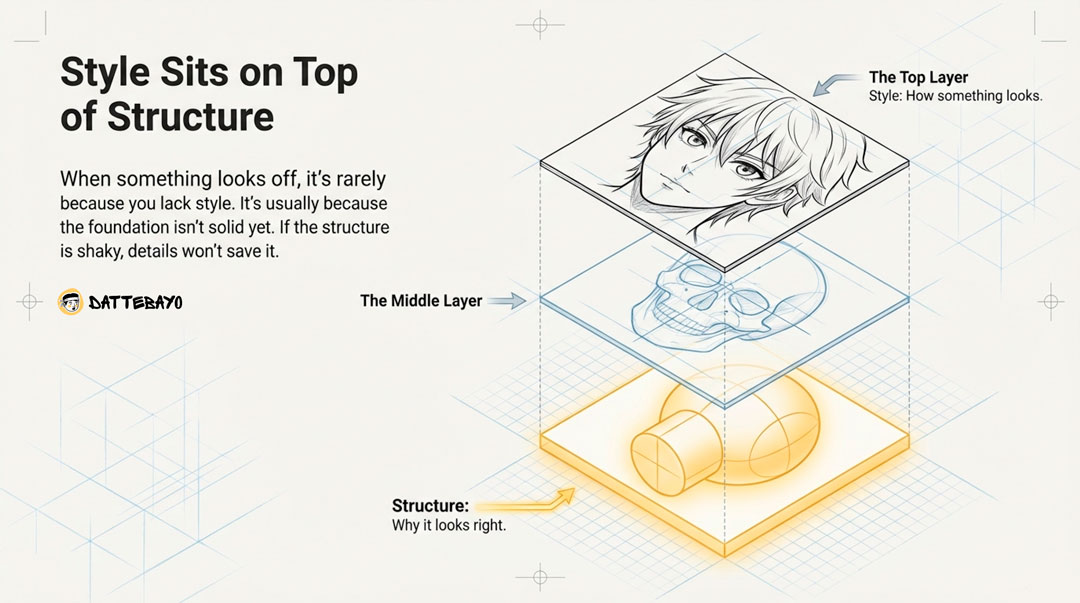
It might feel counterintuitive when you’re excited to draw expressive faces or dynamic poses. But here’s the truth: manga style sits on top of structure—it doesn’t replace it.
When something looks off, it’s rarely because you lack style. It’s usually because the foundation isn’t solid yet.
Think of it like this:
- Style = how something looks
- Structure = why it looks right
If the structure is shaky, details won’t save it.
A more effective way to learn is in layers:
- First: shapes and placement
- Then: proportions
- Then: refinement and style
Strong structure does the heavy lifting. Detail just supports it.
If your drawings feel messy or inconsistent, that’s usually a sign to simplify—not add more.
Quick self-check:
- Lines feel chaotic → focus on basic shapes and control
- Faces look “off” → focus on proportions and placement
Why starting simple makes everything easier later
Simple drawings are easier to fix, adjust, and improve.
When you reduce a face to basic forms, mistakes become obvious—and correctable. Jump straight into detail, and those same mistakes get buried.
That’s why beginner-focused platforms like Dattebayo emphasize clarity first. It’s not about doing less—it’s about learning in the right order.
The most common beginner mistake: chasing detail too early
Detail feels productive—but it often hides the real problem.
Eyes, hair strands, shading—these are fun to draw. But if the proportions are off, they won’t land the way you expect.
That’s how beginners get stuck:
- Add detail
- something feels wrong
- redraw
- repeat
A better approach is to simplify until it looks right before adding anything extra.

What should you practice first? (A simple beginner roadmap)
Focus on shapes → faces → proportions → clean lines.
This isn’t rigid—it’s just a practical path that keeps things manageable and avoids overwhelm.
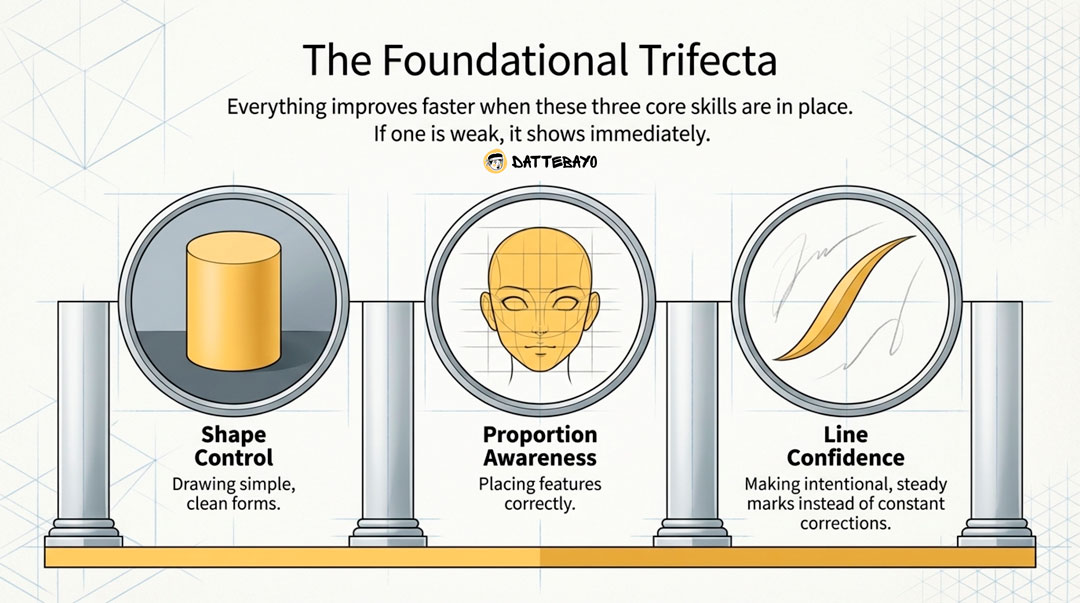
The 3 core skills every beginner should build first
Everything improves faster when these are in place.
- Shape control – drawing simple, clean forms
- Proportion awareness – placing features correctly
- Line confidence – making intentional, steady marks
If one is weak, it shows immediately in your drawings.
What does a simple daily practice look like?
Short, focused, and repeatable beats long, inconsistent sessions.
A solid session might include:
- A few minutes of basic shapes
- A handful of simple faces
- One redraw or refinement
That’s enough to make steady progress.
If you don’t want to plan this yourself, structured paths like Dattebayo’s beginner course can remove the guesswork and keep you moving.
What tools do you actually need to draw manga?
You can start with just a pencil and paper—everything else is optional.
Tools matter far less than most beginners think.
Pencil and paper vs drawing tablet: which is better?
Neither is better—they just serve different purposes.
- Traditional helps you build control and simplicity
- Digital helps with speed, editing, and workflow
Tools like Clip Studio Paint are widely used in manga creation today, but they won’t replace fundamentals.
The simplest setup to start today
- Any pencil
- Any paper
- Optional eraser
That’s all you need.
When should you switch to digital?
Switch when your fundamentals feel stable—not when you feel stuck.
Digital tools can enhance your process, but they won’t fix weak structure.
Do you need to learn anatomy or realism first?
No—but you do need a basic understanding of structure and proportions.
You don’t need full anatomy studies to draw manga well.
How much anatomy is actually enough?
Just enough to support believable forms.
Focus on:
- Basic head structure
- Simple body proportions
- How forms connect
That’s plenty for a strong start.
Why structure matters more than realism
Stylization still follows rules—it just simplifies them.
Manga exaggerates reality, but it doesn’t ignore it. Without structure, the style falls apart.
Why do beginner manga drawings look “off”?
Usually because of proportion or placement—not lack of detail.
It’s frustrating when something feels wrong but you can’t pinpoint why. Most of the time, it comes down to structure.
What proportion mistakes should you watch for?
- Eyes placed too high or uneven
- Jaw too wide or too narrow
- Features drifting off center
These are structural issues, not stylistic ones.
What about stiff poses and same-face syndrome?
That usually comes from relying on habit instead of understanding.
If every character looks the same, you’re repeating a pattern rather than building flexibility.
Why doesn’t copying references always help?
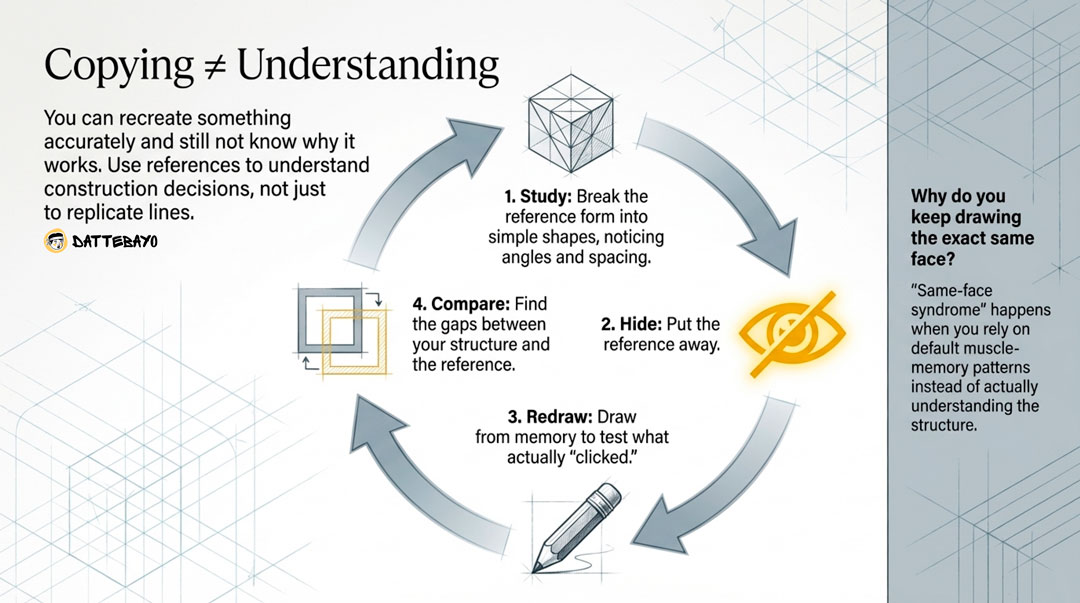
Because copying isn’t the same as understanding.
You can recreate something accurately and still not know why it works—which makes it hard to apply on your own.
How should you use references without becoming dependent?
Use references to understand decisions—not just replicate them.
The goal isn’t copying—it’s learning how things are constructed.
How can you study references more effectively?
Instead of just copying:
- Break forms into simple shapes
- Notice proportions and spacing
- Pay attention to angles and placement
Then try to redraw it in your own way.
Why does drawing from memory feel so difficult?
Because structure hasn’t fully clicked yet.
A simple learning loop:
- Study
- Hide the reference
- Redraw
That gap is where real understanding builds.
How important are sketching, line confidence, and inking?
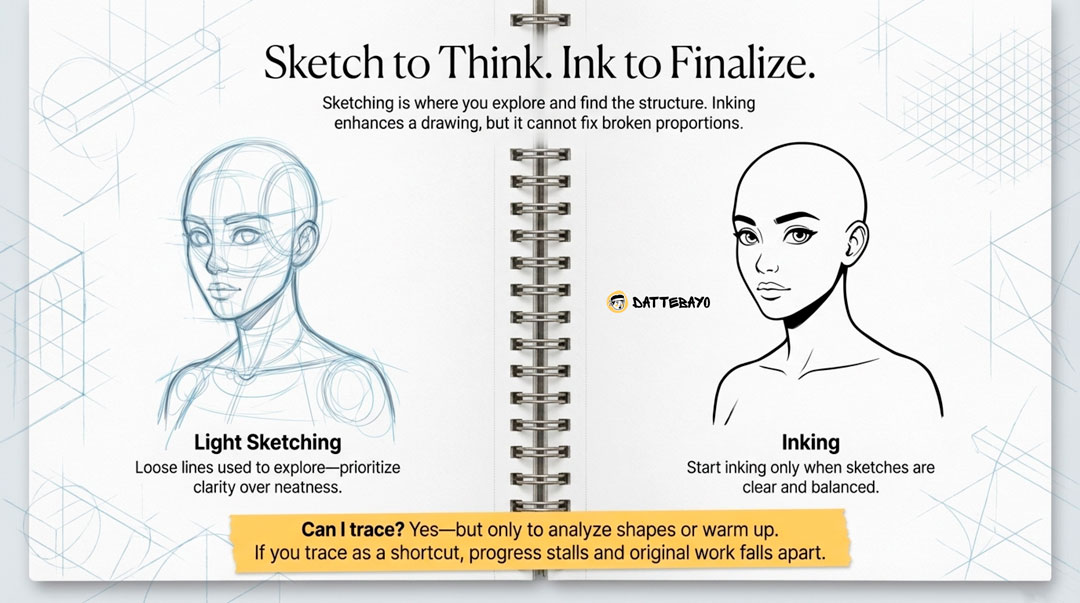
Sketching and control come first—inking comes later.
Rushing into clean lines too early is a common frustration trap.
What does “light sketching” really mean?
Loose, simple lines used to explore—not perfect.
Sketching is where you think through the drawing, not finalize it.
How do you build line confidence?
- Draw slower, more deliberate lines
- Reduce constant corrections
- Prioritize clarity over neatness
When should you start inking?
When your sketches already look clear and balanced.
Inking enhances—it doesn’t fix.
Should you trace manga drawings to improve?
It can help—but only as a support tool, not a shortcut.
How can tracing be useful?
- To analyze shapes and structure
- As a short warm-up
- When followed by redraws
When does tracing become a problem?
- You can’t draw without it
- Your original work falls apart
- Progress stalls
How long does it take to get decent at manga drawing?
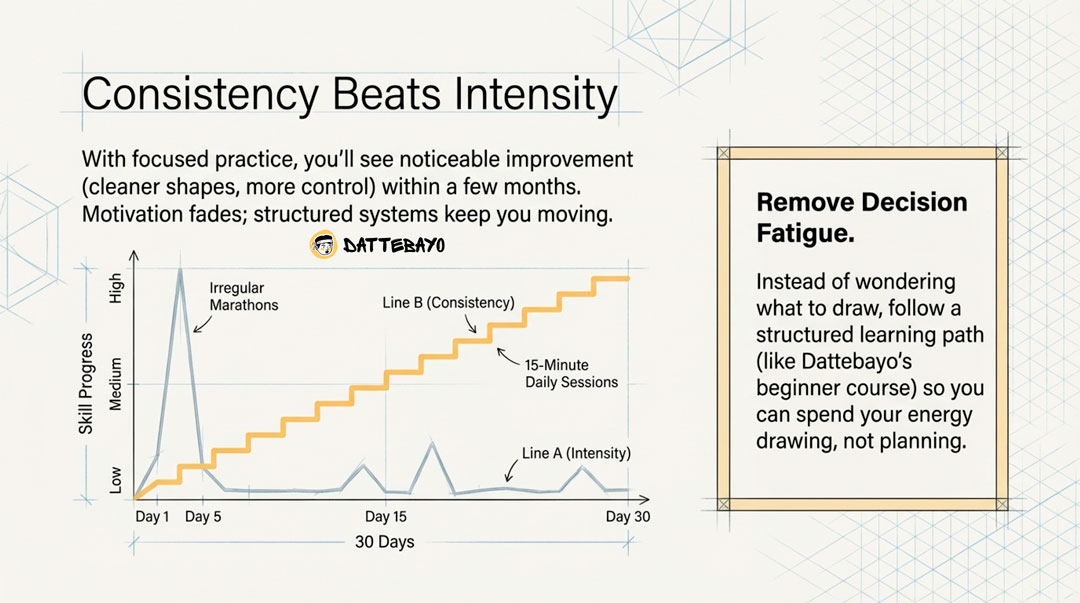
With consistent, focused practice, you’ll see noticeable improvement within a few months.
What does “getting decent” actually mean?
- Cleaner shapes
- Better proportions
- More control
Not perfection—just clarity and consistency.
Why does consistency matter more than intensity?
Short daily sessions beat long, irregular ones.
In 2026, with constant distractions, consistency is a real advantage.
What’s the best way to stay consistent (without burning out)?
Keep your practice simple, structured, and repeatable.
Motivation comes and goes—systems keep you going.
What practice formats actually work?
- Repetition (same subject multiple times)
- Redraws (improving past work)
- Reference studies
Why does structured learning help so much?
Because it removes decision fatigue.
Instead of wondering what to do next, you follow a clear path. That’s where platforms like Dattebayomake a difference—they guide you through the fundamentals without overwhelming you.
What should you focus on after the basics?
Move from faces → expressions → poses → full characters.
This keeps your progress natural and manageable.
How does skill progression usually look?
- Faces
- Expressions
- Upper body
- Full poses
- Characters
Each stage builds on the previous one.
How do you start creating your own manga characters?
Start simple, then add variation.
Change:
- Face shape
- Eye style
- Expression
- Hairstyle
That’s the foundation of character design.
What’s the difference between manga styles like shonen and shojo?
They exaggerate different features—but share the same structure.
- Shonen: sharper, more angular
- Shojo: softer, rounder
Once you understand structure, switching styles becomes much easier.
FAQ: Quick answers beginners often need
What should I learn first in manga drawing as a complete beginner?
Shapes, proportions, and simple faces—before style or detail.
Can I learn manga drawing without copying other artists?
Yes—but you should study references actively rather than avoid them.
Why can’t I draw manga from memory?
Because structure isn’t internalized yet—this improves with repetition and analysis.
Is it better to draw manga with pencil and paper or a tablet?
Start simple. Tools don’t determine skill.
Do I need to be good at realistic drawing before learning manga?
No—but you do need basic structure and proportions.
Why do I keep drawing the same face?
You’re relying on a default pattern instead of understanding structure.
How do I make my manga style look unique?
Style develops naturally after consistency—not before.
Should I trace manga drawings to improve faster?
Use it sparingly as a study tool, not a replacement.
How long does it take to get decent at manga drawing?
A few months of consistent, focused practice for visible improvement.
What’s the best way to stay consistent when learning manga drawing?
Short sessions + structured practice; guided paths like Dattebayo can help.
If you take one thing from this: simplify, focus, and stay consistent. That’s what actually moves you forward in manga drawing—not tools, not complexity, and definitely not perfection.