
If you’ve been jumping between tutorials, copying panels, and still feel stuck—you’re not alone. Learning manga isn’t just about what to practice. It’s about knowing what matters first, what connects, and how to build forward without guessing.
This guide gives you a clear path. Not rigid rules, but a way to approach learning so you can actually improve—and eventually create your own manga, not just copy what you see.
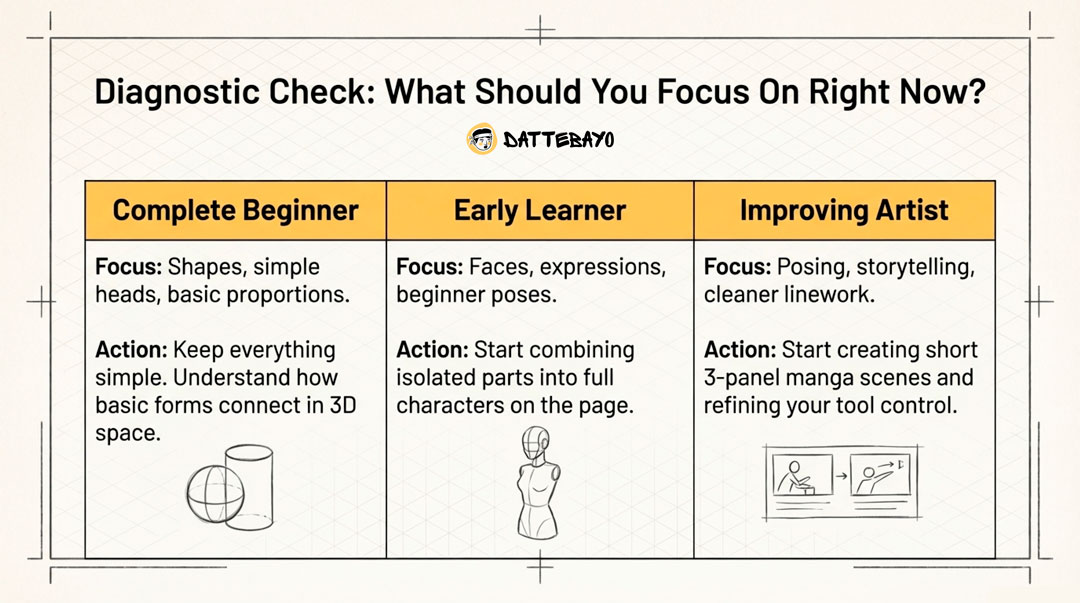
Where should you start if you’ve never drawn manga before?
Start with simple fundamentals—shapes, proportions, and structure—and apply them directly to manga characters.
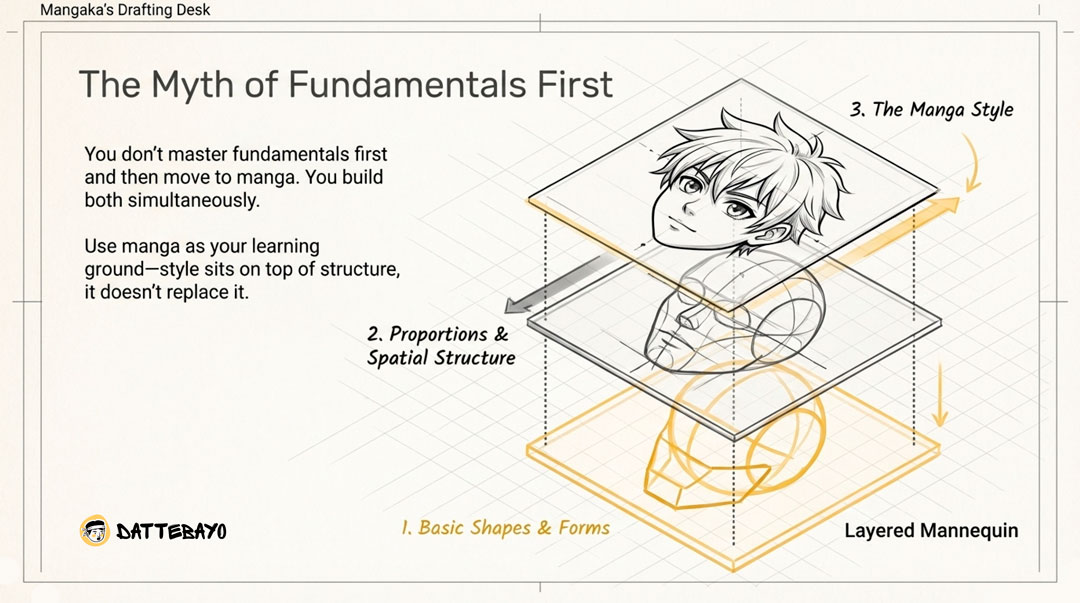
A common mistake is separating “fundamentals” from “style.” In reality, they work best together. You understand basics faster when you see them inside the thing you actually want to draw.
When you sketch a manga head, you’re already using:
- Basic shapes (circles, lines, blocks)
- Proportions (eye placement, facial balance)
- Structure (how the head turns in space)
So instead of delaying manga until you feel “ready,” use it as your learning ground.
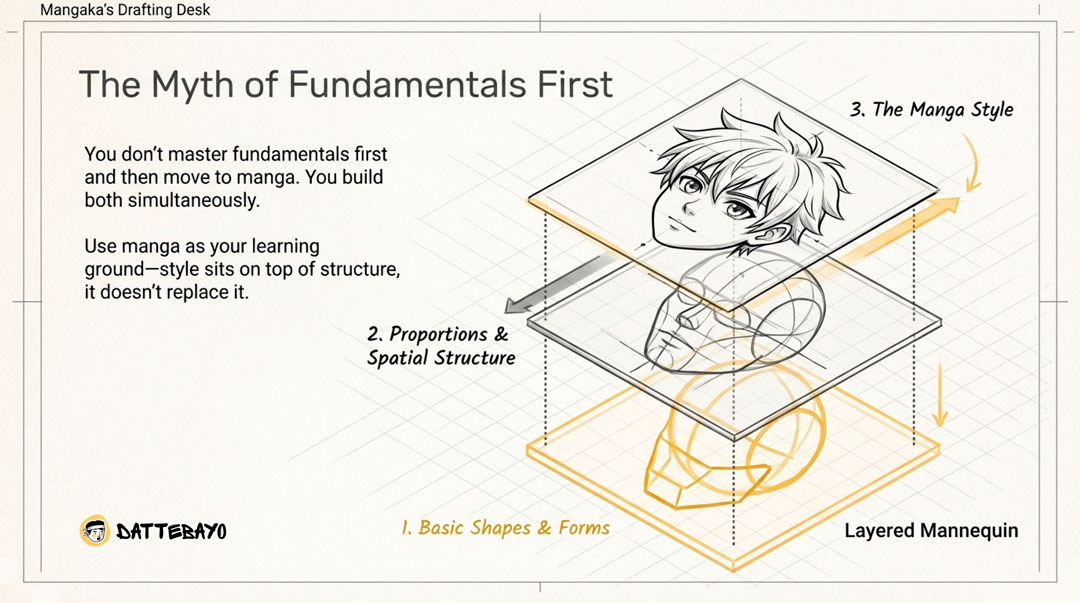
You don’t master fundamentals first and then move to manga—you build both at the same time.
If you want a clearer path without constantly guessing what to practice next, platforms like Dattebayo are built around this idea—teaching fundamentals through anime and manga from the start.
What fundamentals actually matter for manga?
Focus on shapes, proportions, simple anatomy, and volume.
You don’t need complex anatomy studies early on. What matters is understanding:
- How a head is constructed from simple forms
- How the body connects using basic shapes
- How to make drawings feel solid instead of flat
Think of it like building a mannequin. Manga style sits on top of that—it doesn’t replace it.
The biggest beginner mistake: learning randomly
Random practice feels productive, but it slows you down.
Jumping from eyes to hands to shading creates gaps. Nothing connects, so progress feels inconsistent.
What works better is progression:
- Simple forms
- heads
- faces
- poses
- characters
- scenes
This is why structured learning paths—like the beginner roadmap on Dattebayo - feel smoother. Not easier, just clearer.
What should you actually practice as a beginner? (Simple daily plan)
Focus on short, structured sessions that combine fundamentals, character drawing, and observation.
You don’t need long hours—you need focused repetition with purpose. A consistent 20–40 minutes will take you further than occasional long sessions.
What does a good practice session look like?
A balanced session usually includes:
- A quick warm-up (lines, circles, loose shapes)
- Construction practice (heads, simple forms, basic poses)
- Applying that to a manga-style character
- Optional observation from references or manga panels
The key is connection. Everything you practice should support character drawing.
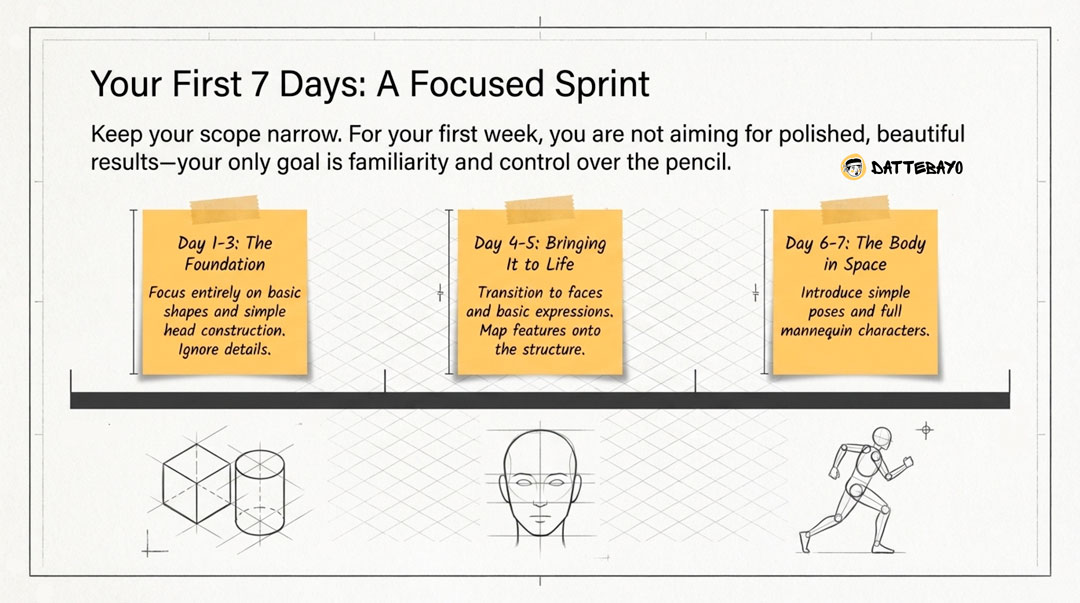
What should you focus on in your first week?
Keep it simple and narrow:
- Day 1–3: Shapes and basic heads
- Day 4–5: Faces and expressions
- Day 6–7: Simple poses and full characters
You’re not aiming for polished results—just familiarity and control.
If you only remember three things
- Be consistent, even with short sessions
- Focus on construction, not details
- Review your drawings and adjust
That last one is where real progress happens.
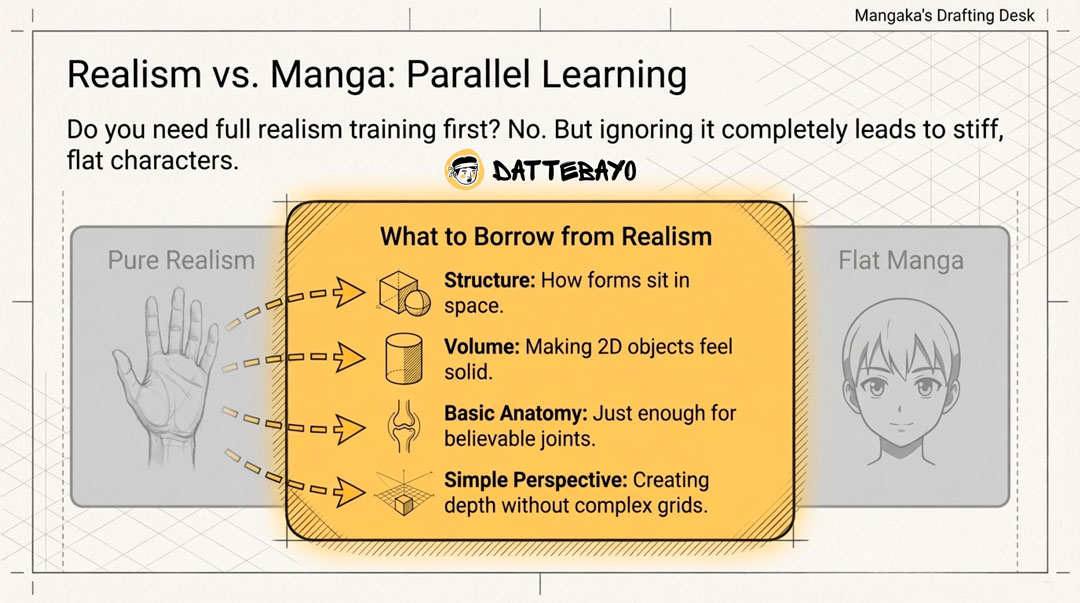
Do you need to learn realistic drawing before manga?
No—but learning some realism alongside manga helps a lot.
You don’t need full realism training. But ignoring it completely often leads to stiff, flat drawings.
A better approach is parallel learning:
- Practice manga directly
- Borrow useful concepts from realism
What parts of realism actually help?
Focus on:
- Structure (how forms sit in space)
- Volume (making things feel solid)
- Basic anatomy (just enough for believable bodies)
- Simple perspective (depth, not complexity)
These improve your manga without pulling you away from your goal.
What happens if you skip it?
You can still draw, but you’ll likely notice:
- Stiff poses
- Flat characters
- Proportions that feel off
It’s not about realism for its own sake—it’s about making your style feel intentional.
What skills matter most for manga (and what can wait)?
Focus on construction, expressions, posing, and storytelling—not detail or rendering.
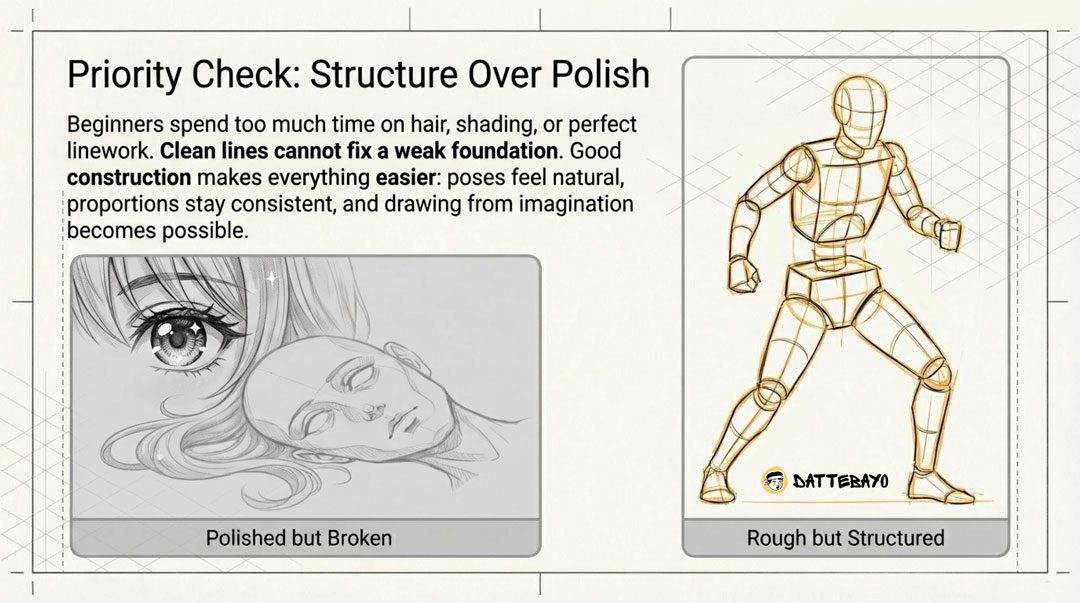
Beginners often spend too much time on hair, shading, or line polish. Those don’t fix weak structure.
Why construction comes first
Good construction makes everything easier:
- Poses feel natural
- Proportions stay consistent
- Drawing from imagination becomes possible
Without it, you’re guessing every time.
How expressions and posing bring drawings to life
Manga is about communication.
Even simple drawings can feel strong if:
- Expressions are clear
- Poses are readable
- Body language supports the emotion
That’s storytelling—before panels even enter the picture.
When should you focus on linework?
Later than you think.
Clean lines help presentation, but they don’t fix core issues. First aim for:
- Clear structure
- Confident strokes
- Intentional shapes
Then refine your linework on top.
Should you copy other manga artists to learn?
Yes—but use copying to understand decisions, not just recreate images.
Copying becomes useful when it’s active.
How do you study manga effectively?
Instead of tracing or blindly redrawing:
- Break characters into simple shapes
- Notice proportions and exaggeration
- Observe how panels guide the reader’s eye
You’re learning why something works.
You can study panels from official sources like MANGA Plus or your favorite series.
When should you start creating your own characters?
Earlier than you might expect.
Even simple original characters help you:
- Apply what you’ve learned
- Build creative confidence
- Move beyond copying
They don’t need to be complex—clarity matters more.
How do you start drawing your first manga scene?
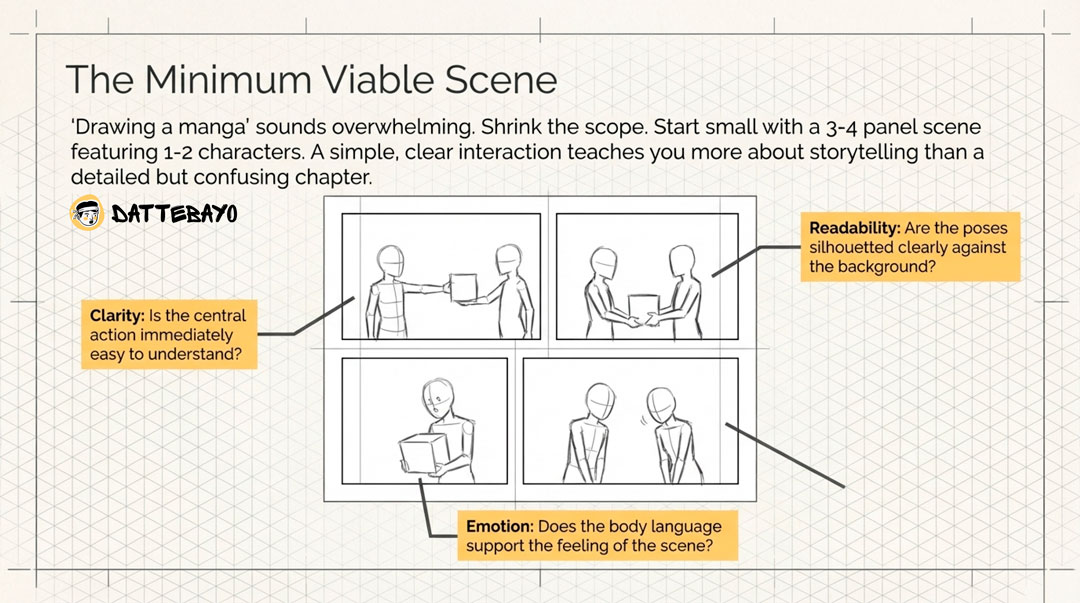
Start small—a short, simple scene with 1–2 characters.
“Drawing a manga” sounds overwhelming, so shrink the scope.
What does a beginner-friendly scene look like?
Think:
- 3–4 panels
- One clear action or interaction
- Simple expressions and poses
That’s enough to start learning storytelling.
What should you focus on?
- Clarity (is the action easy to understand?)
- Readability (are poses clear?)
- Emotion (does the scene feel something?)
A simple, clear scene teaches more than a detailed but confusing one.
Paper or digital—what should beginners use?
Use whatever feels easiest to start. Your progress depends more on practice than tools.
There’s no single “correct” choice here.
When does digital help?
Digital tools are useful for:
- Easy corrections
- Practicing linework
- Faster workflow
With modern apps and tablets continuing to improve into 2026, many beginners find digital more flexible—but it’s not required.
If you’re unsure where to start, beginner-focused platforms like Dattebayo introduce digital tools gradually without overwhelming you.
Do tools affect your progress?
Not much at the beginning.
What matters most:
- Understanding structure
- Practicing consistently
- Reviewing your work
Tools support skill—they don’t replace it.
Do you need expensive tools to draw manga?
No—basic tools are enough.
You can start with:
- Pencil and paper
- Or a simple drawing tablet
That’s all you need.
What’s the simplest setup?
Keep it minimal:
- Any sketchbook or paper
- A basic pencil or pen
- Optional: entry-level tablet
The goal is to remove friction, not build the perfect setup.
When do better tools matter?
Upgrades help when:
- You’re refining linework
- You want efficiency
- You’re creating finished work
Before that, they’re mostly distractions.
How long does it take to get good at manga drawing?
You’ll see noticeable improvement within a few months of consistent, focused practice.
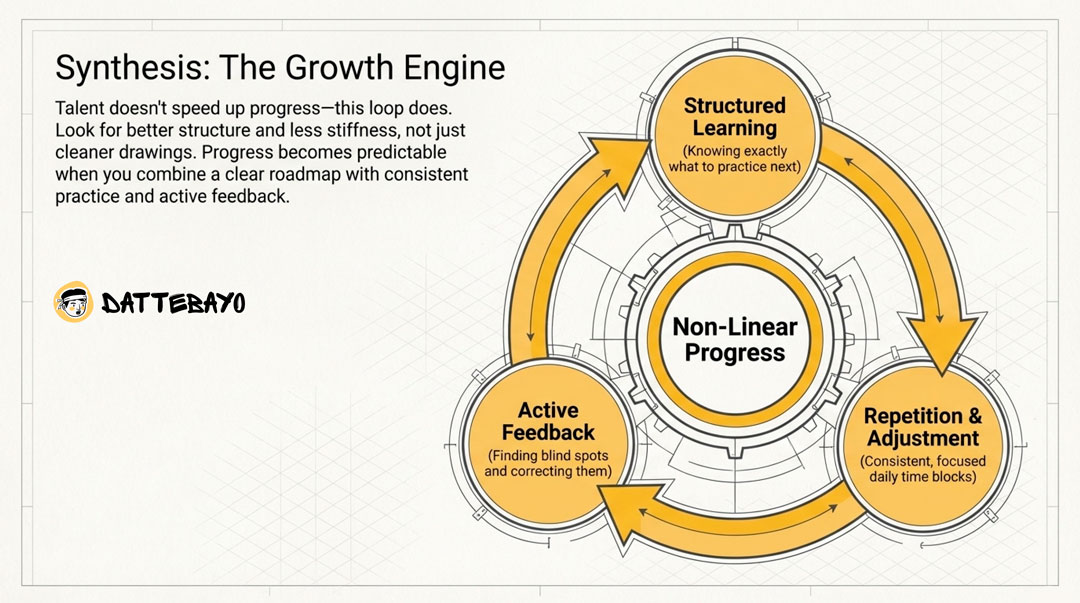
Progress isn’t perfectly linear, but it becomes predictable when your approach is solid.
What actually speeds things up?
- Structured learning
- Feedback
- Repetition with adjustment
This is where guided paths—like those on Dattebayo—can make a big difference, because they combine all three instead of leaving you to figure it out alone.
Why do some beginners improve faster?
Usually not talent.
It’s:
- Better practice methods
- Clearer focus
- Consistency
How do you know if you’re improving?
Look for better structure, proportions, and clarity—not just cleaner drawings.
Clean linework can hide problems. What matters is what’s underneath.
What should you check?
- Less stiffness in poses
- More consistent proportions
- Clearer, more readable characters
If those are improving, you’re on the right track.
Where can you get feedback?
Feedback speeds everything up.
You can get it from:
- Art communities
- Friends or peers
- Structured platforms like Dattebayo
Even small corrections can unlock progress.
What’s the best way to learn manga today without getting stuck?
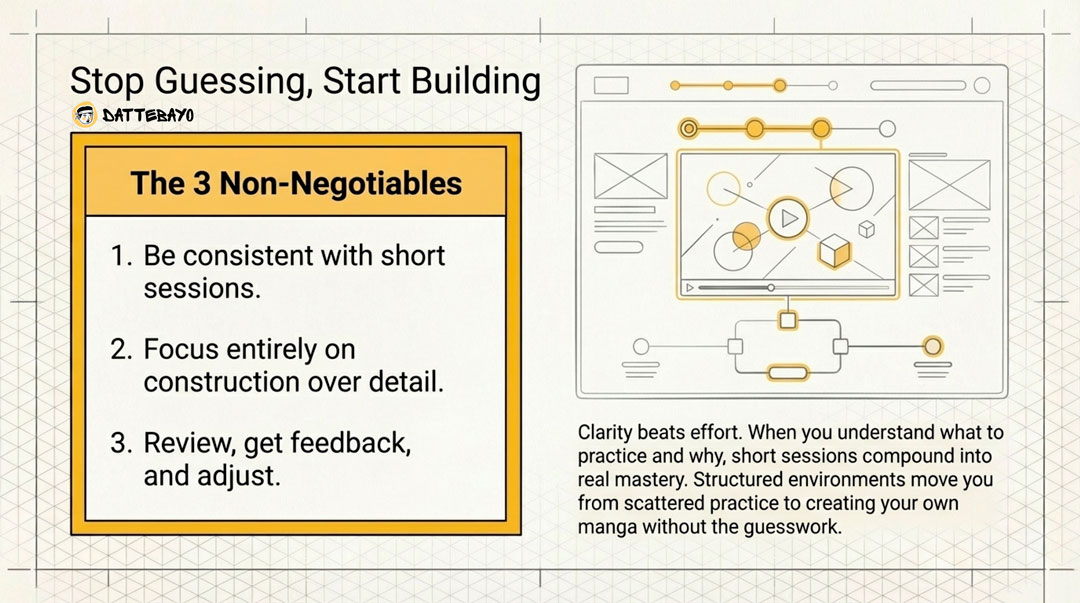
Follow a structured path, practice consistently, and study with intention.
There’s more content than ever—which makes it easy to feel lost.
Why random tutorials don’t work well
They:
- Don’t connect into a system
- Don’t track your progress
- Don’t correct your mistakes
You end up consuming more than improving.
When does a structured course help?
A course makes sense when you want:
- A clear roadmap
- Step-by-step skill progression (without guesswork)
- Feedback and direction
That’s exactly what Dattebayo is designed for—helping beginners move from scattered practice to real progress, and eventually to creating their own manga.
FAQ: Quick answers to common beginner questions
What should I draw first when learning manga?
Start with simple heads, faces, and basic construction before full bodies.
How should I practice every day?
Short, focused sessions combining fundamentals and character drawing.
Why do my drawings look stiff?
Usually weak construction and posing—focus on simple forms and flow.
How do I develop my own style?
Study multiple artists, understand structure, and gradually simplify into your preferences.
Can I learn without digital tools?
Yes—paper works perfectly.
How long should I practice daily?
Even 20–30 minutes of focused practice is enough.
Should I trace to learn?
Only as a study tool—not your main method.
What’s the fastest way to improve?
Structured practice, feedback, and focusing on core skills.
If there’s one idea to hold onto, it’s this: clarity beats effort. When you understand what you’re practicing and why, even short sessions start to compound—and drawing manga begins to feel manageable instead of overwhelming.