
What’s the best way to start learning anime drawing (without getting overwhelmed)?
Start simple, stay consistent, and build fundamentals before worrying about style. That’s the closest thing to a shortcut.
Most beginners don’t fail because anime is “too hard.” They get stuck because they try to learn everything at once—full characters, perfect lines, dynamic poses, digital tools—all in the first few days. That overload slows everything down.
A more effective way to approach this is skill stacking. Instead of chasing polished drawings, you build small, reliable skills that naturally combine:
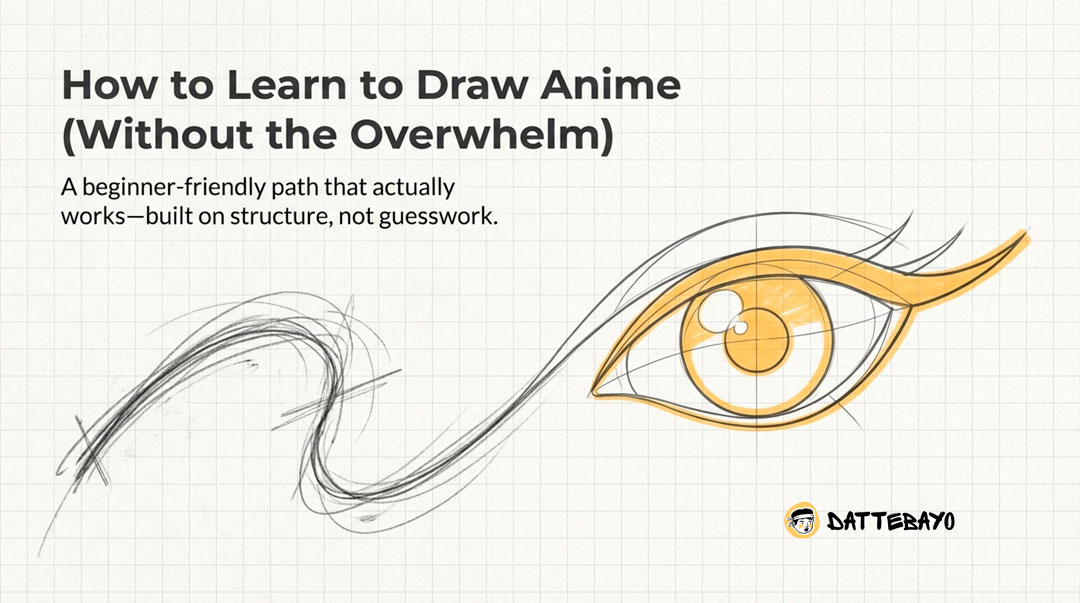
- Basic shapes → structure
- Line control → clarity
- Proportions → believability
- Style → comes later
When you zoom out, anime drawing isn’t mysterious—it’s simplified structure done cleanly and consistently.
A realistic starting point? 10–15 minutes a day. Short sessions are easier to stick to, and consistency is what actually drives progress.
Watching tutorials feels productive. Drawing—even messy drawings—is what actually moves you forward.
The biggest mistake beginners make (and how to avoid it)
Trying to draw detailed characters too early.
It’s tempting to jump straight into your favorite character with full hair, shading, and expression. But without control underneath, it turns into guesswork.
Another common trap is relying only on tutorials. You follow along, get something decent once, but can’t recreate it on your own.
The fix: separate practice from performance. Spend time building skills—not just finishing drawings.
A simple daily routine you can start today
Keep it short, focused, and repeatable.
A beginner-friendly session might look like:
- A few minutes of loose shapes (lines, circles)
- A few minutes of pressure-free drawing
- A few minutes focused on one idea (faces, proportions, etc.)
Simple on purpose. The goal is showing up, not doing everything.
Here’s a small tool to help you stay consistent:
Simple drawing exercises that actually improve your anime skills
Focus on control first—clean drawings come from steady fundamentals, not luck.
Anime art looks effortless, but that smoothness comes from control underneath. If your lines feel shaky or your shapes look uneven, it’s not a talent issue—it just means those skills haven’t been trained yet.
The best exercises are simple, repeatable, and directly useful.
Line confidence: why your lines look shaky (and how to fix it)
Shaky lines usually come from hesitation, not lack of ability.
When you slow down too much and try to “perfect” each line, it starts to wobble. Ironically, trying to be careful makes things worse.
Cleaner lines come from:
- Drawing with a smoother motion instead of tiny strokes
- Using your arm, not just your wrist
- Letting lines be slightly imperfect instead of correcting mid-stroke
You’re building confidence, not precision perfection.
3 foundational exercises (that take under 10 minutes)
A few simple drills solve most beginner issues.
- Straight lines and curves → improve control
- Circles and ellipses → improve shape accuracy
- Basic 3D forms (boxes, cylinders) → build structure awareness
These directly support anime drawing—they’re not random warmups.
If you want a structured way to practice them, Dattebayo includes beginner-focused training inside its anime drawing course.
How these exercises translate into better anime drawings
They quietly fix the problems you feel but can’t explain.
- Better lines → cleaner line art
- Better shapes → more accurate faces
- Better structure → fewer “something feels off” moments
You’re not just practicing—you’re making every future drawing easier.
Do you need to learn real anatomy before drawing anime?
No—but you do need enough structure to make stylization feel believable.
Anime simplifies reality, but it doesn’t ignore it. Think of anatomy as support, not a barrier.

How anime proportions differ from real bodies
Anime exaggerates and simplifies key features.
- Heads are often larger relative to the body
- Eyes are bigger and more expressive
- Details are reduced into clean, readable shapes
Even with these changes, there’s still an underlying structure holding everything together.
If proportions feel confusing, this anime-focused learning hub can help you see those patterns more clearly.
The only anatomy beginners should focus on
Keep it practical and minimal.
You don’t need muscle diagrams. Focus on:
- Head structure (thinking in 3D, not flat)
- Direction of torso and limbs
- Basic balance and alignment
That alone prevents most beginner mistakes.
Should you use pencil and paper or draw digitally?
Start with pencil and paper—it removes distractions and speeds up learning.
Digital tools are powerful, but they come with extra decisions: brushes, layers, settings. That’s a lot when you’re still learning basics.
Paper keeps your focus where it matters.
The simplest beginner setup (no overthinking)
You only need a few things:
- Pencil
- Paper
- Eraser
That’s enough to make real progress.
When it actually makes sense to go digital
Switch when your fundamentals feel stable.
If your shapes are consistent and your lines are more confident, digital tools start helping instead of overwhelming.
The key idea: tools don’t replace skills—they amplify them.
What should you practice first (and in what order)?
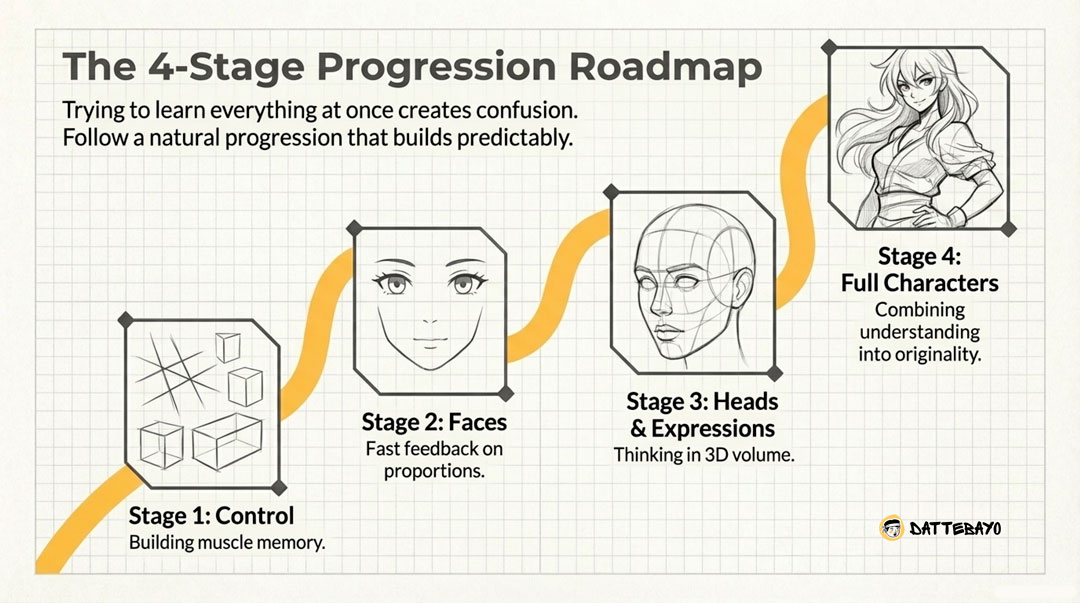
Follow a progression that builds naturally: shapes → faces → heads → bodies → characters.
Trying to learn everything at once creates confusion. A clear order keeps you moving.
Why faces are the best starting point
They’re simple, quick to draw, and give fast feedback.
Anime faces help you focus on:
- Proportions
- Feature placement
- Expression
All without the complexity of full-body drawing.
For a deeper look, this guide on how to draw anime faces fits perfectly at this stage.
When you’re ready to move to full characters
Look for consistency, not perfection.
You’re ready when:
- Your faces look stable across attempts
- You rely less on copying
- You can adjust proportions intentionally
That’s your signal to level up.
Is it okay to copy anime characters to learn?
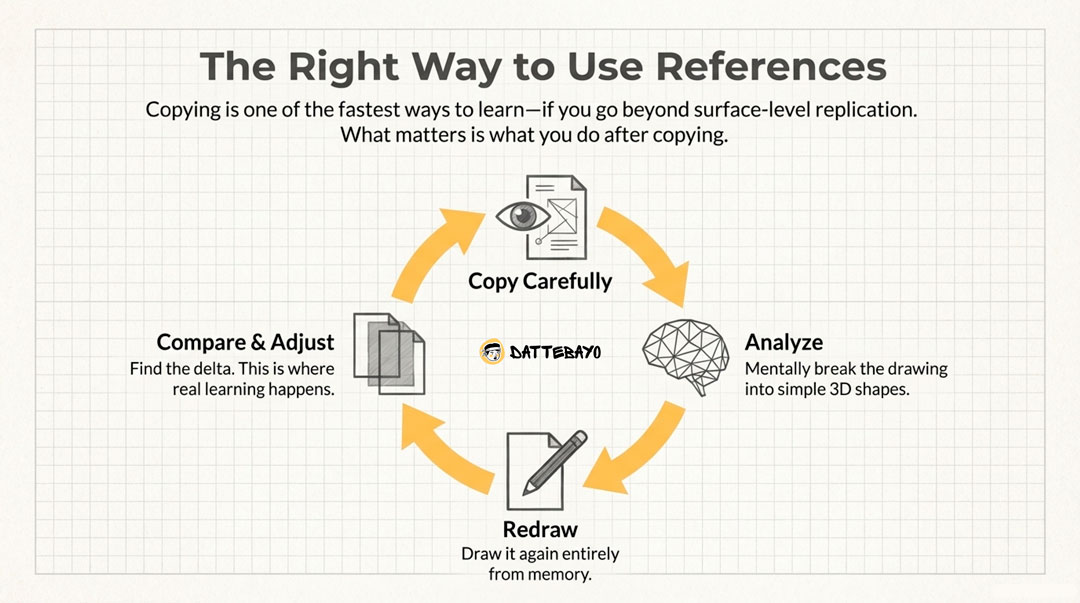
Yes—copying is useful if you use it to understand, not just replicate.
It’s one of the fastest ways to learn, but only if you go beyond surface-level copying.
The “copy → analyze → redraw” method
What matters is what you do after copying.
- Copy carefully
- Break the drawing into simple shapes mentally
- Redraw it from memory
- Compare and adjust
That comparison step is where real learning happens.
How to start creating your own characters
Originality comes from combining what you understand.
- Mix features from different characters
- Adjust proportions slightly
- Experiment with expressions
You don’t need to invent everything from scratch—just build from what you’ve learned.
Why your anime drawings look “off” (quick fixes that work)
Most issues come down to proportion, spacing, and stiffness—not effort.
If something feels wrong but you can’t explain it, it’s usually a small structural issue.
The most common beginner mistakes
These show up all the time:
- Uneven eye spacing
- Misaligned facial features
- Slightly distorted head shapes
Small errors—but they affect the whole drawing.

A simple checklist to fix your drawing
Before starting over, check:
- Are the eyes evenly spaced?
- Is the head shape balanced?
- Are features aligned along the same angle?
Tiny adjustments can dramatically improve the result.
How to make your drawings less stiff
Loosen your approach before refining.
Stiffness often comes from focusing on clean lines too early.
- Keep early sketches loose
- Focus on flow and direction
- Add detail after the structure feels right
Where to find good anime references (and how to use them correctly)
Use clear, intentional references—not random images.
References aren’t just for copying—they help you understand structure and design choices.

Good sources for beginner-friendly references
Clarity matters more than complexity:
- Anime screenshots with clear poses
- Official character sheets
- Simple pose libraries
What to look for in a reference
Pick images that actually teach you something:
- Clear silhouette
- Readable proportions
- Simple lighting
Avoid overly complex scenes early on—they hide the fundamentals.
How long does it take to get good at drawing anime?
You’ll see improvement in weeks, but confidence builds over months of consistency.
Progress isn’t linear. Some days feel great, others don’t—but improvement is happening underneath.
What progress actually looks like early on
It’s subtle but noticeable:
- Cleaner lines
- More balanced shapes
- Easier mistake detection
That’s real growth.
Why consistency beats long sessions
Short, regular practice wins.
Drawing 10–15 minutes daily is more effective than occasional long sessions. It builds momentum without burnout.
In 2026, with endless short-form tutorials and AI-generated references everywhere, it’s easy to feel behind. But your progress doesn’t need to match the speed of your feed.
Are online courses worth it for learning anime drawing?
Yes—if they give you structure and remove guesswork.
Random tutorials can help, but they’re often scattered and inconsistent.
What to look for in a quality course
Focus on progression, not just content:
- Clear learning orde
- Beginner-friendly explanations
- Practice-focused lessons
When a course like Dattebayo makes sense
When you feel stuck or overwhelmed.
Dattebayo is designed for beginners who want a clear path instead of jumping between videos. If you’ve been learning without direction, a structured approach like Dattebayo can make your progress feel much more predictable.
A simple anime drawing roadmap you can follow starting today
Keep it simple, follow a clear path, and stay consistent.
Everything in this guide fits into a straightforward progression.
A realistic 4-stage beginner roadmap
Think in stages, not perfection:
- Control (lines and shapes)
- Faces
- Heads and expressions
- Full characters
Each stage builds naturally on the last.
How to stay consistent without burning out
Make it easy to continue.
- Keep sessions short
- Rotate focus areas
- Track small improvements
If you prefer guided structure, Dattebayo’s lessons are built around this exact progression, helping you move forward without feeling overwhelmed.
FAQ
Can I learn anime drawing if I’ve never drawn before?
Yes. Start simple and stay consistent.
Why can’t I draw anime from imagination yet?
Because your visual library is still developing. Use references and redraw from memory.
How do I make my anime drawings look less stiff?
Keep early sketches loose and avoid adding detail too soon.
Do I need a drawing tablet to take anime art seriously?
No. Fundamentals matter more than tools.
When should I start learning shading or coloring?
After you’re comfortable with clean lines and proportions.
How do I practice anime drawing every day without getting bored?
Keep sessions short and vary your focus.
What’s the difference between anime and manga drawing styles?
Manga is typically black-and-white and print-focused; anime is colored and animated, but both share core stylization.
Why do my drawings look worse than the reference?
You’re likely missing the underlying structure—focus on simplifying into shapes first.
If you keep things simple, stay consistent, and focus on understanding instead of perfection, learning how to draw anime becomes far more manageable—and a lot more enjoyable.