
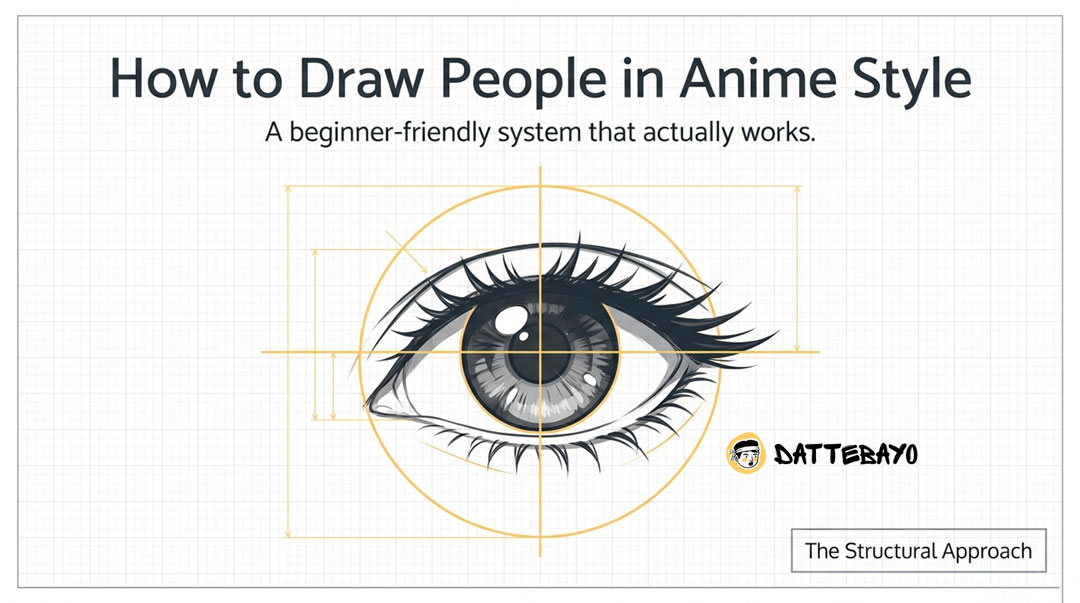
What does it actually mean to draw people in anime style?
Drawing people in anime style means simplifying real human structure into clear shapes, then exaggerating features on purpose for expression. It’s not random—and it’s definitely not just “big eyes.” It’s a deliberate, controlled version of reality.
At its core, anime is stylized realism. You’re still building a human body, but you choose what to simplify and what to emphasize. Eyes get larger to show emotion. Noses are reduced to minimal marks. Hair becomes grouped shapes instead of individual strands.
The idea many beginners miss is simple: style sits on top of structure. If the structure is off, no amount of stylization will fix it.
Anime isn’t easier than realism—it’s more selective.
How is anime different from realistic drawing?
Anime reduces information, while realism tries to capture it.
- Realism: more anatomy detail, subtle transitions, complex lighting
- Anime: simplified forms, clear lines, intentional exaggeration
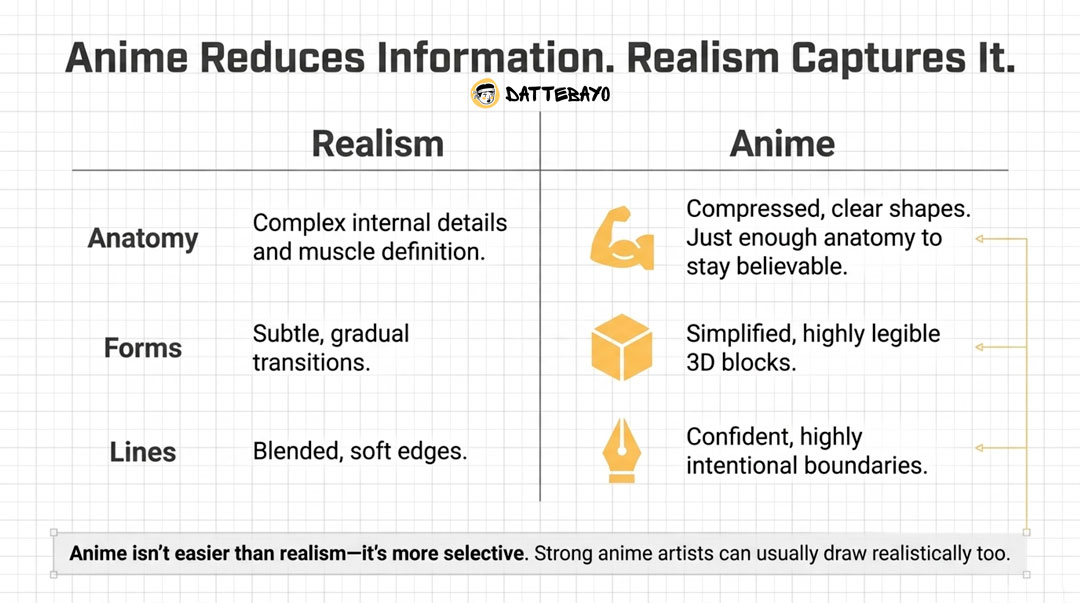
But here’s the important part: anime still depends on anatomy. You’re not skipping it—you’re compressing it into something cleaner and easier to read.
That’s why strong anime artists can usually draw realistically too—they understand what they’re simplifying.
Why beginners struggle with anime style
Most beginners struggle because they jump straight into details without building a solid base.
Common patterns:
- Copying eyes and hair without constructing the head
- Ignoring proportions
- Treating features as separate pieces instead of a connected whole
Without a clear system, drawings feel inconsistent. Once you understand the process behind anime art, things start to click.
The core process: how anime drawings actually come together
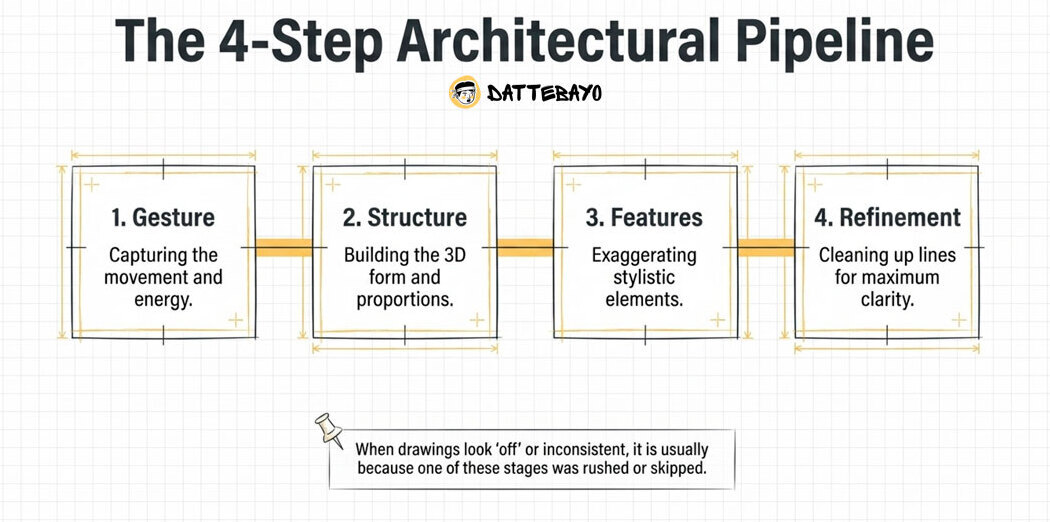
Most anime drawings follow a simple flow: gesture → structure → features → refinement.
This isn’t a strict checklist—it’s a way of thinking that keeps your drawing grounded. When something looks off, it’s usually because one of these stages was rushed or skipped.
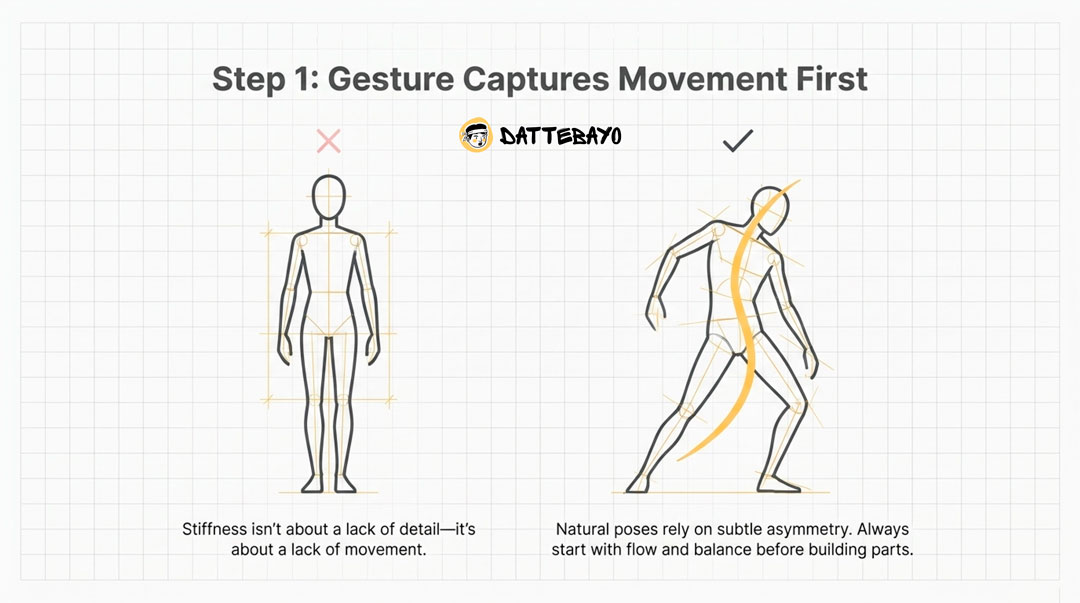
Gesture — why movement comes first
Gesture captures the energy and flow of a pose before details get in the way.
Instead of focusing on body parts, you’re focusing on movement. Is the character leaning? Twisting? Relaxed?
When gesture is missing, drawings feel stiff—even if everything else looks “correct.”
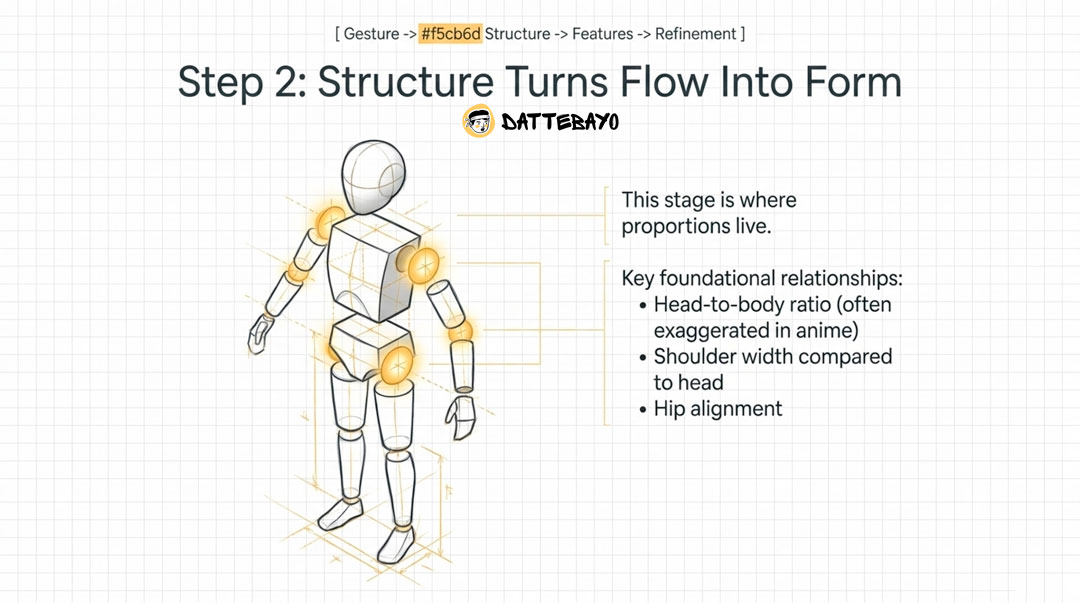
Structure — how to build a solid base
Structure turns that movement into something believable using simple 3D forms.
Think in basic shapes:
- A sphere-like head
- A simplified torso block
- Cylinders for limbs
This stage is where proportions live. It’s also what helps your drawing feel three-dimensional instead of flat.
Features — where style becomes visible
Features sit on top of structure—they’re not guessed into empty space.
This is where your anime style shows up:
- Eye shape and size
- Hair design
- Clothing and details
Because the structure is already there, everything feels more consistent and intentional.
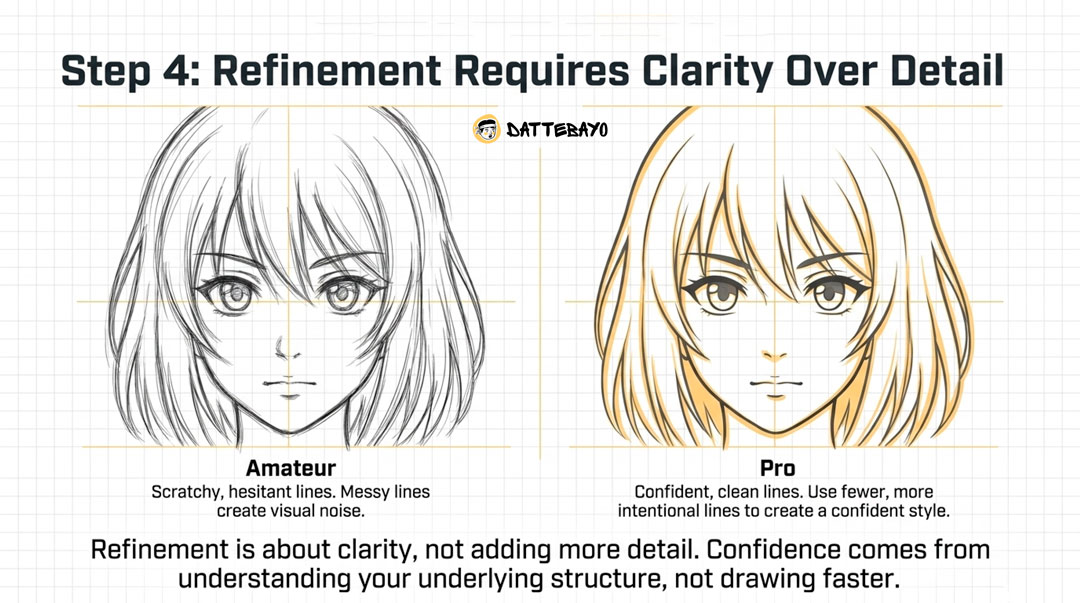
Refinement — making the drawing clear
Refinement is about clarity, not adding more detail.
You’re cleaning up lines, simplifying decisions, and making the drawing readable. Clean doesn’t mean perfect—it means confident.
What should you learn first (and what can wait)?
Focus on proportions, simple structure, and basic head construction before worrying about details.
It might feel tempting to jump into eyes and hair, but a strong foundation saves you a lot of frustration.
If your base is solid:
- Faces look balanced
- Bodies feel natural
- Stylization becomes easier
If it’s not, everything feels slightly “off,” even if you can’t explain why.
Do you need real anatomy before anime?
Yes—but only the basics.
You don’t need deep anatomical knowledge. What matters is:
- Balance
- Joint placement
- Simple proportions
Think of it as just enough anatomy to stay believable.
The most important proportions to understand
A few key relationships will take you far:
- Head-to-body ratio (often exaggerated in anime)
- Shoulder width compared to the head
- Hip alignment and leg length
Different anime styles push these differently, but they always stay internally consistent.
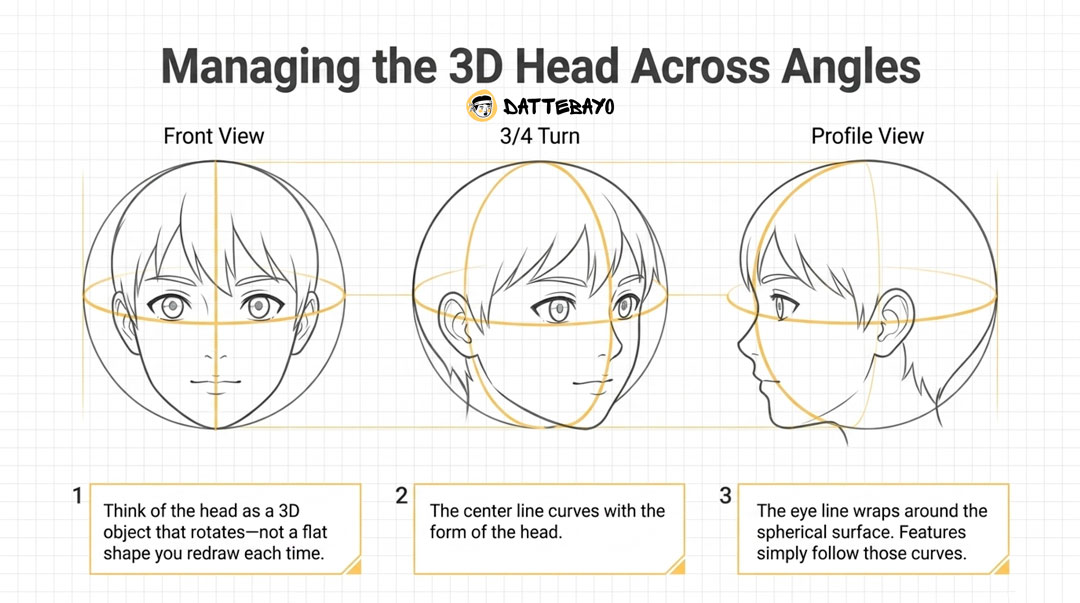
If you want these fundamentals explained in a structured, beginner-friendly way, platforms like Dattebayo break them down so they actually stick.
A simple way to start today
Start small and focus on repetition, not perfection.
- Quick sketches
- Simple poses
- Focus on balance over detail
If you’d rather not guess what to practice, this course follows the same core system in a clear progression.
How to construct anime heads and faces correctly
Build the head from a sphere and use guidelines to keep everything aligned.
This approach solves one of the most common beginner issues: faces that feel “off” without a clear reason.
The sphere represents the skull. The jaw attaches to it. Guidelines keep features consistent.
Where should facial features actually go?
Facial features follow consistent relationships—not guesswork.
- Eyes sit roughly around the horizontal midpoint
- Nose and mouth align along the center line
- The space between eyes is about one eye width
When these relationships drift, the face starts to feel uneven.
If you want to reinforce this visually, Dattebayo’s lessons dive deeper into why these placements work and how to remember them.
Why anime eyes look mismatched (and how to fix it)
It’s usually a symmetry issue, not a skill issue.
Two common causes:
- Skipping guidelines
- Inconsistent spacing
Anchor both eyes to the same structure, and they’ll naturally align better.
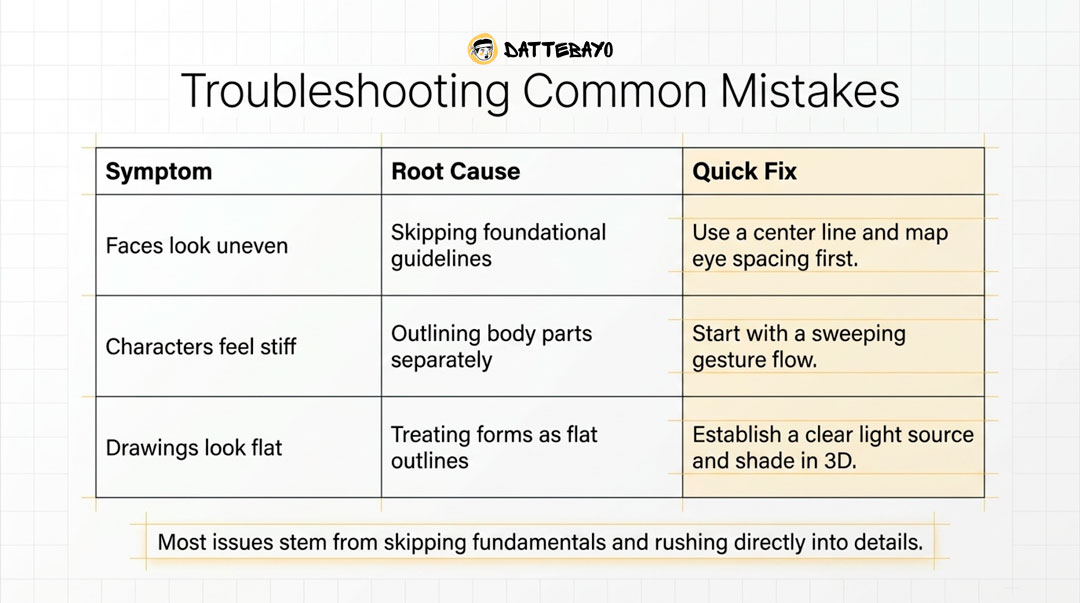
How to draw heads from different angles (conceptually)
Think of the head as a 3D object that rotates—not a flat shape you redraw each time.
- The center line curves with the head
- The eye line wraps around the form
- Features follow those curves
Once you see the head this way, angles become much easier to manage.
How to draw anime bodies without stiffness
Start with flow and balance, then build structure on top.
Stiffness isn’t about lack of detail—it’s about lack of movement.
What makes a pose feel natural?
Natural poses include weight and subtle asymmetry.
- One leg carries more weight
- Shoulders and hips tilt slightly
- The body isn’t perfectly straight
Even simple standing poses have these shifts.
Why stiffness happens
Stiff drawings often come from outlining parts instead of building them together.
Drawing the head, then arms, then legs separately breaks the sense of connection. Starting with gesture keeps everything unified.
How to draw anime hair (without getting lost in details)
Think of hair as volume and grouped shapes, not individual strands.
Hair has structure—it’s not random lines.
Breaking hair into simple shapes
Start big, then refine.
- Overall silhouette
- Large sections
- Smaller accents
This keeps the design clean and readable.
Adding detail without overcomplicating
Use fewer, more intentional lines.
Too many lines create noise. Selective detail creates clarity—and makes your style feel more confident.
How to make your drawings look less flat
Think in 3D and use a clear light source.
Flat drawings usually come from treating everything like outlines instead of forms.
- Light hits surfaces facing it
- Shadows appear where light is blocked
- Forms turn gradually
Where should shadows go on an anime face?
Shadows follow the structure of the face.
- Under the chin
- Around the nose
- Beneath the hair
Even simple shading adds depth when it follows form.
Simple shading techniques beginners can use
Keep it consistent rather than complex.
- Soft shading for smooth transitions
- Light hatching for subtle texture
Here’s a simple visual tool to experiment with light direction:
Line quality: the hidden factor that makes drawings look “anime”
Confident, intentional lines can elevate even simple drawings.
Line quality has a huge visual impact, but it’s often overlooked.
Why messy lines ruin good drawings
Messy lines create noise and weaken clarity.
Even strong drawings can look amateur if the lines are:
- Scratchy
- Repeated too many times
- Hesitant
How to improve line confidence over time
Confidence comes from understanding, not speed.
- Draw with intention
- Accept imperfect lines
- Practice controlled repetition
Cleaner lines are a result of clearer thinking.
Should you copy anime characters or create your own?
You should do both—study existing work, then apply what you learn.
Copying isn’t the problem. Copying without understanding is.
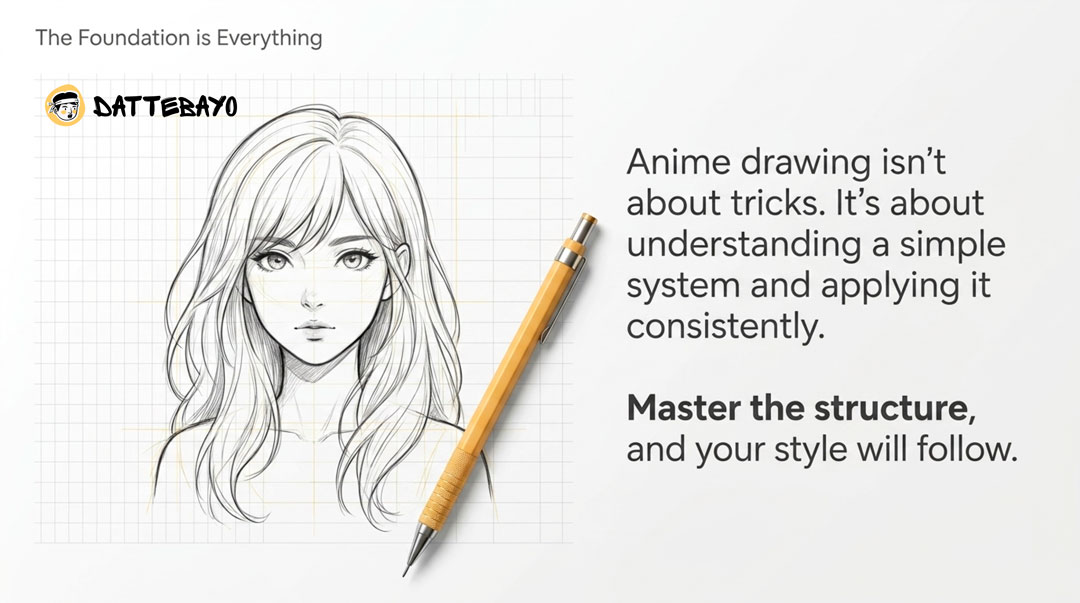
How to study anime art effectively
Break drawings into decisions, not just shapes.
- What was simplified?
- What was exaggerated?
- How is the structure built?
Tracing can help if you use it to analyze, then redraw from memory.
Study to understand, not to replicate.
When to move to original characters
Start creating your own earlier than you think.
You don’t need mastery—just:
- Basic proportions
- Simple structure
- A clear process
Dattebayo encourages this shift early so you don’t get stuck copying forever.
How long does it take to get good at drawing anime people?
With consistent practice, most beginners see clear improvement within a few months.
Not perfection—but real progress.
What real progress actually looks like
Progress shows up in small but noticeable ways:
- Better proportions
- Less stiffness
- More confident lines
It builds gradually, but it’s visible.
How to practice without burning out
Short, focused sessions work better than long, inconsistent ones.
- 20–40 minutes
- One focus per session
- Consistency over intensity
If you want a clearer path, Dattebayo provides structured guidance so you’re not guessing what to practice next.
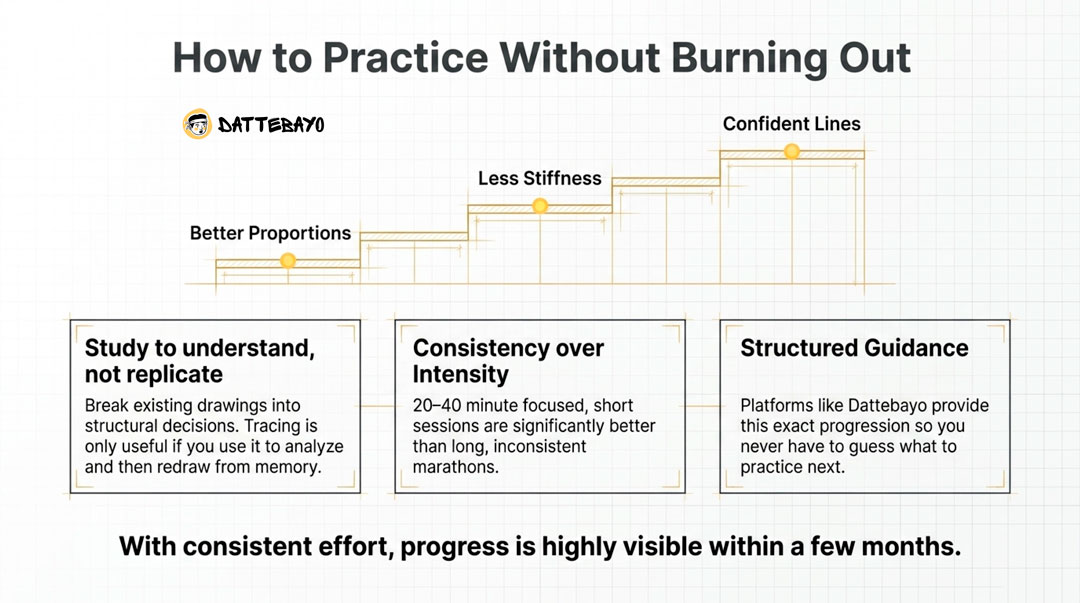
Common mistakes (and quick fixes)
Most issues come from skipping fundamentals or rushing into details.
Why your drawings look “off”
Usually a structure or proportion problem.
Fix:
- Simplify into basic shapes
- Compare relative sizes
Why your faces look uneven
It’s often a guideline issue.
Fix:
- Use a center line
- Keep feature spacing consistent
Why your characters look flat or stiff
Missing gesture or lighting logic.
Fix:
- Start with flow
- Add a clear light source
FAQ
What’s the first thing I should learn to draw anime people?
Proportions, simple structure, and the core workflow (gesture → structure → features).
Do anime artists skip anatomy?
No. They simplify it, but it’s still based on real structure.
Why do my anime eyes look uneven or mismatched?
Usually missing guidelines or inconsistent spacing.
How do you draw anime heads from different angles?
Think of the head as a rotated 3D form with consistent guidelines.
What’s the easiest anime style for beginners?
Simpler styles with clear shapes and minimal detail.
Is tracing bad for learning anime drawing?
No—if you use it to understand and then redraw from memory.
How do I make my anime characters look less flat?
Use a clear light source and think in 3D.
What should I practice daily to improve fastest?
Gesture, head construction, and proportions.
Do I need expensive tools to start drawing anime?
No. Basic tools are enough.
How long does it take to get good at anime drawing?
With consistent effort, most beginners improve noticeably within months.
If there’s one thing to remember, it’s this: anime drawing isn’t about tricks—it’s about understanding a simple system and applying it consistently. Once that clicks, everything starts to feel much more manageable.