
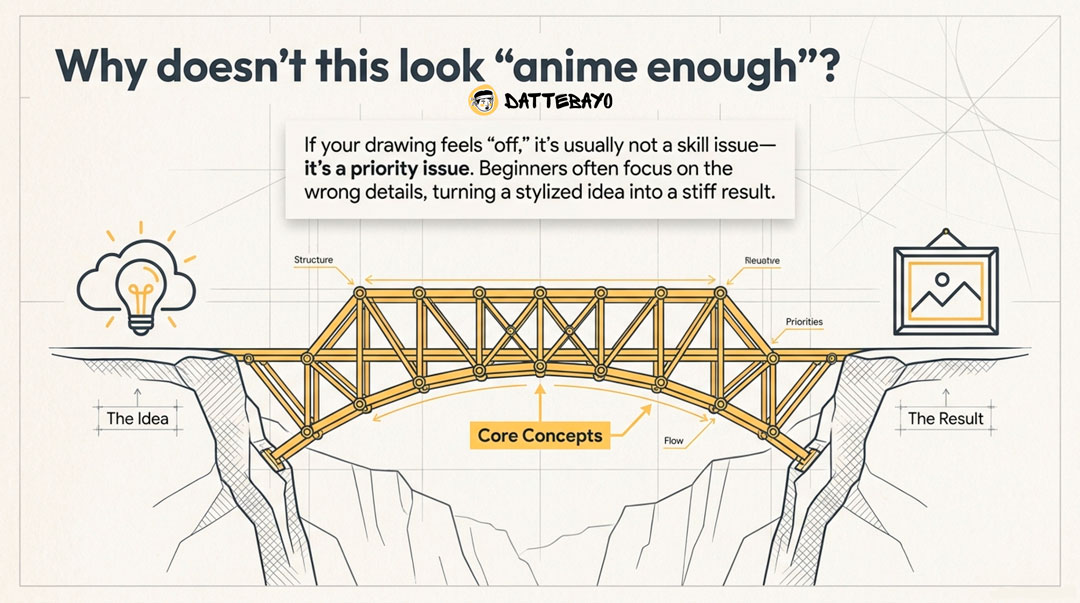
If you’ve ever finished a drawing and thought, “Why doesn’t this look anime enough?”—you’re in very familiar territory. The gap between your idea and your result usually isn’t about talent or tools. It comes down to a few core concepts that most beginners haven’t been shown clearly.
This guide is here to make those concepts click—and stick.
What actually makes a drawing look like “anime style”?
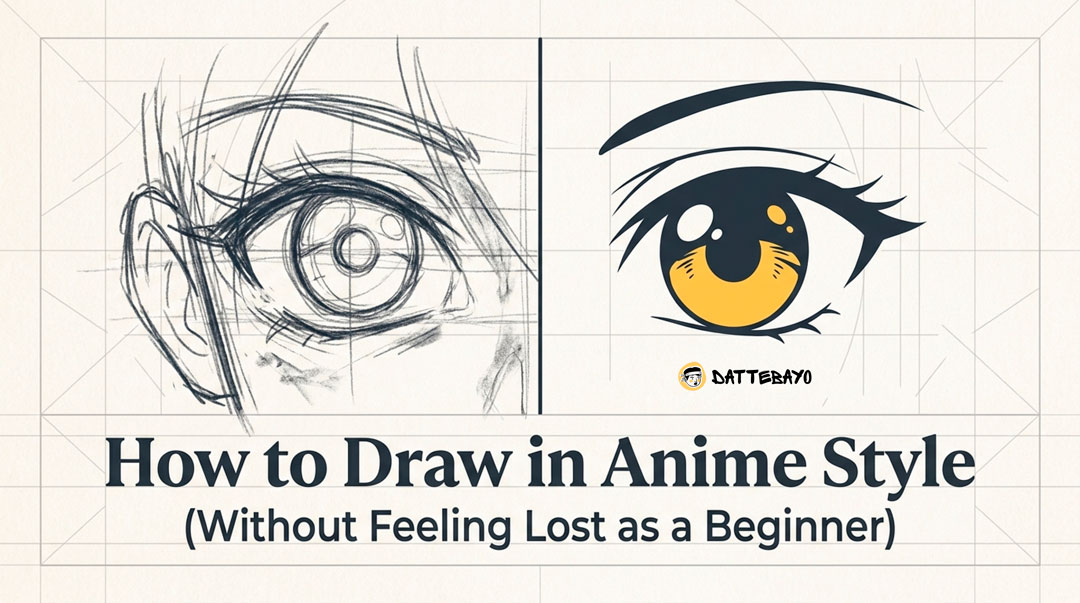
Anime style comes from simplifying real forms and exaggerating what matters—especially eyes, hair, and expression—while keeping everything clean and easy to read.
It’s not about adding more detail. It’s about choosing the right detail.
A helpful way to think about it:
- Realism tries to capture everything
- Anime decides what’s important—and pushes it
That decision-making is what creates stylization. You’re not copying reality—you’re interpreting it.
In most anime styles:
- Eyes are larger and more expressive
- Hair is grouped into clear, bold shapes
- Noses and mouths are minimal
- Shading is simplified to support clarity
The goal isn’t accuracy—it’s readability and emotion.
One thing that trips people up: anime isn’t a single style. It’s a range of styles built on the same visual logic.
Why are anime eyes, hair, and faces so distinctive?
Because they carry the viewer’s attention on purpose.
This is visual hierarchy in action:
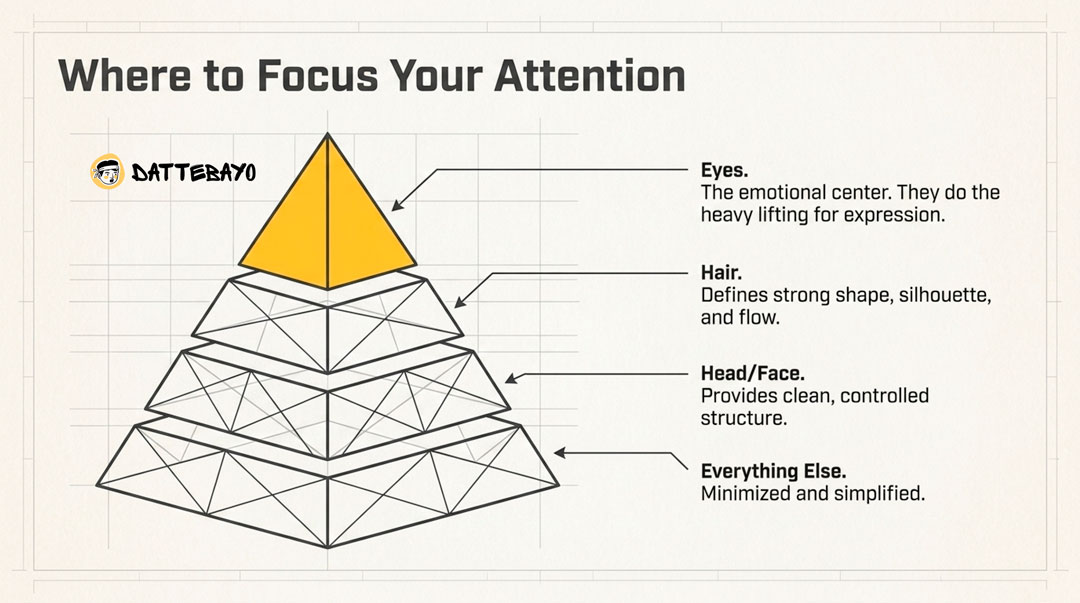
- Eyes = main focus and emotional center
- Hair = strong shape and personality
- Face = clean, controlled structure
- Everything else = simplified
Eyes do most of the emotional heavy lifting. Even small tweaks can completely change a character’s mood.
Hair works differently—it defines silhouette and flow. It’s less about strands and more about grouped shapes that feel intentional.
If your drawing feels “off,” it’s often not a skill issue—it’s a priority issue.
Is anime one style or many styles?
It’s many styles built on shared principles.
Shonen, shojo, and seinen all look different—but they rely on the same foundation: simplification, exaggeration, and consistency.
Instead of chasing a “correct” look, focus on:
- Clear shapes
- Intentional exaggeration
- Stable proportions
That’s what makes your work read as anime across styles.
The 3 rules that make drawings instantly read as anime
If your drawing has clear shapes, focused exaggeration, and controlled detail, it will read as anime—even if it’s simple.
Think of these as a quick mental checklist:
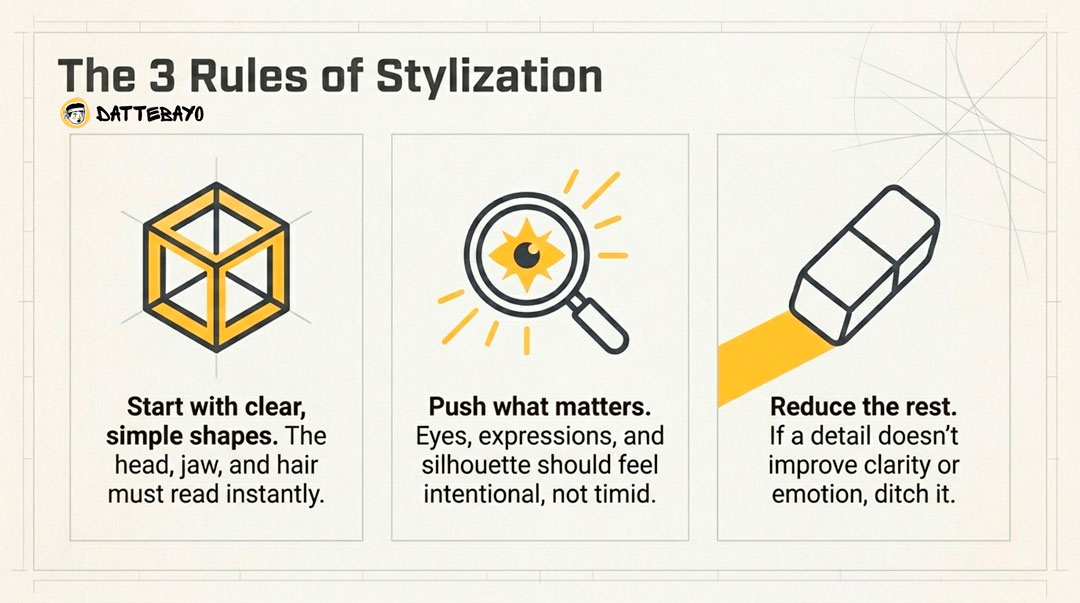
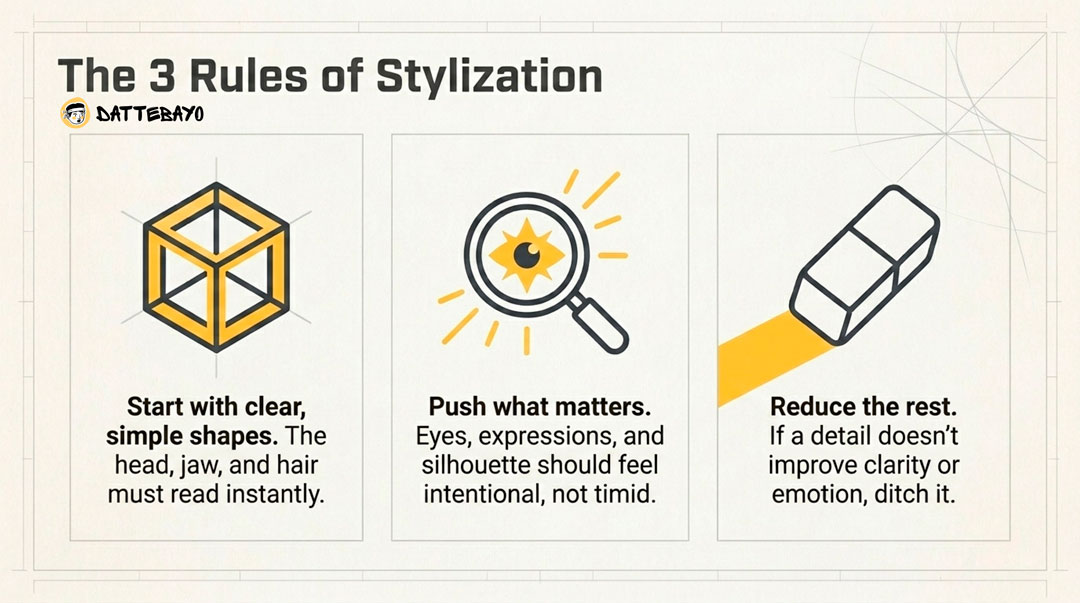
- Start with clear, simple shapes. The head, jaw, and hair should read instantly—even from far away.
- Push what matters. Eyes, expressions, and silhouette should feel intentional—not timid.
- Reduce the rest. If something doesn’t improve clarity or emotion, simplify it.
A common beginner pattern is doing the opposite: over-detailing everything while under-emphasizing what matters.
Try this: zoom out or step back. If the face doesn’t read clearly, adding detail won’t fix it—simplifying will.
A quick self-check before you finish a drawing
- Does the face read clearly at a glance?
- Are the eyes carrying the expression?
- Is anything detailed without a clear reason?
If something feels off, it’s usually not missing detail—it’s missing clarity.
What are the most important features to get right in anime characters?
Eyes, head shape, and hair structure do most of the work.
If you focus your effort here, your progress speeds up noticeably.
- Eyes: define expression and attention
- Head shape: controls proportions and style consistency
- Hair: defines silhouette and flow
These three areas dominate recognition. You can simplify almost everything else and still create a convincing character.
If you want to go deeper, studying focused topics like anime eyes or hair construction helps—but always bring that knowledge back into full characters.
Why small mistakes here feel so noticeable
Because these features are very sensitive to proportion and placement.
A tiny shift can:
- Break symmetry
- Change expression
- Make the face feel “off”
And adding more detail won’t fix it—it usually makes it more obvious.
When something feels wrong, don’t add. Adjust.
How should you think about anime face construction?
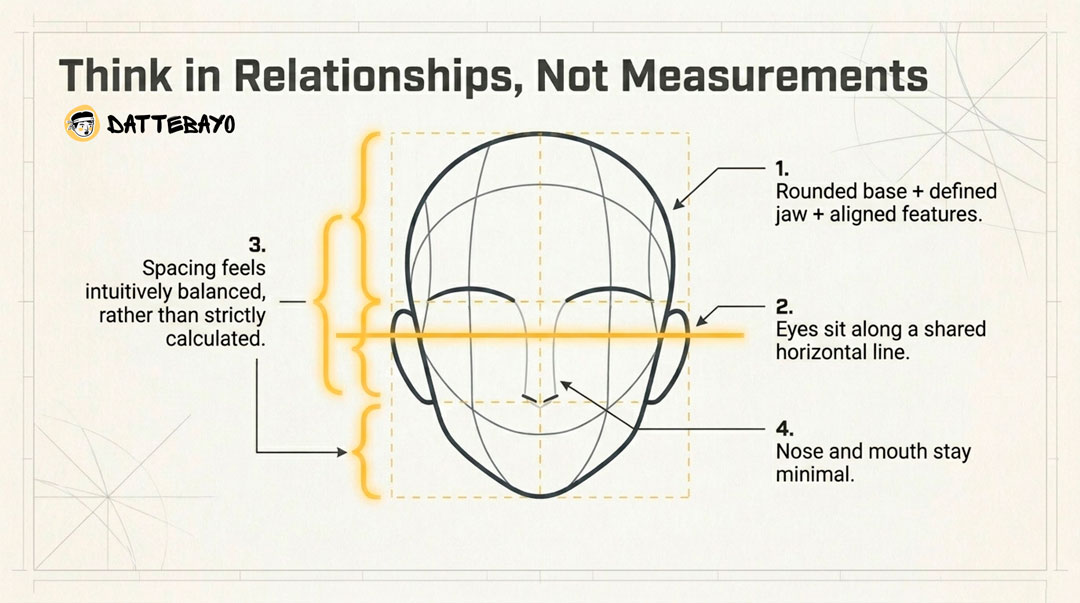
Think in simple shapes and relationships—not exact measurements.
Instead of asking “where exactly does this go?”, think:
- What is this shape relative to the others?
- Does everything feel balanced together?
Most anime faces are built from:
- A rounded base
- A defined jaw
- Aligned features
For example:
- Eyes usually sit along a shared horizontal line
- Spacing feels balanced rather than calculated
- Nose and mouth stay minimal but aligned
You don’t need precision—you need consistency.
If something looks off even after following a tutorial, it’s often because you copied shapes without understanding how they relate.
Do you need to learn anatomy before drawing anime?
No—but a bit of structure makes a huge difference.
You don’t need detailed anatomy knowledge. What helps is:
- Basic balance
- Where joints bend
- How the body carries weight
Anime simplifies anatomy—but it still relies on it.
How much anatomy is enough?
Just enough to avoid stiffness and broken proportions.
A practical baseline:
- General body proportions
- Joint placement
- Basic movement awareness
That’s enough to make your characters feel believable without overcomplicating things.
Why skipping structure causes problems
Because you’re guessing instead of building.
That often leads to:
- Limbs that don’t connect properly
- Stiff poses
- Characters that feel weightless
Even a little structure goes a long way.
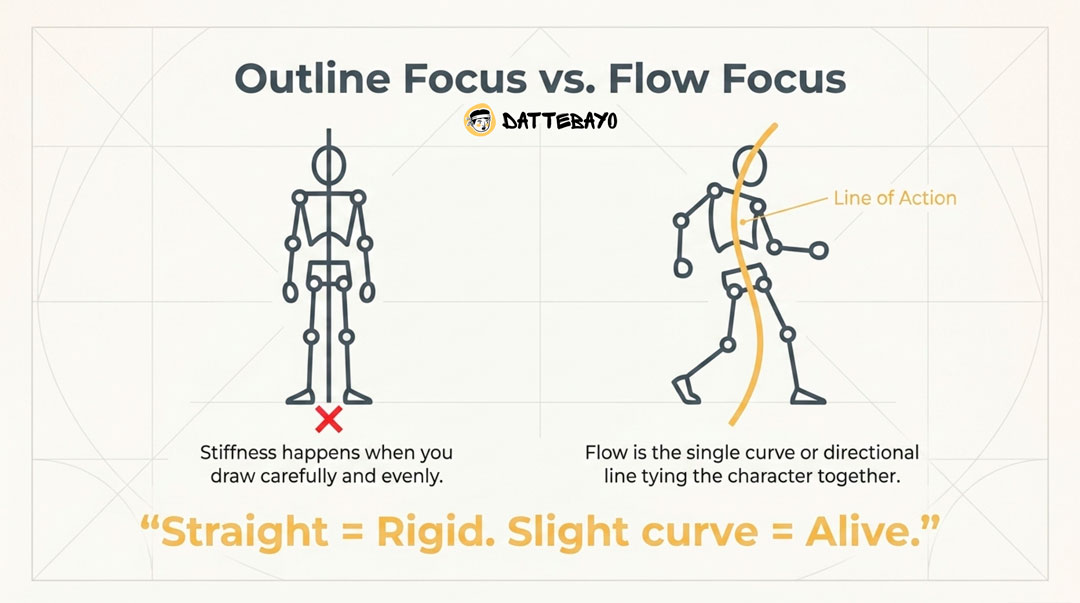
Why do your anime drawings look stiff or awkward?
Because you’re focusing on outlines and symmetry instead of movement.
Many beginners draw carefully and evenly—which sounds good, but often creates lifeless results.
Instead, think in terms of:
- Direction
- Flow
- Energy
What is “flow” in anime drawing?
Flow is the sense of movement running through the character.
It’s often captured as a single curve or directional line tying everything together.
Straight = rigid
Slight curve = alive
A quick pose check
- Is there a clear directional flow?
- Does the pose feel balanced or frozen?
If it feels stiff, loosen the structure before refining details.
Common beginner mistakes (and how to fix them fast)
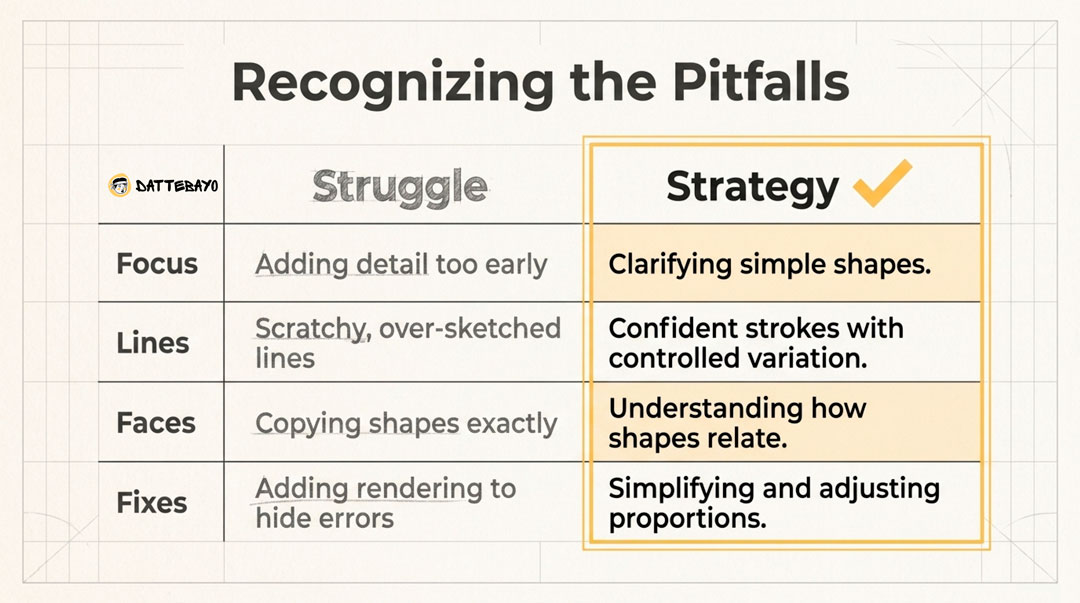
Most issues come from over-detailing, weak structure, and proportion errors.
The most common ones:
- Adding detail too early
- Misaligned eyes
- Overcomplicated hair
- Scratchy line work
- Ignoring overall head structure
Why adding detail backfires
Because it hides the real issue instead of solving it.
If proportions are off, more detail just makes the mistake louder.
Clarity beats complexity—every time.
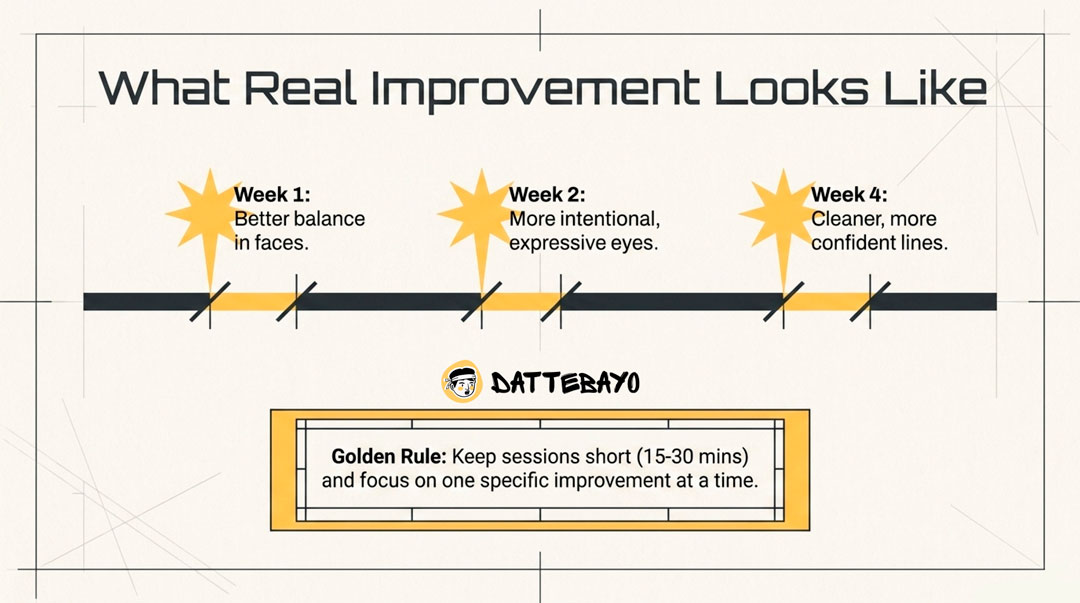
What real improvement looks like
- Cleaner shapes
- More consistent proportions
- More confident lines
Not more detail—better decisions.
How can you practice anime style without copying?
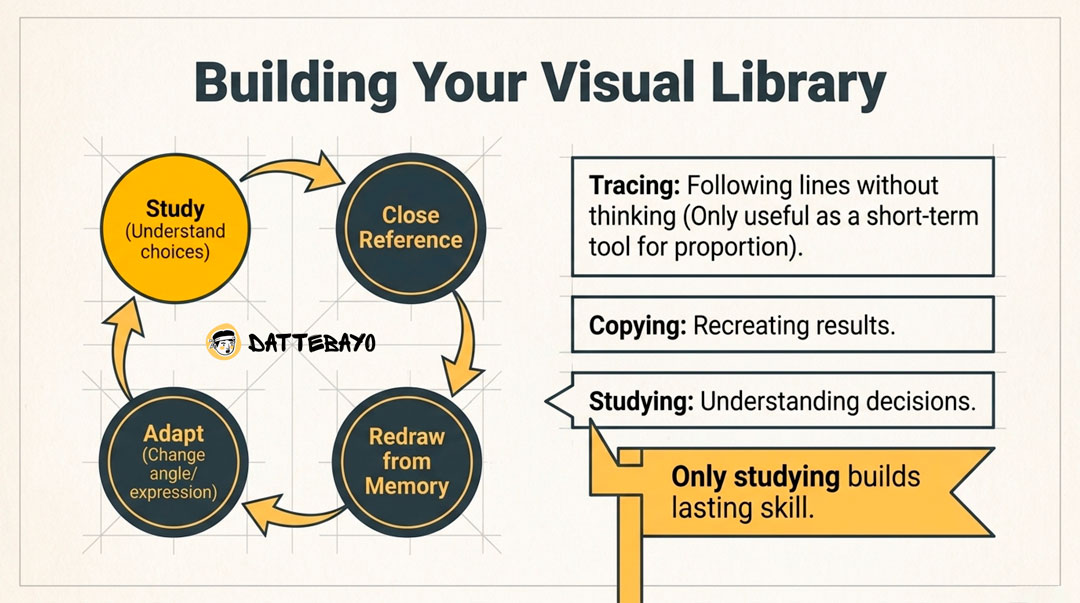
Use references to understand choices, then redraw from memory and adapt what you learned.
References are essential—but how you use them matters.
Good sources include:
- Anime screenshots
- Manga panels
- Real-life photos
- 3D pose tools
To actually improve:
- Notice what’s simplified or exaggerated
- Close the reference and redraw from memory
- Change something (hair, angle, expression)
That’s how you build your own visual library.
What’s the difference between studying, copying, and tracing?
- Studying = understanding decisions
- Copying = recreating results
- Tracing = following lines without thinking
Only studying builds lasting skill.
Should beginners ever trace?
Yes—but only as a short-term learning tool.
It can help you understand:
- Proportions
- Line flow
- Shape relationships
Just don’t rely on it—it doesn’t build decision-making.
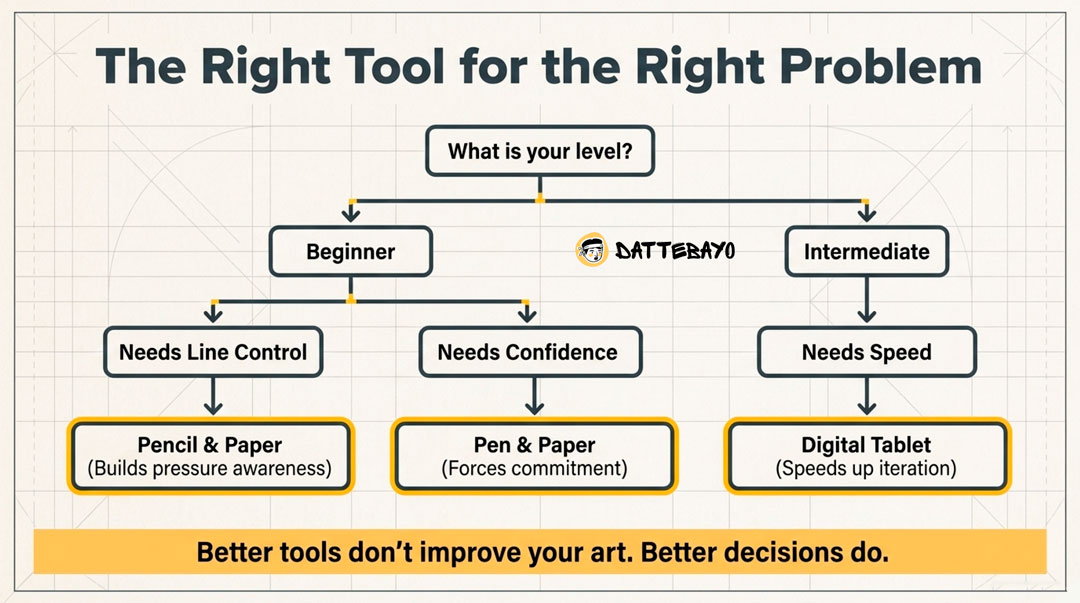
Pencil or digital—what actually helps you learn faster?
Pencil builds control early. Digital helps you iterate later.
The tool matters less than your habits—but it still shapes how you learn.
- Pencil: builds control and pressure awareness
- Pen: builds confidence and commitment
- Digital: speeds up iteration and experimentation
If you’re just starting, simple tools usually help more.
When should you switch to digital?
When your shapes are consistent and your lines feel controlled.
If everything still feels shaky, digital tools can actually slow your learning.
Do better tools improve your art?
Not directly. Better decisions do.
A basic setup is enough to get good.
How do line art and shading work in anime style?
Anime uses clean line art and simple, intentional shading to stay readable.
Line art is design—not tracing.
- Confident lines > perfect lines
- Controlled variation > random thickness
- Clean shapes > messy detail
Shading is usually minimal:
- Flat (cell) shading
- Limited gradients
- Clear light direction
Why simple shading looks more “anime”
Because it supports clarity instead of competing with it.
Too much rendering makes the drawing feel heavy and less stylized.
Common line art mistakes
- Scratchy strokes
- Inconsistent line weight
- Over-sketching without cleanup
Clean lines come from confidence and clarity—not perfection.
How long does it take to get good at anime drawing?
With consistent, focused practice, you’ll see real improvement within weeks.
Not perfection—but noticeable progress.
You’ll start to see:
- Better balance in faces
- More intentional eyes
- Cleaner lines
What speeds up progress?
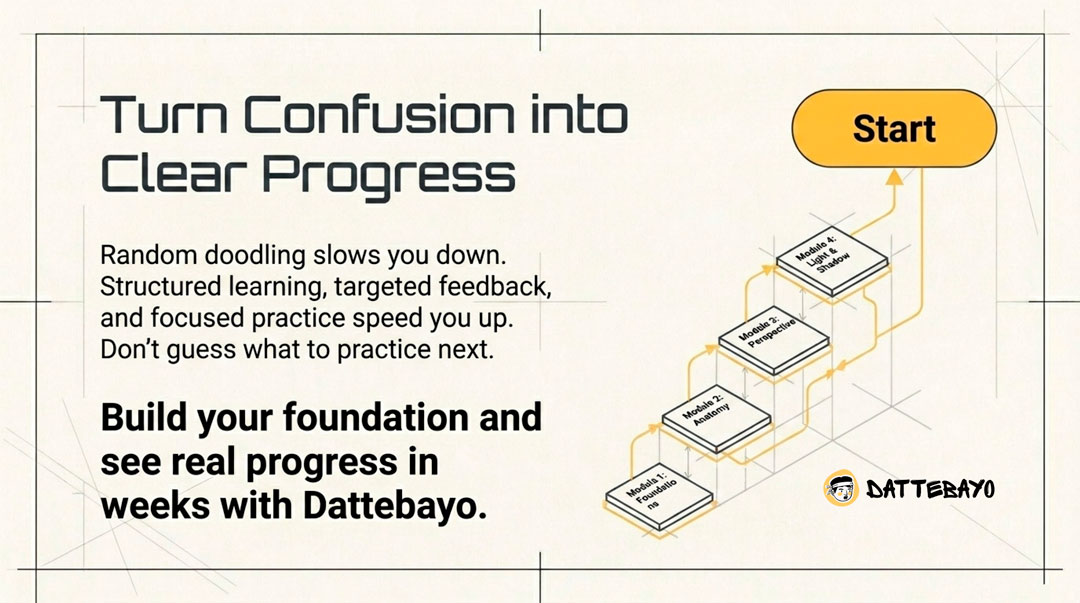
- Focused practice (not random doodling)
- Feedback and correction
- Structured learning
If you want a clear path instead of guessing what to practice next, something like Dattebayo can help you stay on track.
What slows you down?
- Inconsistent practice
- Over-detailing too early
- Not knowing what to fix
The simplest way to start today (without overthinking it)
Focus on simple head shapes, clear expressions, and short sessions.
You don’t need a perfect plan—just a repeatable approach.
What to focus on first
- Head shape
- Eye placement and expression
- Simple, grouped hair
- Clear silhouette
That’s enough to build momentum quickly.
How to stay consistent
- Keep sessions short (15–30 minutes)
- Focus on one improvement at a time
- Let imperfect drawings happen
If you want guidance without overwhelm, Dattebayo is built for exactly this stage—helping you turn confusion into clear progress.
FAQ: Quick answers to common beginner questions
What makes a drawing look anime instead of realistic?
Simplification, exaggeration, and clarity.
What matters most in anime characters?
Eyes, head shape, and hair.
Why do my faces look off even when I copy?
You’re copying shapes without understanding proportions.
Do I need anatomy first?
No—but basic structure helps a lot.
Why do my drawings look stiff?
Too much focus on outlines, not enough on flow.
Should I trace to learn?
Only as a temporary learning tool.
Can beginners learn without talent?
Yes—progress comes from practice and feedback.
What’s the easiest style to start with?
Simple styles with clean shapes and minimal detail.
Pencil or digital?
Pencil first, digital later.
How long does improvement take?
You’ll see progress in weeks with consistent practice—especially with structured learning like Dattebayo.
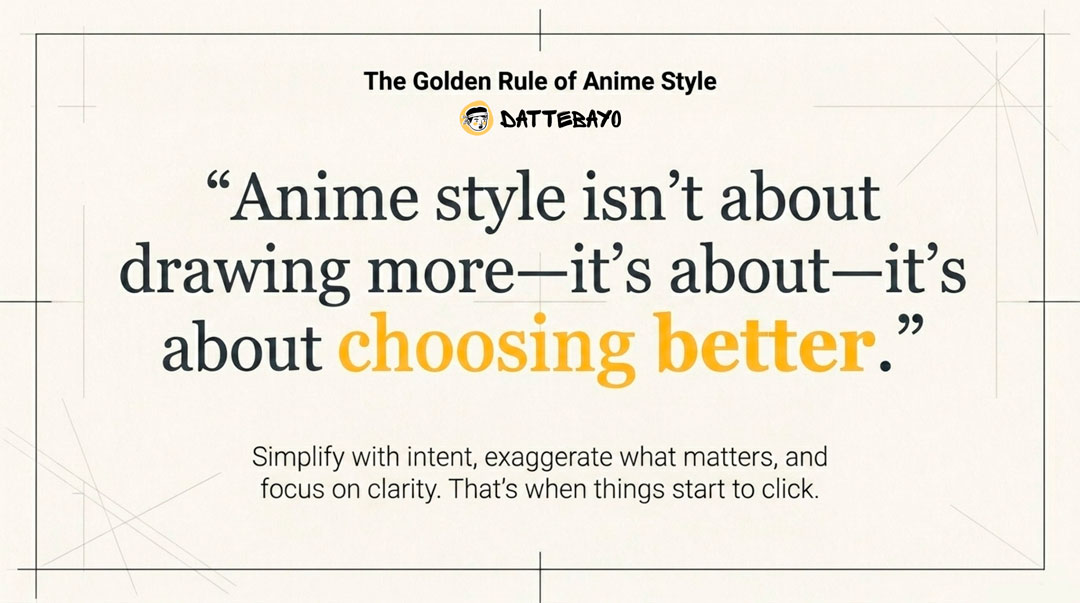
If you take one idea from this, make it this: anime style isn’t about drawing more—it’s about choosing better.
Simplify with intent, exaggerate what matters, and focus on clarity. That’s when things start to click.