
If your characters feel stiff, awkward, or like they might tip over, you’re not alone. Learning how to draw anime poses isn’t about cleaner lines—it’s about seeing movement differently.
This guide keeps things simple and practical. No heavy anatomy lectures, no rigid instructions—just clear ways to think so your poses start feeling natural.
What’s the easiest way to start drawing anime poses?
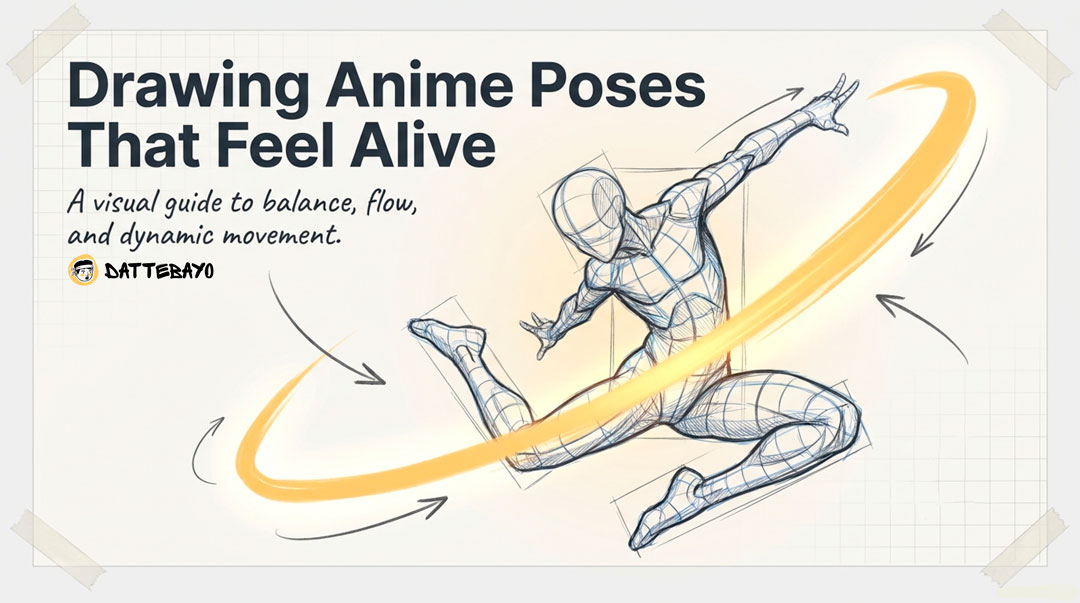
Start with gesture drawing—capture movement first, then worry about structure.
Most beginners jump straight into outlining the body. That’s what creates stiffness. A better approach is to treat a pose as motion first, structure second.
At its core, every pose can be simplified into:
- A line of action (the overall flow)
- A few basic shapes (torso, pelvis, limbs)
That’s enough to get something that already feels alive.
A rough sketch with strong movement will always beat a polished drawing with no energy.
What is gesture drawing (and why does it matter)?
Gesture drawing is quick sketching focused on movement, not details.
You’ll often see short time limits like 30–60 seconds. The point isn’t speed—it’s to stop overthinking.
Instead of asking:
- “Is this arm perfect?”
You start asking:
- “Does this feel like a real action?”
That shift builds:
- A sense of flow
- Confidence in loose sketching
- The ability to simplify complex poses
It’s the backbone of expressive anime art.
A simple framework you can reuse
Think in layers: flow → structure → balance → refine.
Not strict steps—more like a mental checklist:
- Flow: What direction is the pose moving?
- Structure: How can you simplify the body?
- Balance: Does it feel stable?
- Refine: Add details last
If something feels off, one of these is usually missing.
Why do anime poses look stiff (and how do you fix it)?
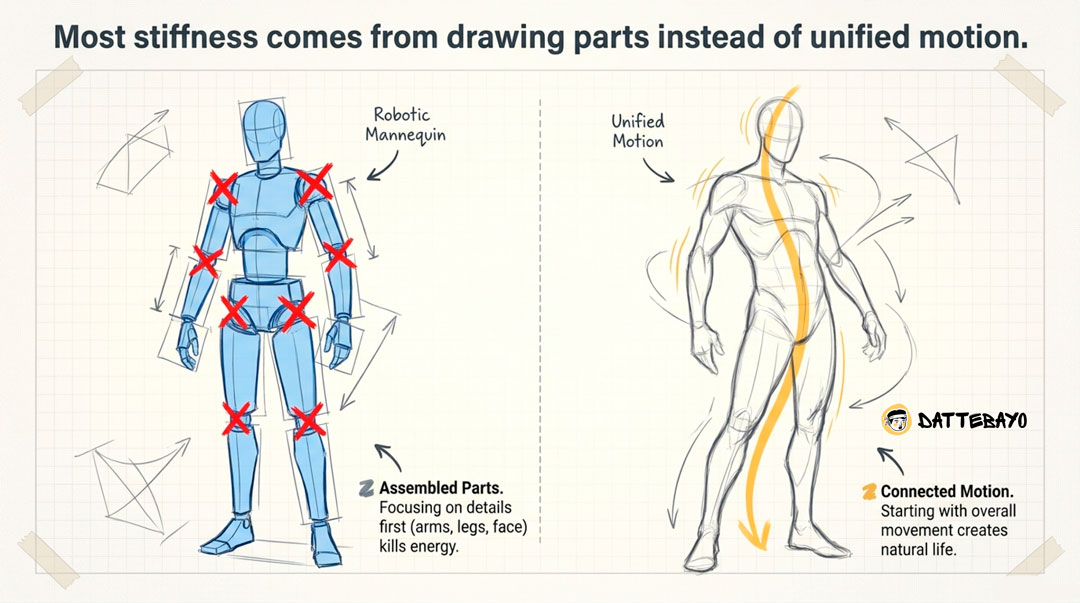
Stiffness usually comes from drawing outlines instead of movement—fix it by focusing on flow and asymmetry early.
If your characters feel like mannequins, it often means:
- You started with details
- You used too many straight lines
- Everything is too symmetrical
Real bodies are never perfectly even—they tilt, twist, and shift constantly.
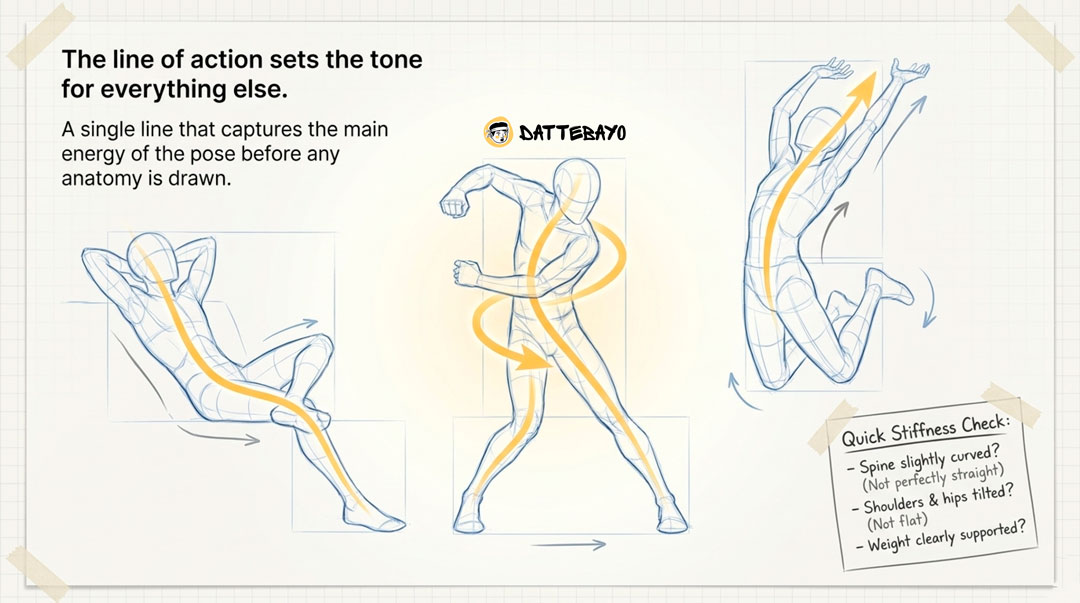
How does the line of action bring a pose to life?
The line of action shows the main direction of movement—it’s the core of the pose.
Think of it as a single sweeping curve running through the body.
- Straight line → stiff
- Curved line → dynamic
Even a slight curve can make a pose feel natural instead of rigid.
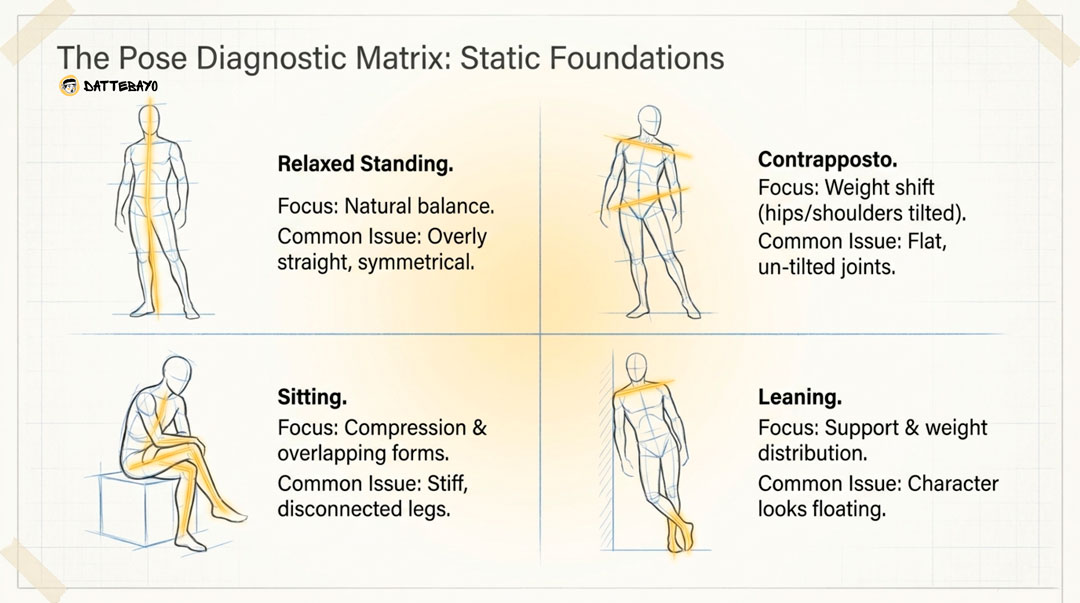
Why does symmetry make poses feel unnatural?
Perfect symmetry removes the sense of movement.
In real life:
- One shoulder is higher
- One hip drops
- One leg carries more weight
Adding small imbalances instantly makes a pose feel more believable.
If a pose looks “off,” check if it’s too even—it usually is.
How do you build a pose that actually feels balanced?
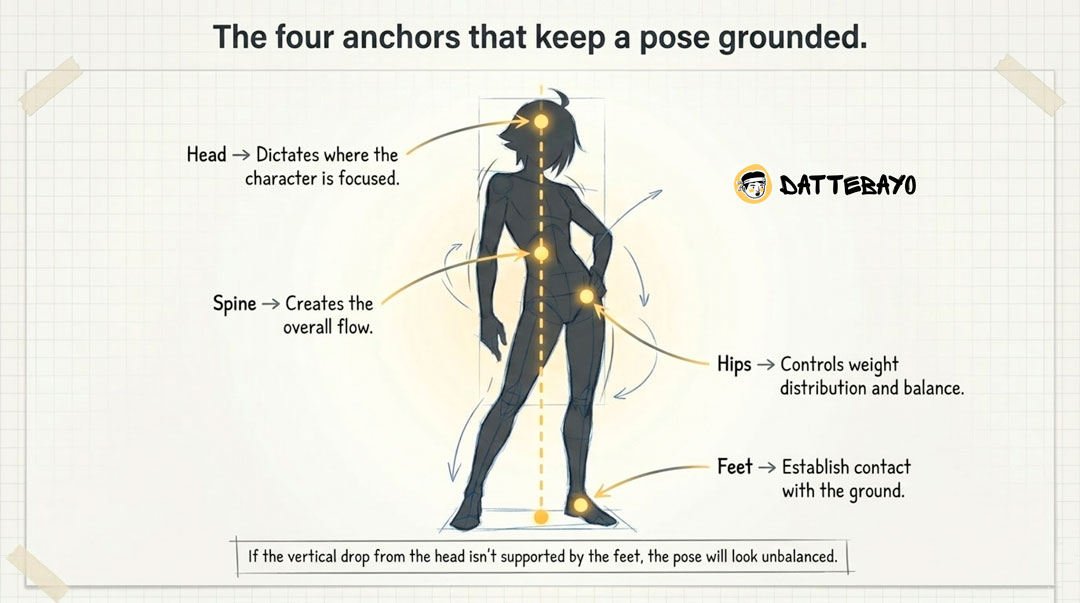
You make it believable by showing where the weight goes.
A dynamic pose can still feel wrong if the balance doesn’t make sense. Everything comes back to one idea:
- Where is the weight supported?
How can you quickly check balance?
Ask: would this character fall over?
Simple checks:
- Is the weight clearly on one leg or both?
- Is the body centered over the feet?
- Does the pose feel grounded?
If it’s unclear, the drawing will feel floaty.
How do hips and shoulders affect movement?
They usually tilt in opposite directions to create natural motion.
You don’t need to memorize terms—just remember:
- Hips tilt one way → shoulders counter it
This creates rhythm in the body. Without it, poses feel stiff even if proportions are correct.
Do you need anatomy to draw anime poses?
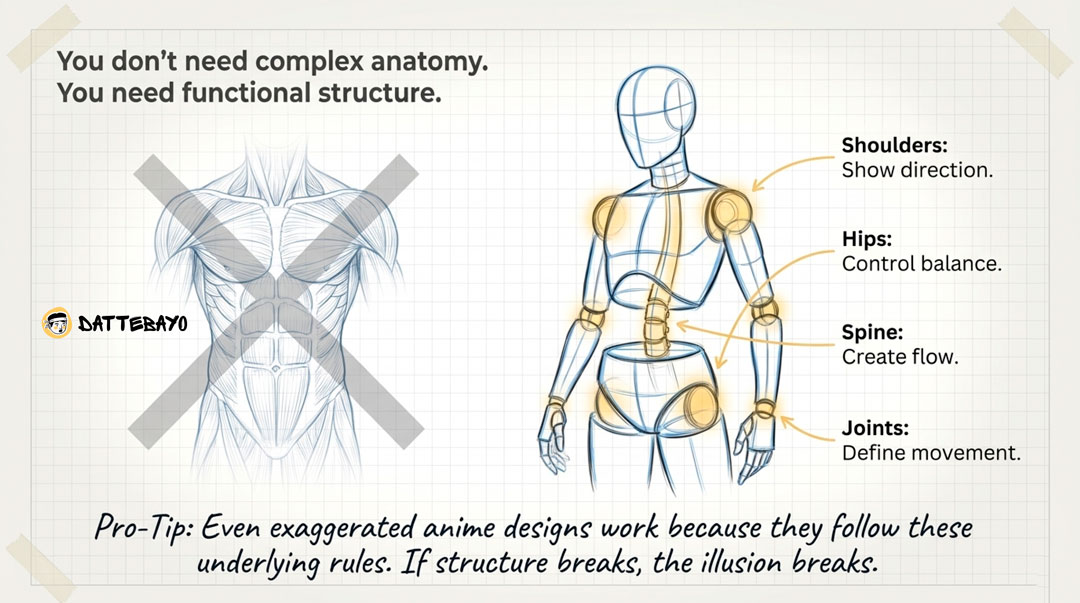
You only need basic body mechanics, not detailed anatomy.
It’s easy to think you need to master muscles first—you don’t.
Focus on:
- How joints move
- Basic proportions
- How balance works
Anime is stylized, but it still follows structure.
If you want a clearer path, Dattebayo’s approach to anime fundamentals keeps things simple and practical instead of overwhelming.
Which body parts matter most for posing?
Focus on the parts that control movement:
- Spine
- Shoulders
- Hips
- Limbs as simple segments
Think of the body as a system, not a list of muscles.
How does anime exaggerate anatomy without breaking it?
It pushes reality—but doesn’t ignore it.
For example:
- Longer legs still connect logically to the hips
- Dramatic poses still respect balance
- Stylized proportions still follow structure
Good stylization feels intentional, not random.
What are common mistakes that ruin anime poses?
Most issues come from ignoring movement, balance, or clarity.
Common problems:
- No clear line of action
- Overly symmetrical poses
- Floating characters
- Unnatural joints
- Messy silhouettes
These all tie back to the same fundamentals.
Why do characters look like they’re floating?
There’s no clear sense of weight or ground contact.
To fix it:
- Make one leg clearly support the body
- Show contact with the ground
- Align the body’s center properly
What causes broken or unnatural joints?
Joints are bending in ways they shouldn’t.
Watch for:
- Elbows bending backward
- Knees twisting oddly
- Limbs overextending
You don’t need deep anatomy—just basic limits.
Why does silhouette clarity matter?
A strong pose should be readable even as a solid shape.
If you filled your character in black, you should still see what they’re doing. If everything overlaps too much, the pose loses impact.
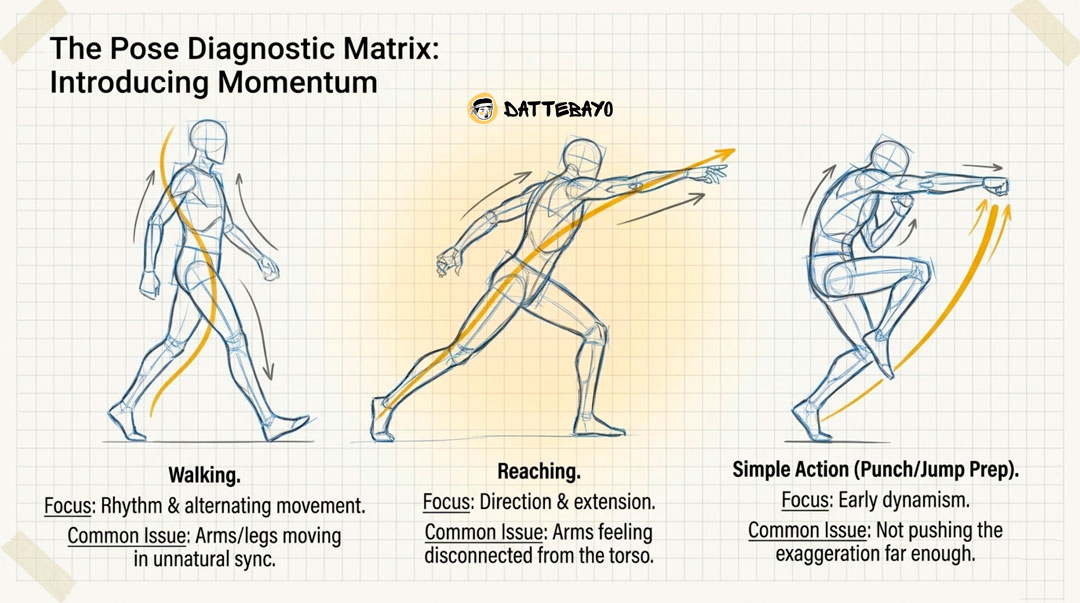
How do you make anime poses more dynamic?
Push movement using exaggeration, angles, and depth.
Dynamic poses aren’t about complexity—they’re about intention. You’re slightly distorting reality to make the motion clearer.
What is foreshortening in simple terms?
It’s when parts of the body look compressed because they point toward or away from you.
For example:
- A hand closer to the viewer looks larger
- The arm behind it appears shorter
This adds depth and makes poses feel more immersive—something you’ll notice a lot in modern anime and 3D-assisted workflows.
A quick mental check for dynamic poses
Before moving on, ask:
- Is there a clear flow?
- Are things slightly tilted or twisted?
- Is there depth, not just flat shapes?
- Did I push the pose a bit?
If everything feels safe, it probably looks stiff.
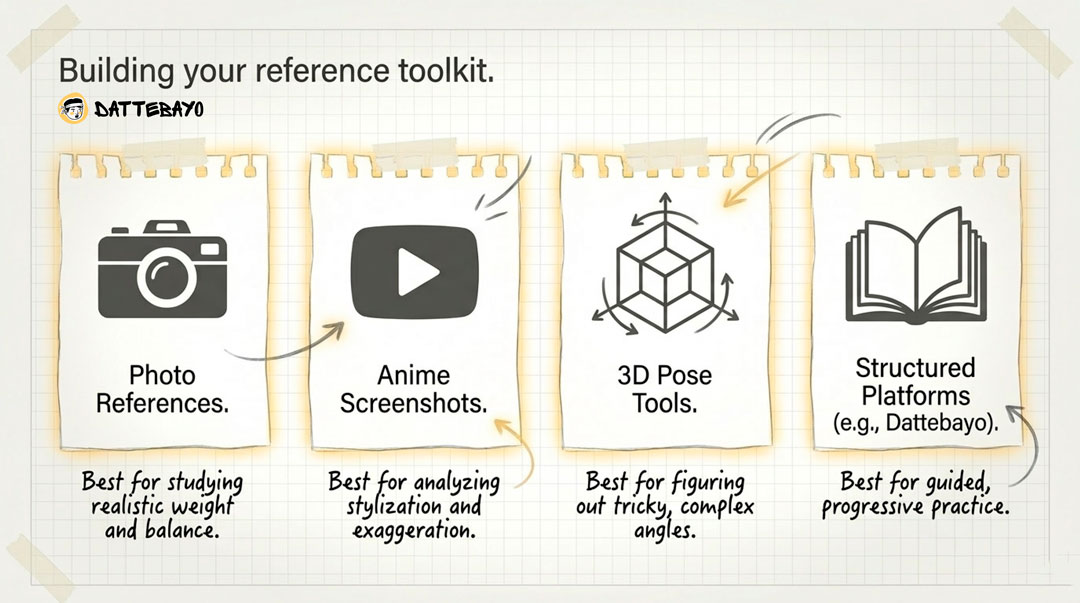
Should you use pose references or draw from imagination?
Use references to understand poses, then build your own from that knowledge.
The idea that “real artists don’t use references” is a myth. Professionals rely on them all the time—especially now, with pose apps and 3D models being standard tools in 2026.
How do you study references without copying?
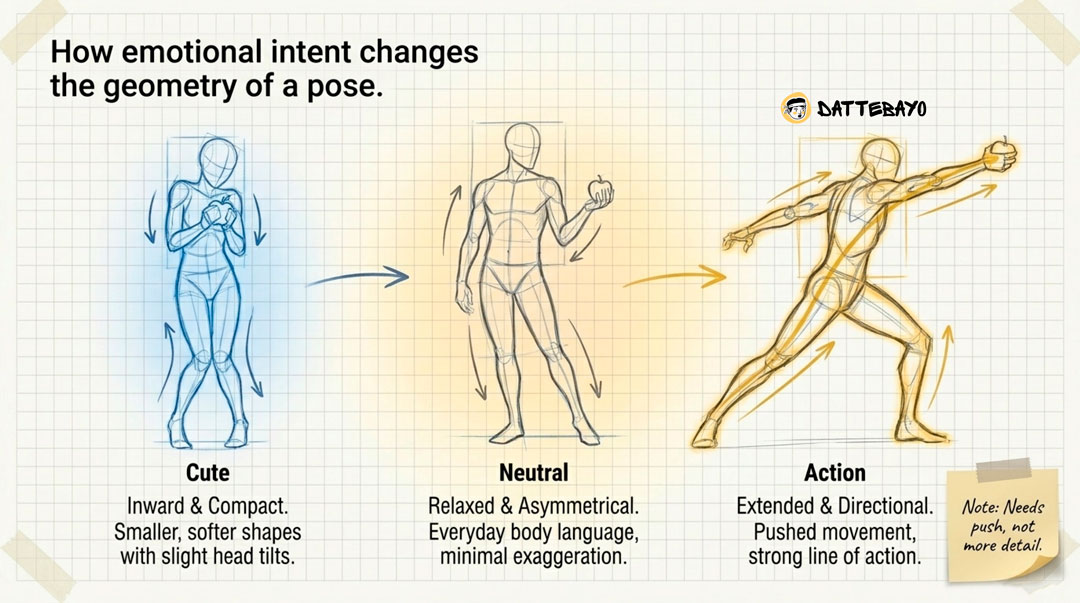
Focus on understanding, not tracing.
Look for:
- The line of action
- Simple shapes
- Where the weight is
Ask yourself:
- “Why does this pose feel natural?”
That’s where improvement happens.
How do you come up with original pose ideas?
Think in terms of story and emotion.
Ask:
- What is the character feeling?
- What just happened?
- Where is the energy going?
You can mix references, exaggerate elements, and adapt ideas into something new.
This connects closely with character design fundamentalshttps://dattebayo.me/en/courses/drawing-anime-and-manga-from-scratchign fundamentals—pose and personality go hand in hand.
How can you practice anime poses without getting overwhelmed?
Keep practice short, focused, and consistent.
You don’t need long sessions—just repeatable habits.
What does a simple practice routine look like?
Try something manageable:
- 10–15 minutes of gesture drawing
- Focus on one idea at a time (flow, balance, etc.)
- Occasionally review older sketches
That’s enough to see steady progress.
Can guided lessons help you improve faster?
Yes—structure removes guesswork.
If you’re unsure what to practice next, a course can connect everything together.
Dattebayo’s anime drawing course focuses on exactly that—helping you build skills step by step without confusion.
How long does it take to get good at drawing anime poses?
You’ll notice improvement in weeks if you stay consistent, but real skill builds over time.
Progress is gradual, not dramatic.
What does early progress actually look like?
At first, you’ll see:
- Less stiffness
- Better balance
- More confident sketches
Not perfect drawings—but better instincts.
Why does consistency matter more than long sessions?
Short, regular practice beats occasional long sessions.
Even 10 minutes a day adds up quickly when you stay consistent.
Putting it all together: how should you think about anime poses?
Every pose comes back to: flow → structure → balance → refine.
That’s your core system.
When something feels wrong, check:
- Is the movement clear?
- Is the structure simple?
- Does the balance make sense?
You’re not just drawing a body—you’re capturing a moment.
If you want a clearer path for practicing all of this without feeling lost, Dattebayo is built to guide you from basics to confident drawing in a way that actually sticks.
FAQ
What’s the easiest way to start drawing anime poses?
Start with gesture drawing—focus on movement using a line of action and simple shapes.
Why do my anime poses look stiff or unnatural?
Because you’re focusing on outlines instead of flow, or using too much symmetry.
What is gesture drawing in anime?
It’s quick sketching that captures movement rather than details.
Do I need anatomy to draw anime poses?
No—just basic understanding of joints, proportions, and balance.
How do you make poses more dynamic?
Use curves, exaggeration, tilted hips and shoulders, and add depth.
Why do my characters look unbalanced?
The center of gravity isn’t aligned with the support (usually the feet).
What is foreshortening?
It’s when parts of the body look shorter or larger due to perspective.
Should I use references?
Yes—use them to understand poses, then adapt and create your own.
How should I practice anime poses?
Keep it short and consistent—daily gesture drawing is one of the most effective methods.