You don’t need a huge toolbox to figure out how to draw anime mouth shapes—you need a few simple forms and the ability to adjust them on purpose. Once that clicks, expressions stop feeling random and start feeling controllable.
If your characters ever look stiff or slightly “off,” even when everything else seems fine, the mouth is often the culprit. It’s small, but it carries a surprising amount of emotion.
Let’s break this down so you actually understand what you’re doing—not just copy shapes.
What are the basic anime mouth shapes? (Start here)
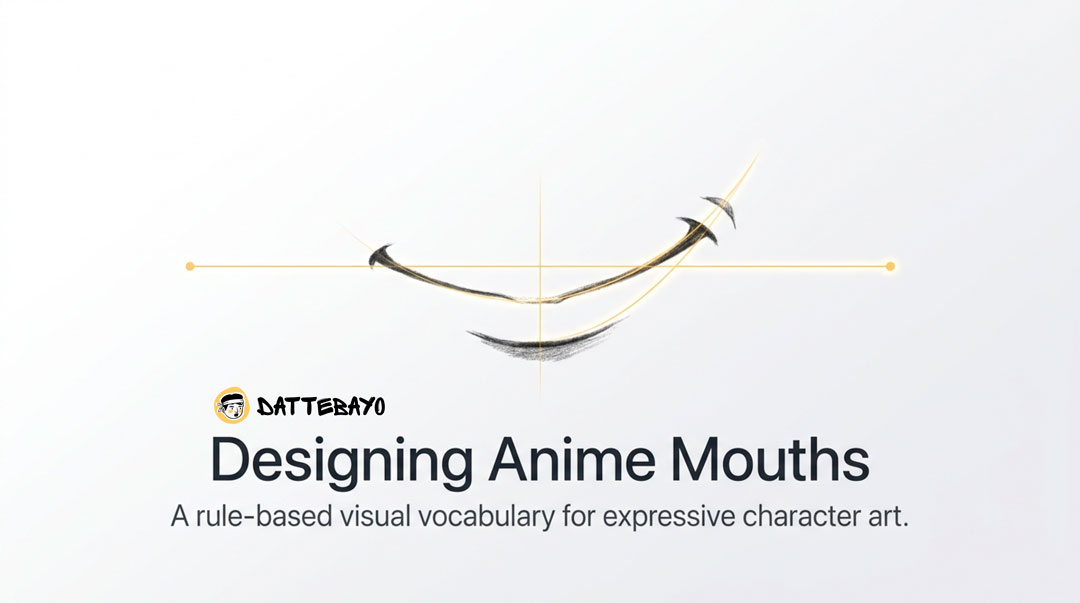
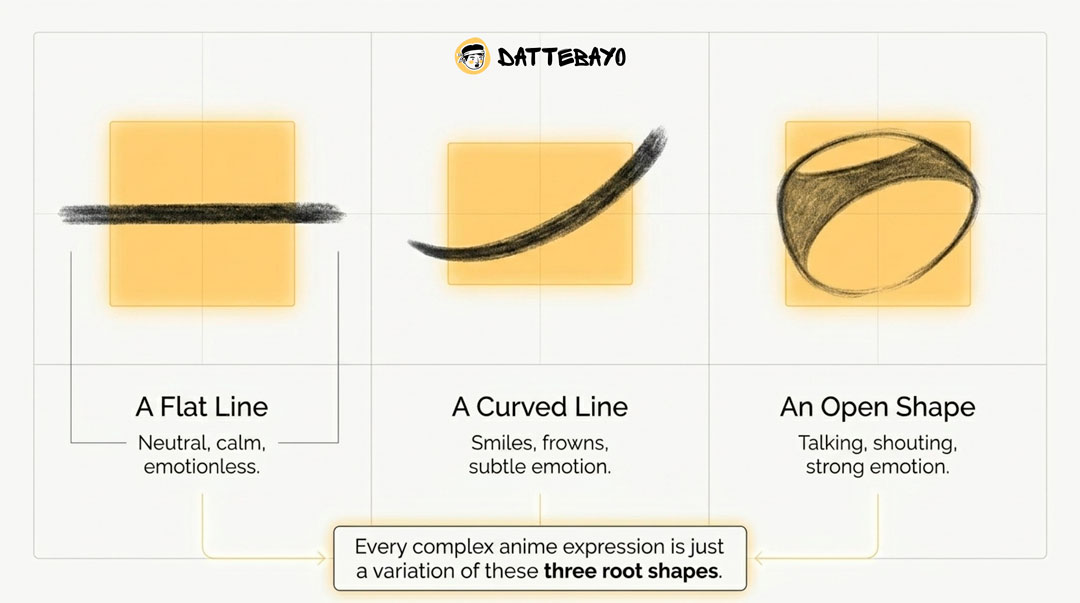
Most anime mouths come from three simple shapes: a line, a curve, or a soft open form. Everything else is just a variation.
Instead of thinking “I need to draw a mouth,” think: Which shape matches this feeling?
The 3 shapes every anime mouth comes from
At the core, you’re working with:
- A flat line → neutral, calm, emotionless
- A curved line → smiles, frowns, subtle emotion
- An open shape (oval or wedge) → talking, shouting, strong emotion
That’s really it. Even stylized or detailed anime builds on these.
What changes isn’t the base—it’s how you adjust it: curve, thickness, openness, and placement.
Strong drawings come from choosing the right shape, not adding more detail.
How small changes create completely different expressions
Tiny adjustments do most of the work.
- Slight upward curve → gentle smile
- Sharper curve → excitement or mischief
- Soft downward curve → sadness
- Uneven curve → tension, sarcasm, personality
Beginners often jump to complex expressions too early. In reality, small changes matter more than new shapes.
If you practice one thing, practice variations of the same shape.
What makes anime mouths different from realistic mouths?
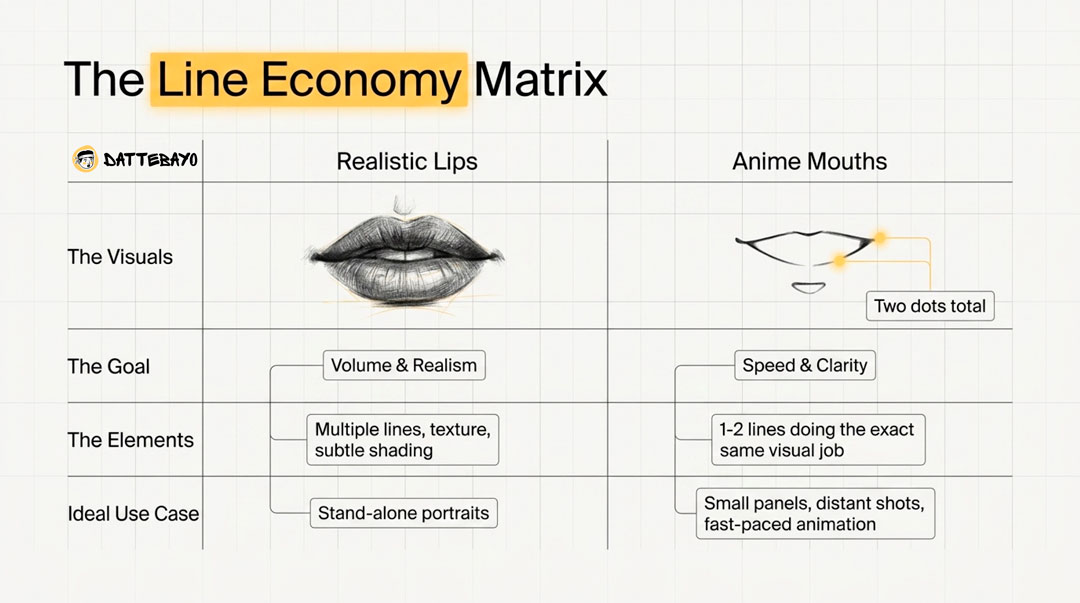
Anime mouths are simplified on purpose—they aim for clarity, not realism.
In realistic drawing, lips have volume, texture, and subtle shading. Anime often strips that down to the minimum needed to communicate the expression.
Why simpler often looks better
Anime designs need to read quickly. Characters appear:
- in small panels
- from a distance
- in motion (especially with today’s fast-paced formats and short-form animation trends)
Too much detail can turn into visual noise.
That’s where line economy comes in:
- fewer lines
- clearer shapes
- intentional simplification
Compare:
- Realistic lips → multiple lines and shading
- Anime mouth → one or two lines doing the same job visually
Both approaches are valid—anime just prioritizes efficiency.
When more detail actually helps
Detail works best when it has a reason.
You’ll usually see more of it when:
- the shot is close-up
- the emotion is intense (crying, anger, panic)
- the style leans semi-realistic
The key is contrast. If everything is detailed, nothing stands out.
How detailed should an anime mouth be?
It depends on context—distance, emotion, and your overall style matter more than fixed rules.
A common beginner mistake is using the same level of detail for every mouth.
Minimal vs expressive: what actually changes
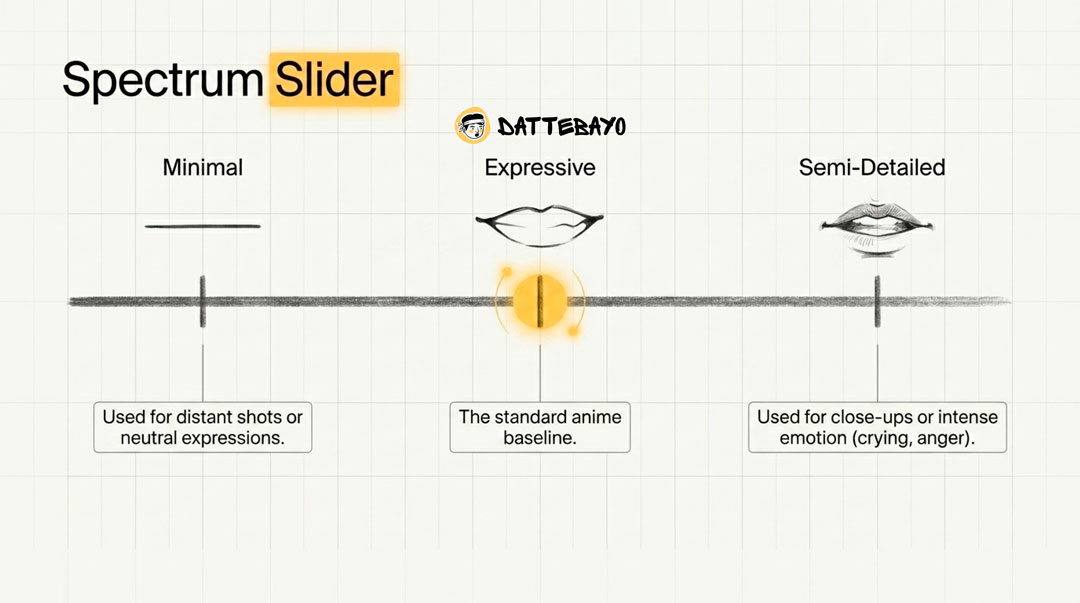
Think of detail as a range:
Minimal
- single line
- used for neutral or distant shots
Expressive
- clearer curves, slight thickness
- subtle asymmetry
Semi-detailed
- hints of lips or corners
- possible teeth or inner mouth
What changes isn’t just how much you draw—it’s what you emphasize.
Matching mouth detail to your style
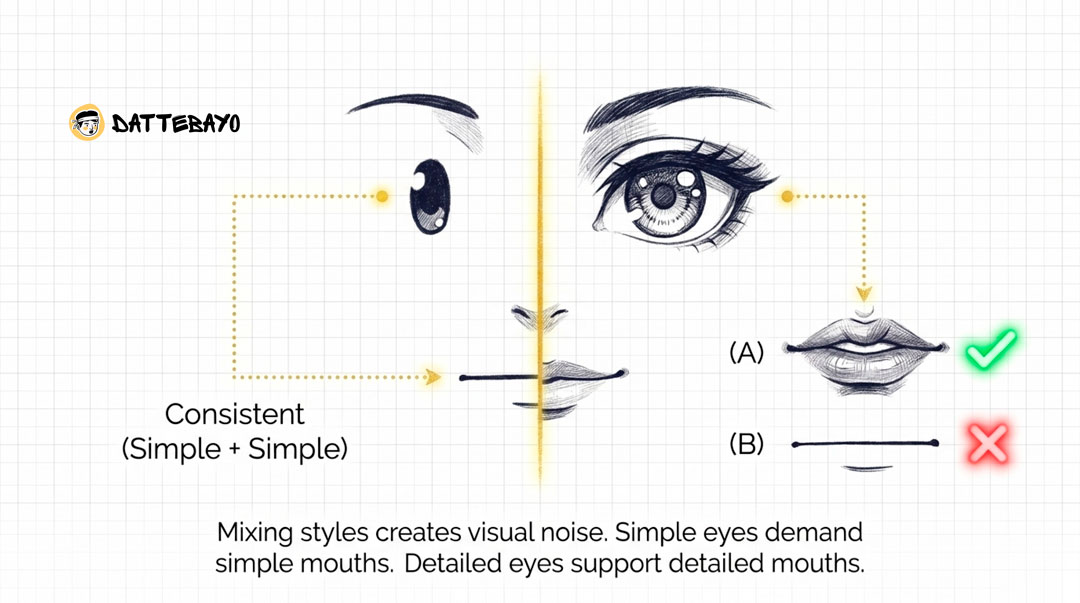
Your mouth should feel like it belongs on the same face.
- Simple eyes → simpler mouth
- Detailed eyes → slightly more mouth detail works
Mixing styles is where things start to feel off.
If you’re unsure what “consistent” looks like, studying structured examples—like in Dattebayo’s beginner course—can make this much clearer.
How do you draw anime mouths that don’t look stiff?
Stop treating the mouth like a sticker—think of it as something that moves and deforms.
Stiffness usually comes from repeating the same shape without adjusting for expression.
The “sticker mouth” problem
You’ll notice it when the mouth:
- looks perfectly symmetrical every time
- doesn’t change with emotion
- feels disconnected from the face
It ends up looking pasted on.
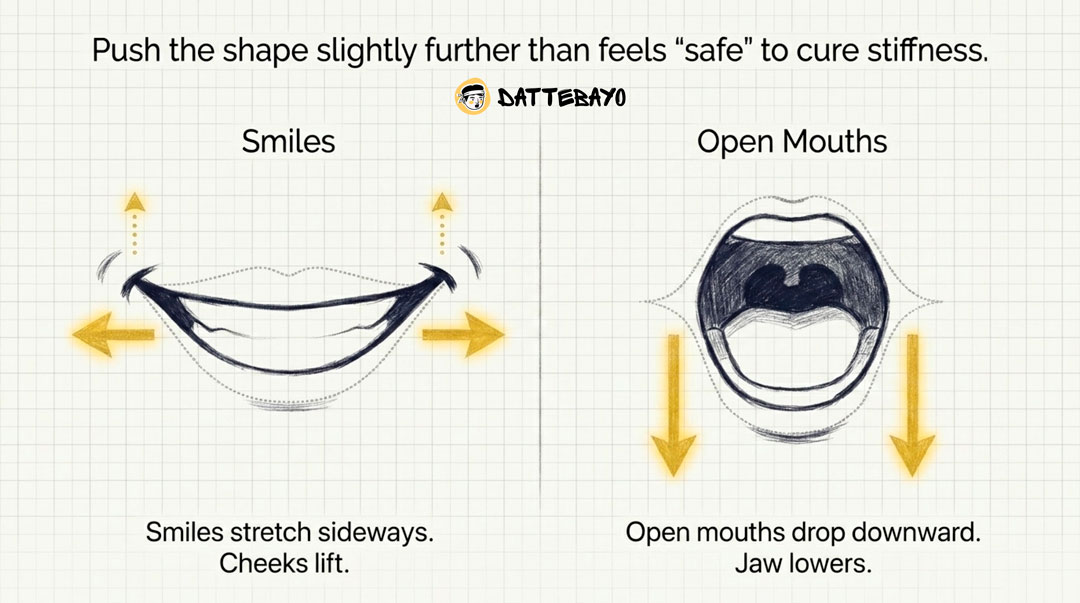
Using squash and stretch (in a simple way)
You don’t need animation theory—just keep this in mind:
- Smiles stretch sideways
- Open mouths drop downward
- Strong emotions become less symmetrical
And the mouth doesn’t act alone:
- cheeks lift when smiling
- the jaw lowers when shouting
- tension creates uneven shapes
If something feels stiff, push the shape slightly further than feels “safe.” That’s often the fix.
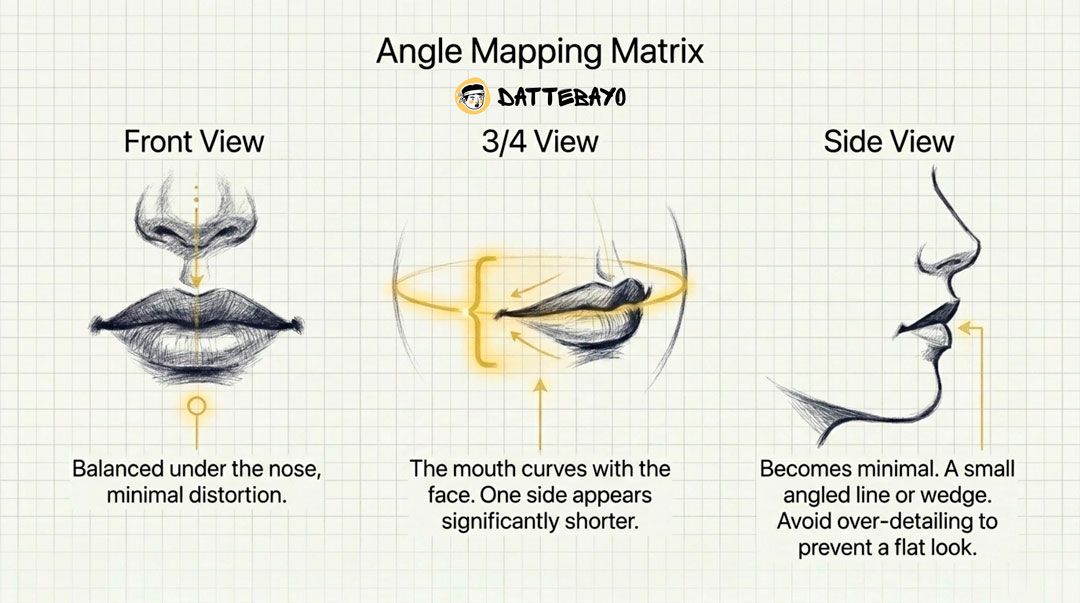
How do anime mouths work from different angles?
Anime mouths follow the curve of the head—they don’t sit flat on the face.
This is where many beginners struggle.
Front view: what stays simple
In front view, the mouth is centered and balanced.
- aligned under the nose
- evenly spaced with the face
There’s very little distortion here.
3/4 view: why the mouth shifts
In 3/4 view, the mouth curves with the face.
- one side appears shorter
- the line follows the head’s roundness
If you draw it like a flat front view, it immediately looks off.
Side view: less detail, same structure
In side view, the mouth becomes minimal—but still structured.
- small angled line or wedge
- slight indication of opening or lips
The balance is avoiding:
- too much detail (looks out of place)
- too little structure (looks flat)
If this feels tricky, it usually ties back to overall face construction. You can explore that further here:
How do you draw anime mouths with teeth and tongue?
Teeth and tongue are simplified into clean shapes—not individually drawn details.
This is where over-detailing happens fast.
Why individual teeth look wrong
Drawing each tooth often leads to:
- clutter
- uneven spacing
- an uncanny look
Instead, anime typically uses:
- one clean shape for teeth
- maybe a simple dividing line
Keeping open mouths clean
For open mouths:
- teeth → one solid shape
- tongue → soft, rounded form
- inside → flat tone or minimal shading
If the expression reads clearly, you’ve done enough.
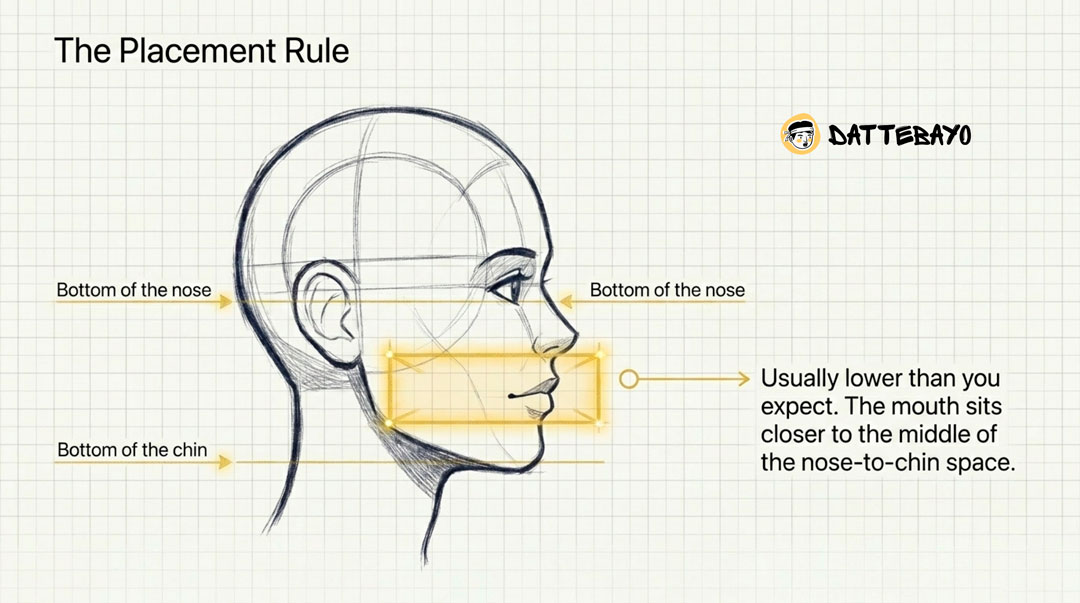
Where should the anime mouth sit on the face?
Usually lower than you expect—between the nose and chin.
Placing it too high is one of the most common issues.
A simple way to think about it:
- nose above
- chin below
- mouth sits closer to the middle of that space
Style can shift this slightly, but not dramatically.
What are the most common mistakes (and quick fixes)?
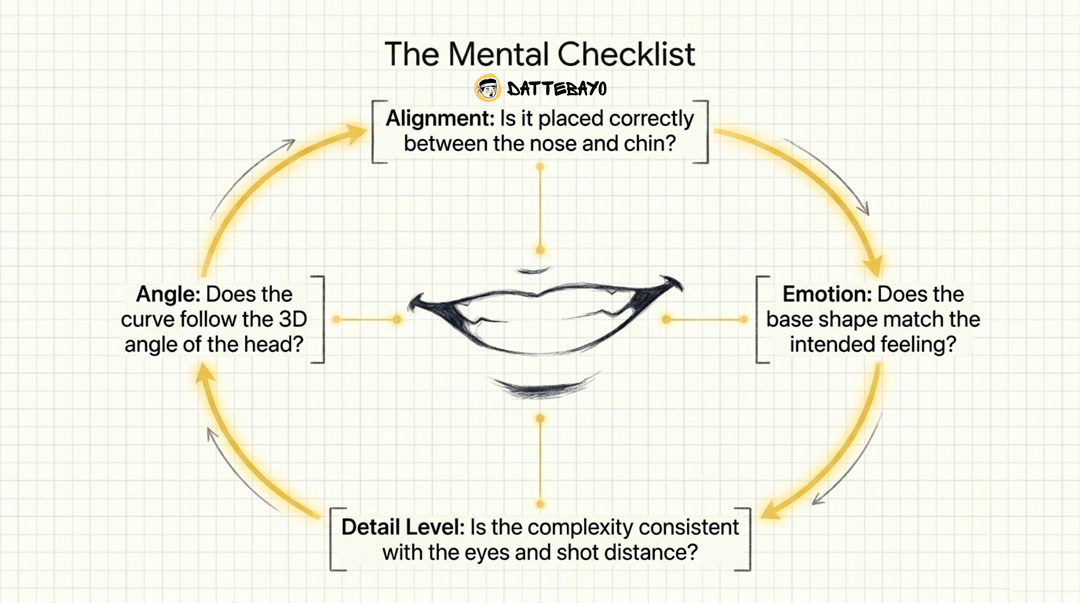
Most issues come down to placement, stiffness, over-detailing, or mismatch with expression.
Quick mental checklist
- Is it aligned with the face?
- Does it match the emotion?
- Is it too detailed for the style?
- Does it follow the head angle?
If something feels off, it’s usually one of these—not a lack of talent.
How can you practice anime mouths effectively?
Focused variation beats random repetition every time.
You improve faster by being intentional.
A simple practice idea
- pick one base shape
- explore multiple emotions with it
- repeat using references
This builds control quickly.
Why studying anime frames works (Dattebayo approach)
Looking at real scenes helps you:
- spot patterns
- understand simplification
- see how expressions are designed for clarity
This kind of structured learning is a big part of how Dattebayo teaches—breaking things into systems you can actually reuse.
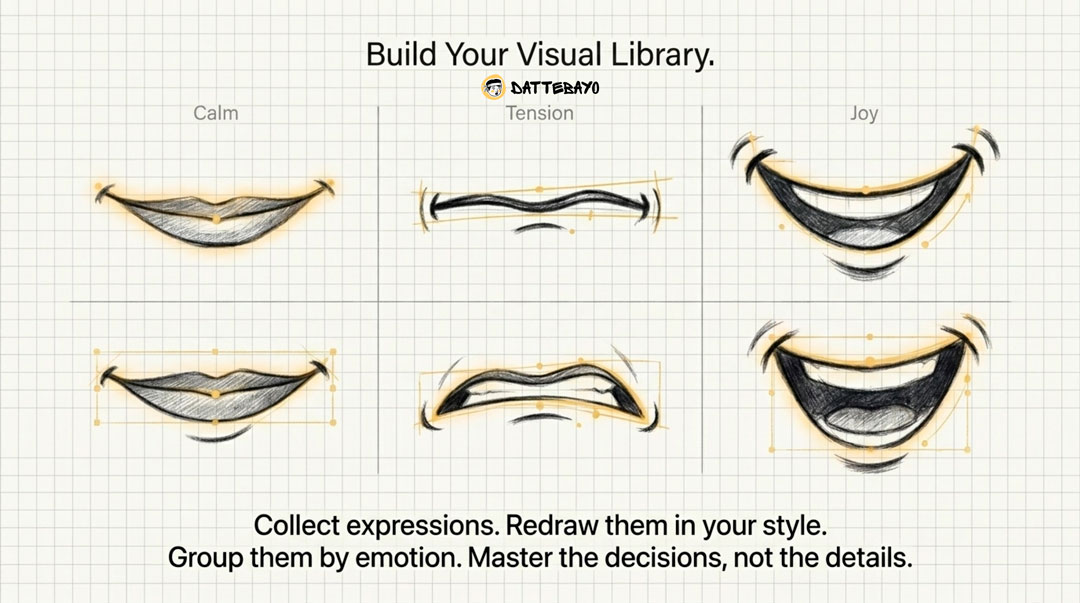
Build your own visual library
Instead of starting from scratch every time:
- collect expressions you like
- redraw them in your style
- group them by emotion
Over time, you build a reliable “mental library” you can draw from.
FAQ: Common beginner questions about anime mouths
How to draw anime mouth with teeth?
Use a single clean shape instead of individual teeth. Add separation only if needed.
Why does my anime smile look creepy or off?
It’s often too symmetrical or too detailed. Slight asymmetry and softer curves help.
Where should the mouth be placed on an anime face?
Between the nose and chin, usually a bit lower than expected.
How do you draw a talking anime mouth?
Reuse a small set of open and closed shapes rather than inventing new ones each time.
Do I need realistic anatomy first?
No—basic placement and movement understanding is enough.
How do I make mouths more expressive?
Push curves further, allow asymmetry, and match the emotion clearly.
What’s the easiest mouth to start with?
A simple curved line—it can become almost any expression.
Why do mouths look flat in 3/4 or side view?
They’re not wrapping around the face. Adjust curvature and placement with the head angle.
If you remember one thing: learning how to draw anime mouth shapes is about decisions, not detail. Shape, placement, and intent matter far more than complexity.
And if you want to connect those decisions into full characters, a structured path—like what you’ll find on Dattebayo—can make the whole process feel a lot more manageable.