
Why do anime action poses look stiff (and how do you fix it)?
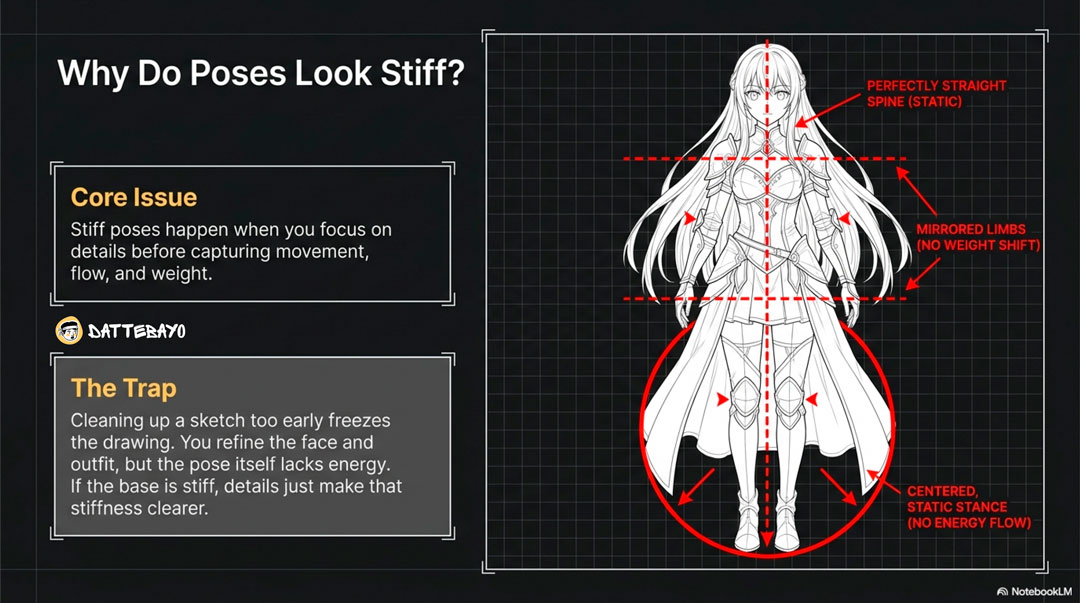
Stiff poses happen when you focus on details before capturing movement, flow, and weight. The fix is simple: prioritize motion first, structure second, and detail last.
A lot of beginners accidentally “freeze” their drawings by cleaning things up too early. You refine the face, adjust the outfit, fix the hands… but the pose itself never had energy. So even if it looks neat, it feels lifeless.
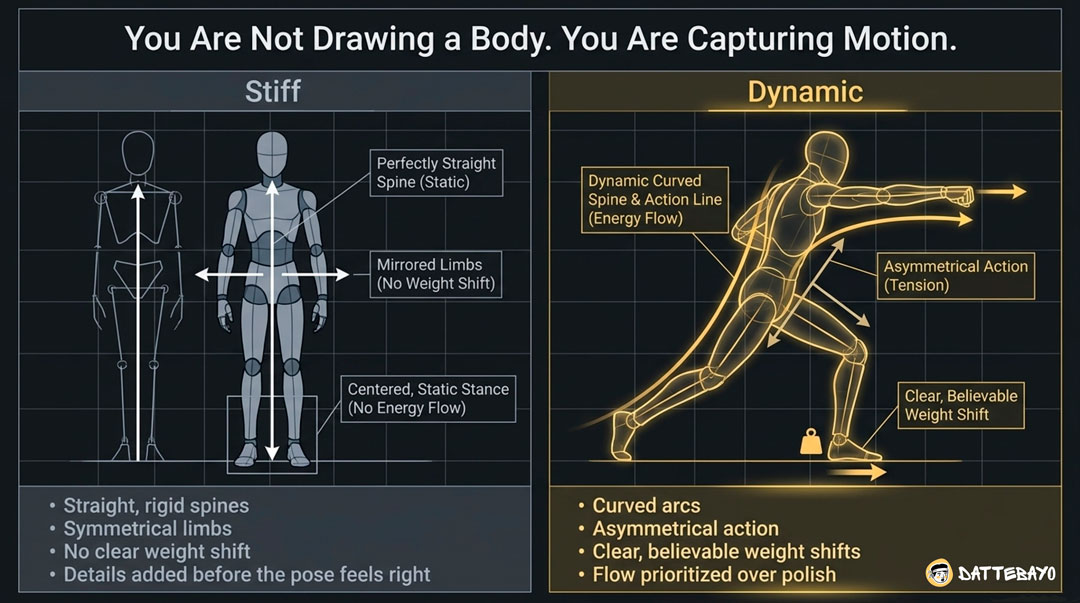
Stiffness usually shows up as:
- Straight, rigid spines
- Symmetrical limbs doing similar things
- No clear weight shift
- Details added before the pose feels right
Dynamic poses feel like they’re caught mid-action. That sense of life comes from flow, not polish.
If your pose doesn’t feel alive as a rough sketch, no amount of detail will fix it later.
At Dattebayo, this is one of the biggest mindset shifts: you’re not drawing a body—you’re capturing motion.
What is the line of action (and why does it fix stiffness fast)?
The line of action is the main curve that carries the energy of a pose. Think of it as the direction of movement, not anatomy.
Stiff poses tend to follow straight vertical lines. Dynamic ones lean into curves—arcs that suggest force, rhythm, or motion.
- Straight line → static or tense
- Curved line → fluid and energetic
Even in intense fight scenes, there’s almost always a dominant flow tying everything together.
Why does drawing details too early hurt your poses?
Detail locks in whatever structure you started with—good or bad. If the base is stiff, details just make that stiffness clearer.
That’s why experienced artists stay loose early on. It’s not about being messy—it’s about staying flexible. Adjusting a simple structure is easy. Fixing a fully rendered drawing isn’t.
Stiff vs Dynamic Pose
What’s the basic workflow for drawing an anime action pose?
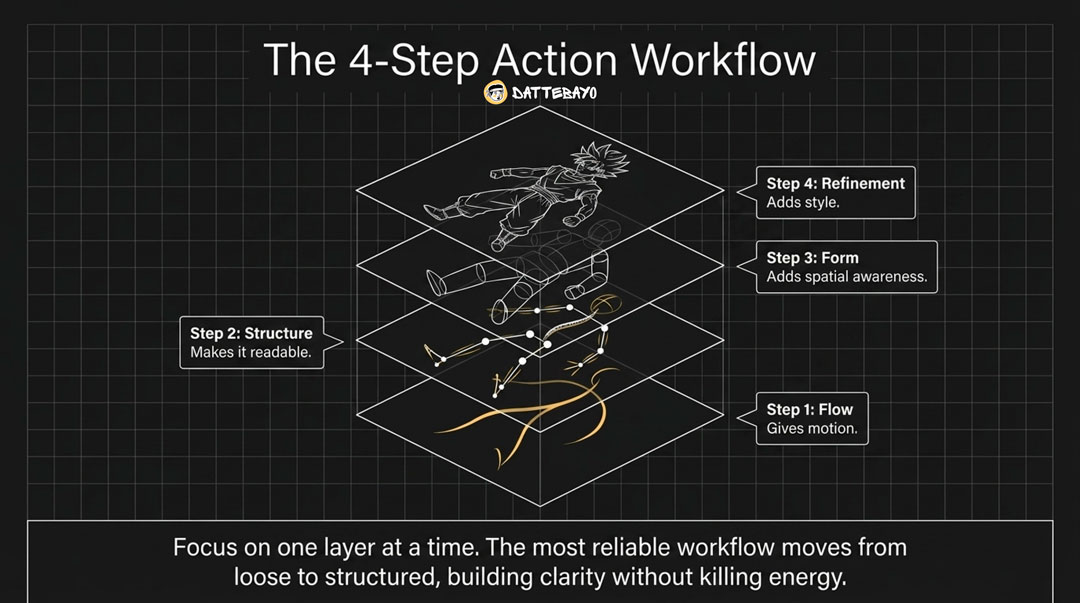
The most reliable workflow moves from loose to structured: flow → structure → form → refinement. Each stage builds clarity without killing energy.
Think of it like layering:
- Flow gives you motion
- Structure makes it readable
- Forms add volume
- Refinement adds style
If you’ve ever felt overwhelmed, this is your anchor: focus on one layer at a time, not everything at once.
How do you capture movement and balance first?
Start with motion, then check if the pose could physically work.
At this stage, you’re not worried about details—you’re asking:
- Where is the weight going?
- Is the character pushing, falling, jumping, or bracing?
- Does it feel stable—or intentionally unstable?
Getting this right early saves you from fixing bigger problems later.
When should you add form and detail?
Only after the pose already works.
Simple 3D shapes help you understand how the body sits in space. Then refinement should support the motion—not distract from it.
If you want a structured way to practice this, Dattebayo’s full course walks through the same progression in a beginner-friendly way
How do you make poses look dynamic instead of flat?
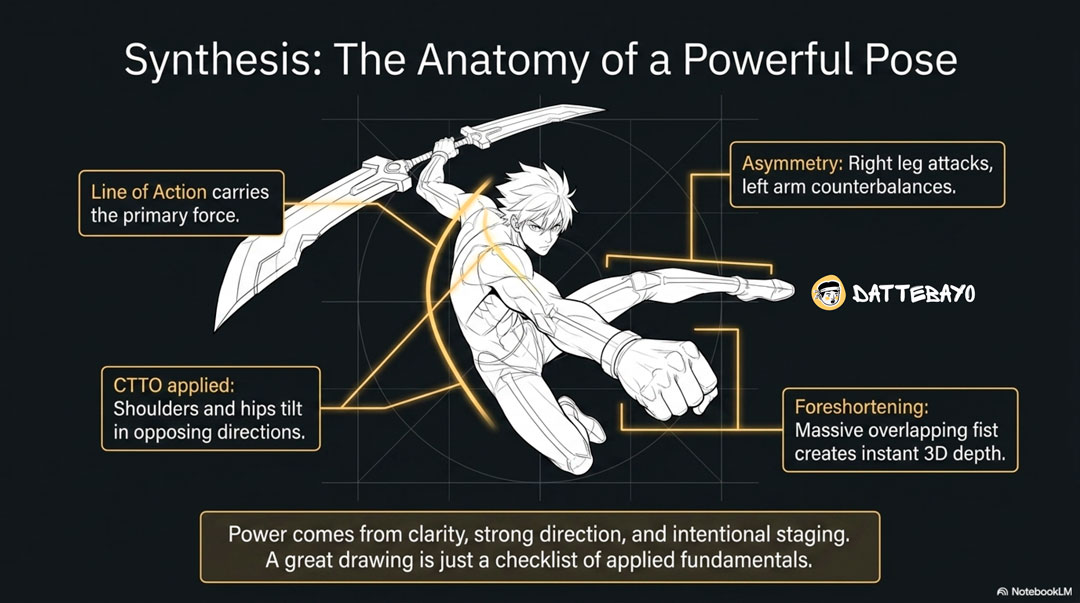
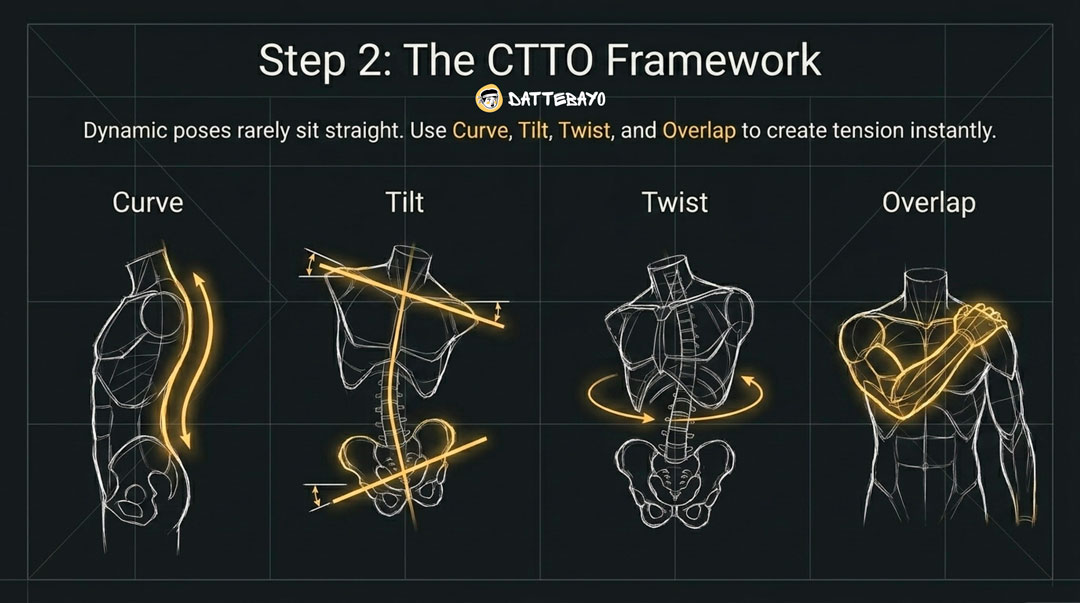
Use curves, tilt, twist, and asymmetry to create direction and energy.
A simple way to remember this is CTTO:
- Curve
- Tilt
- Twist
- Overlap
You don’t need all of them every time, but the more you use them, the more control you gain.
Why do curve, tilt, and twist matter so much?
Because dynamic poses rarely sit straight—they lean, rotate, and spiral.
- Curve: the spine bends instead of staying rigid
- Tilt: shoulders and hips angle differently
- Twist: upper and lower body rotate against each other
These small shifts create tension and movement instantly.
Why does symmetry kill energy?
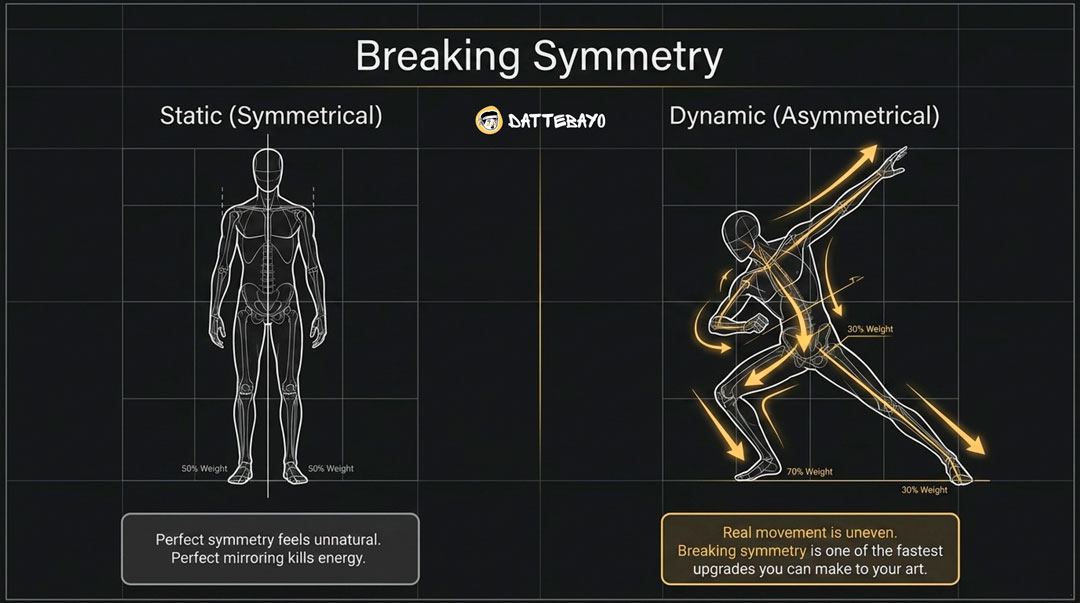
Perfect symmetry feels unnatural and static.
Real movement is uneven:
- One arm leads, the other supports
- One leg carries weight, the other reacts
- One side stretches while the other compresses
Breaking symmetry is one of the fastest upgrades you can make.
How far should you push exaggeration?
Push until it’s clear—stop before it’s confusing.
A quick check:
- Can you read the action instantly?
- Does the silhouette still make sense?
If yes, your exaggeration is doing its job.
How do balance and weight make or break a pose?
A pose feels believable when the weight clearly goes somewhere.
Even in stylized anime, gravity still applies. The viewer should be able to feel what’s holding the character up.
How can you quickly check balance?
Ask: would this character fall if they were real?
If the answer is yes (and that’s not intentional), something’s off.
Look at:
- Foot placement
- Body lean
- Center of gravity
What balance mistakes are most common?
- Feet that don’t feel grounded
- Upright spines in fast movement
- No counterbalance between upper and lower body
Balance doesn’t mean stiffness—it means intentional control.
What is foreshortening (and how do you use it without confusion)?
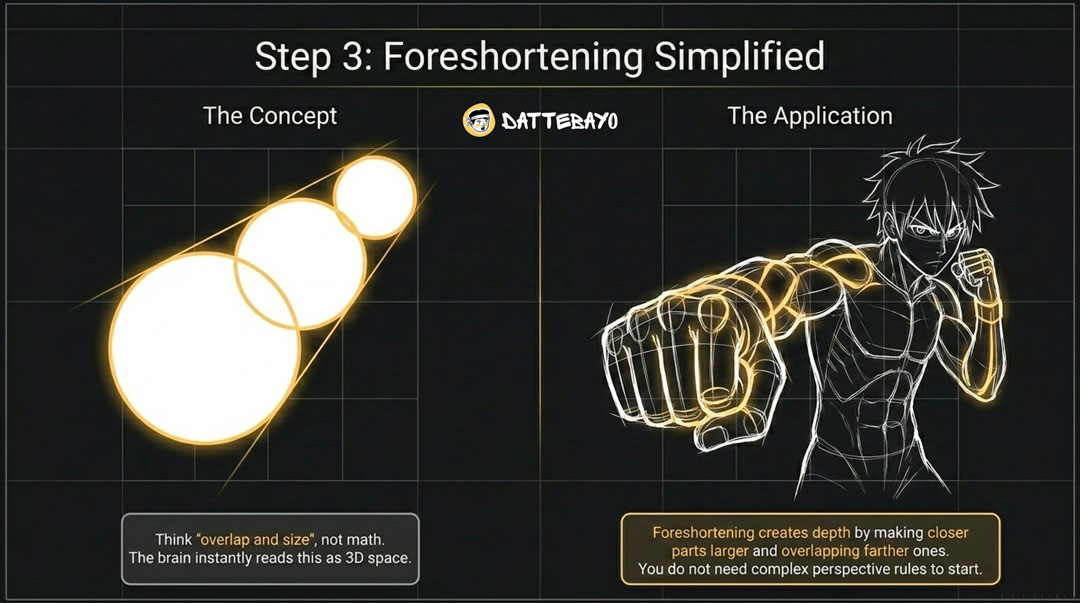
Foreshortening creates depth by making closer parts larger and overlapping farther ones.
You don’t need complex perspective rules to start. Just think visually:
- What’s closer?
- What overlaps?
That alone gets you surprisingly far.
How should you think about foreshortening?
Think “overlap and size,” not math.
If a fist is coming toward the viewer:
- It looks bigger
- It overlaps the arm behind it
That’s enough to sell depth.
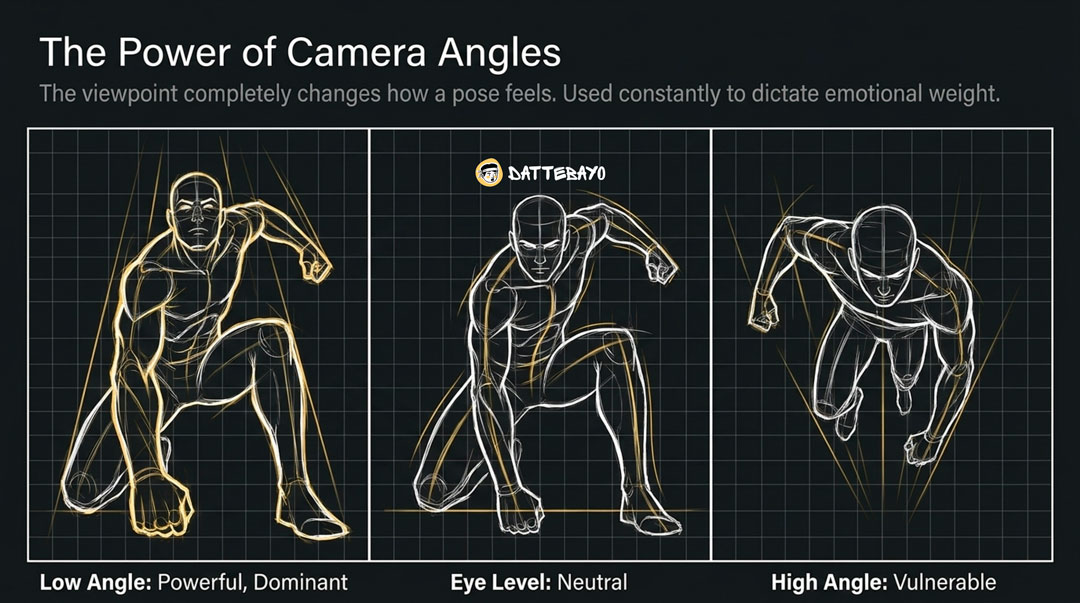
How does camera angle change the pose?
The viewpoint completely changes how a pose feels.
- Low angle → powerful, dominant
- High angle → vulnerable
- Eye level → neutral
You’ll see this used constantly in anime fights and manga panels, and it’s worth studying in modern animation clips or short-form videos.
Do you need anatomy to draw good action poses?
You only need basic structure to start—details can come later.
You don’t need every muscle memorized. Focus on:
- Where joints bend
- How limbs connect
- Basic proportions
That’s enough to create convincing motion.
What anatomy matters most for beginners?
- Joints (shoulders, elbows, hips, knees)
- Limb direction
- Simple torso structure
Why does structure matter more than muscle detail?
Clear structure gives you consistency. Muscles without structure just add noise.
Dattebayo keeps anatomy simple on purpose, so you can actually use it while drawing instead of getting stuck memorizing.
Why do proportions break in action poses (and how do you control them)?
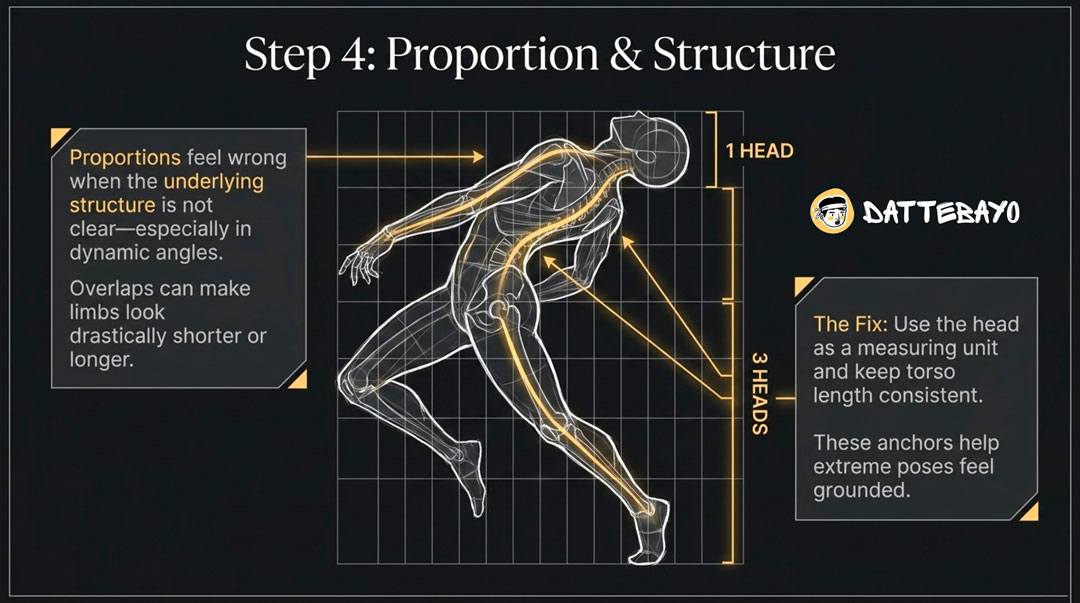
Proportions feel “wrong” when the underlying structure isn’t clear—especially in dynamic angles.
When poses tilt, twist, or come toward the viewer, your usual rules feel unreliable. They’re not broken—you just need better anchors.
When are “wrong” proportions actually correct?
Foreshortening can make limbs look shorter or longer than usual.
That’s not an error—it’s perspective doing its job.
The real question is:
- Is everything consistent with the same viewpoint?
- Do overlaps make sense?
How do you keep proportions stable?
- Use the head as a measuring unit
- Keep torso length consistent
- Check limb relationships before refining
These anchors help even extreme poses feel grounded.
Should you use references or draw from imagination?
Use references to understand movement—then adapt them.
There’s a big difference between copying and learning. The goal is to build a mental library of motion you can reuse.
How do you study references without copying?
Think in a simple flow:
- Observe → simplify → exaggerate
You’re extracting the idea of the pose, not tracing it.
Where can you find good pose references today?
- Short-form videos (great for slow-motion study)
- Sports footage (natural, powerful movement)
- Pose libraries and apps
Even casual scrolling can turn into useful practice if you focus on how bodies move.
Common mistakes that instantly ruin action poses
Most problems come from a few repeat patterns.
What should you watch out for?
- Straight spine
- Equal limb angles
- No weight shift
- No overlap
- Too much detail too early
How do you fix a weak pose quickly?
Simplify, then push.
Strip it back to the basics, then rebuild with clearer motion and stronger exaggeration.
How can you practice action poses and actually improve fast?
Short, focused practice beats long, unfocused sessions.
You don’t need hours—you need consistency and intention.
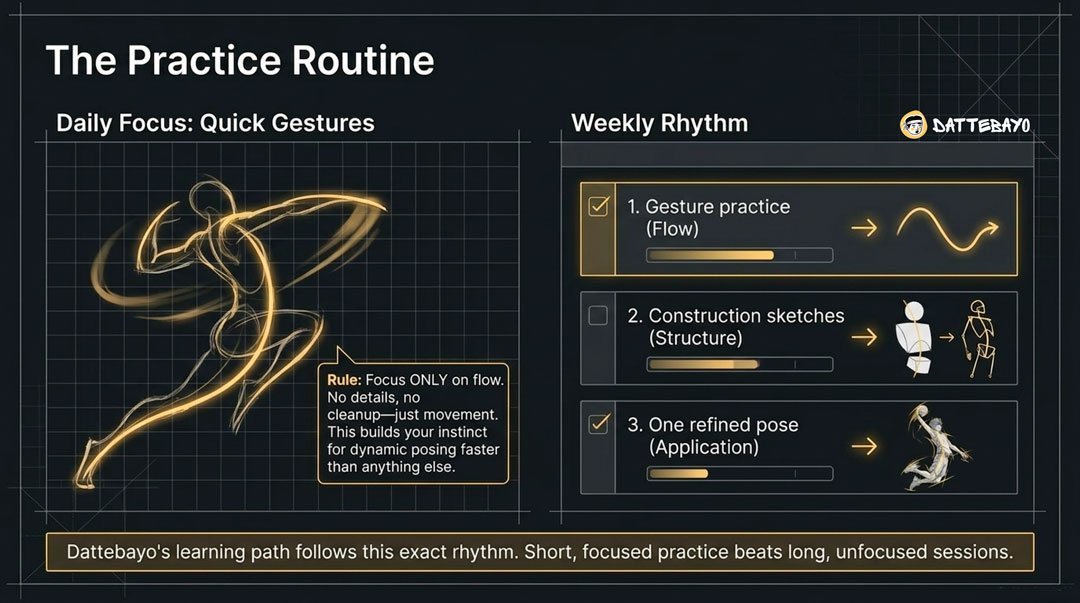
What’s an effective daily practice?
Quick gesture sketches focused only on flow. No details, no cleanup—just movement.
This builds your instinct for dynamic posing faster than anything else.
How do you translate real movement into anime style?
Watch real motion—a jump, a punch, a turn—then reinterpret it with more clarity and exaggeration.
This is how you stylize without losing believability.
What’s a simple weekly routine?
- Gesture practice (flow)
- Construction sketches (structure)
- One refined pose (application)
Dattebayo’s learning path follows a similar rhythm, helping you improve steadily without burnout.
How to make action poses feel powerful, not just dynamic
Power comes from clarity, strong direction, and intentional staging—not just exaggeration.
A pose can be dynamic but still feel weak if the action isn’t clear.
What makes a pose feel strong?
- Clear direction
- Grounded weight
- Readable silhouette
What makes a pose feel weak?
- Unclear action
- Floating limbs
- Messy overlap
How do anticipation and follow-through help?
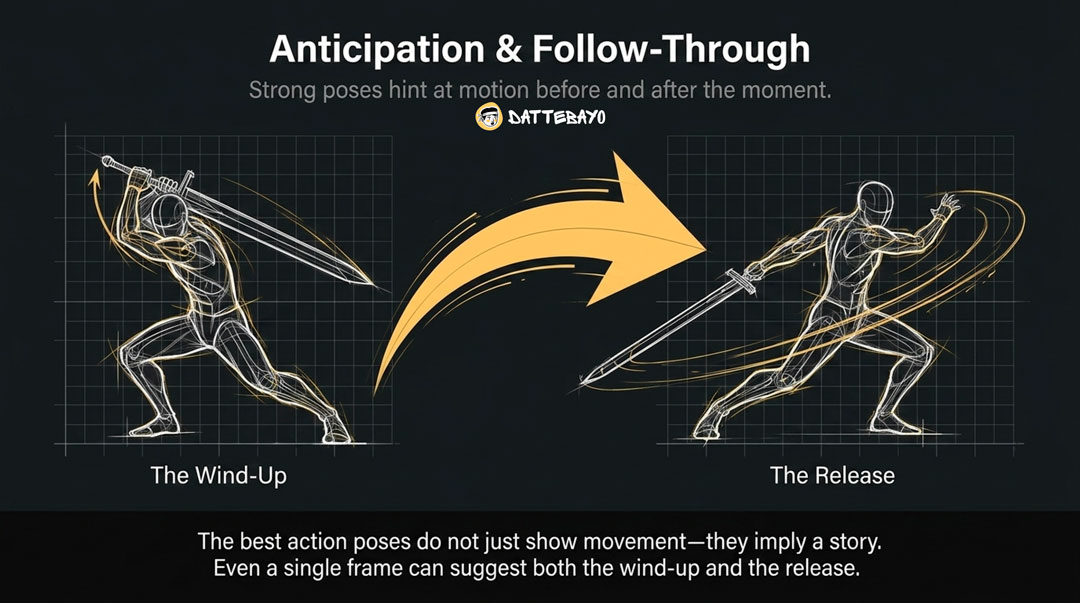
Strong poses hint at motion before and after the moment.
- Anticipation: the wind-up
- Follow-through: the release
Even a single frame can suggest both.
The best action poses don’t just show movement—they imply a story.
FAQ
Why do my anime action poses still look stiff even when I use references?
You’re likely focusing on surface details instead of the underlying motion. Start with the line of action.
What’s the fastest way to improve action poses daily?
Short gesture sessions focused on flow, not detail.
How do you draw fighting or combat poses in anime?
Think in terms of force, direction, and impact—not just anatomy.
What makes a pose look powerful instead of weak?
Clear weight distribution, strong angles, and a readable silhouette.
How do you avoid flat-looking poses?
Use overlap, foreshortening, and varied camera angles.
Can beginners draw dynamic poses without gesture drawing?
Yes—but gesture is the fastest way to build flow.
Why do my poses look off even when proportions seem correct?
It’s usually a balance or perspective issue.
How do I know if I exaggerated too much?
If the pose becomes hard to read at a glance, pull it back slightly.