
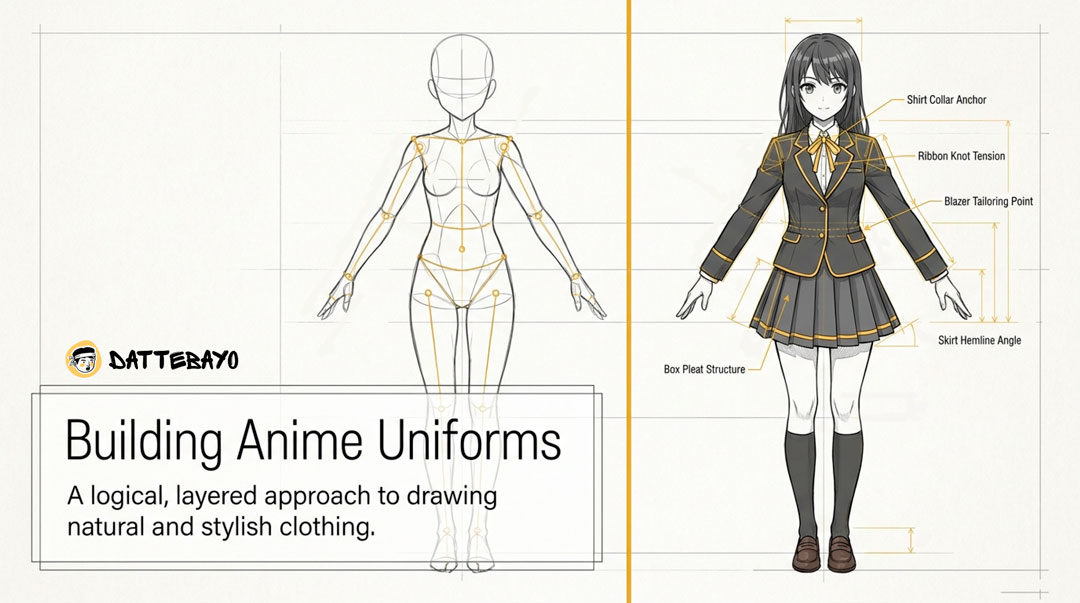
A simple way to approach drawing an anime school uniform (without overthinking it)
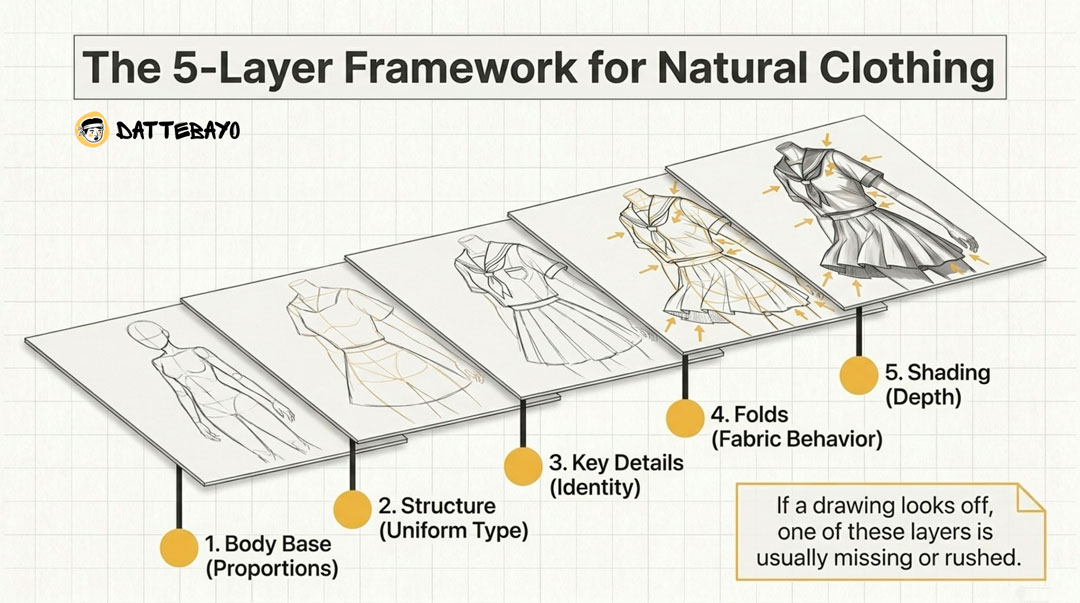
Think in layers: body → structure → key details → folds → simple shading. This keeps your drawing clear instead of overwhelming.
A common beginner mistake is trying to draw the whole outfit at once. That’s when things start to look stiff or inconsistent. Instead, treat clothing like something built on top of the body, not separate from it.
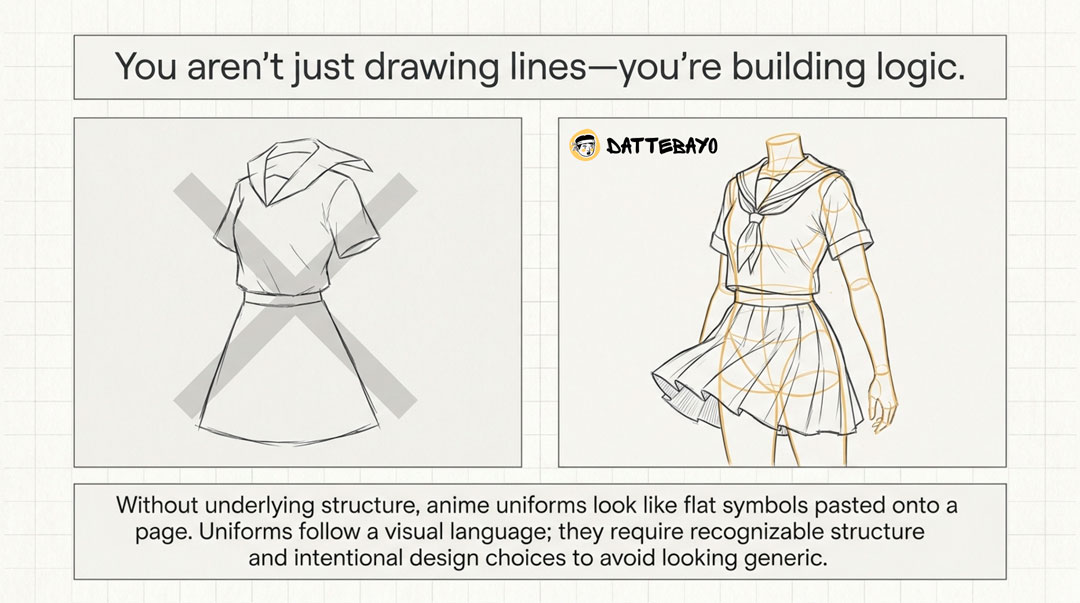
You’re not just drawing lines—you’re building logic.
- Body base sets proportion and balance
- Structure defines the type of uniform
- Details (collar, ribbon, seams) give identity
- Folds show how the fabric behaves
- Shading adds depth
If something looks off, one of these layers is usually missing or rushed.
What makes an anime school uniform look “correct” instead of random clothes?
It comes down to recognizable structure and intentional design choices.
Anime uniforms follow a visual language. Even when stylized, they rely on consistent elements like distinct collars, clear silhouettes, and balanced proportions. Without those, it just looks like generic clothing.
Core pieces every anime school uniform is built from
Most designs come down to three parts:
- Top: sailor uniform, blazer, or gakuran
- Bottom: pleated skirt or straight pants
- Accessories: ribbon, tie, socks, bag, or crest
These aren’t extras—they’re what make the outfit instantly readable.
Why small details (like collars and ribbons) matter so much
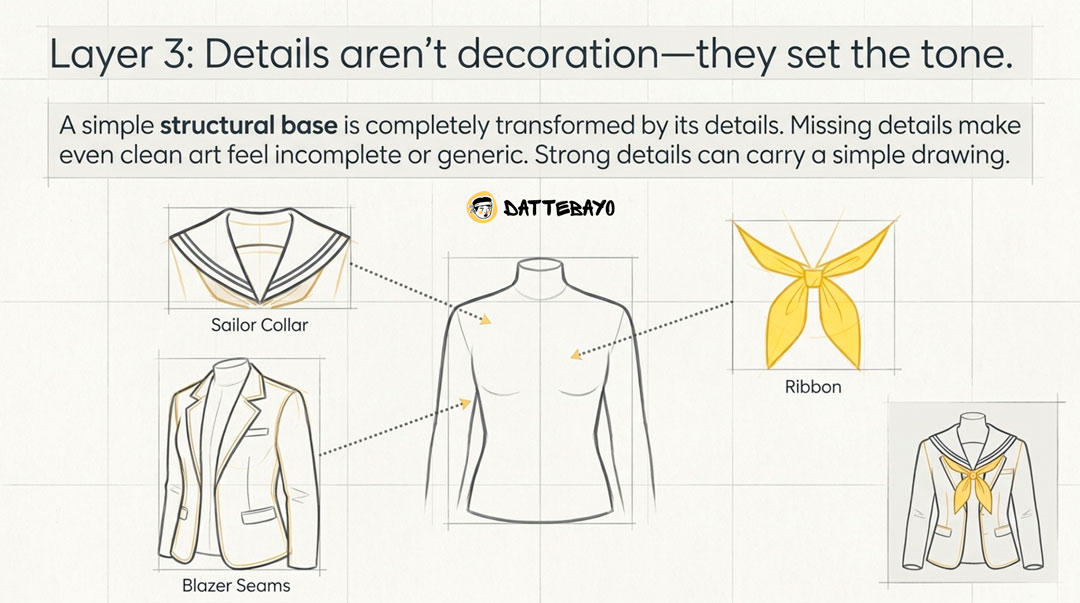
Details define the identity of the uniform.
A sailor collar or ribbon isn’t decoration—it sets the tone of the entire design. If you simplify too much and lose these, the drawing feels generic.
Strong details can carry a simple drawing. Missing details make even clean art feel incomplete.
This kind of structural thinking is exactly what platforms like Dattebayo emphasize—understanding why designs work, not just copying them.
Do you need to understand the body before drawing the uniform?
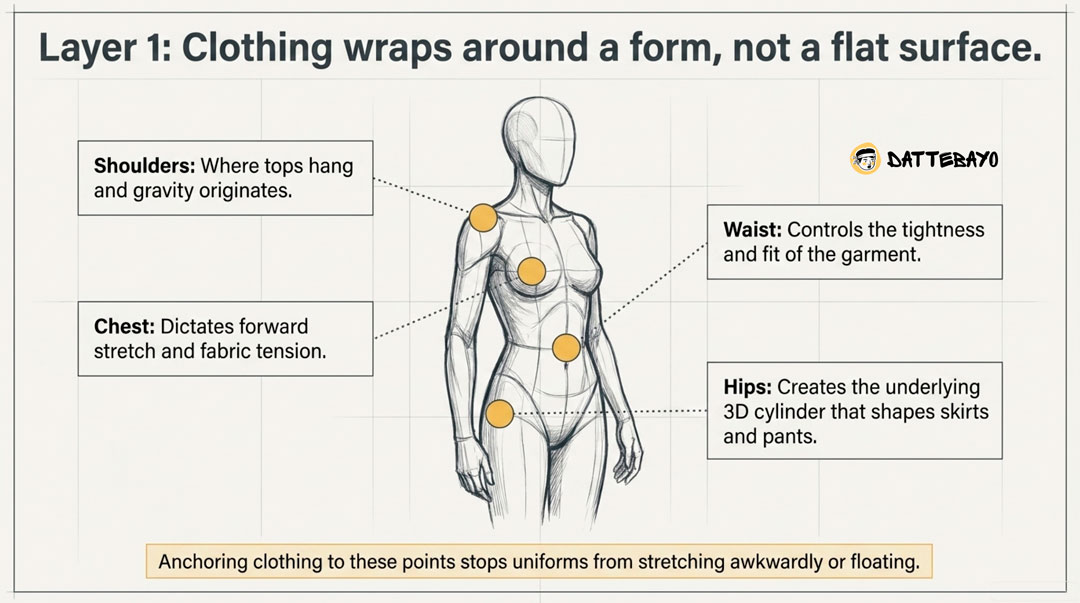
Yes—because clothing wraps around a form, not a flat surface.
Even a basic grasp of proportions makes a huge difference. Without it, uniforms tend to float, stretch awkwardly, or feel pasted on.
Where uniforms sit on the body (key anchor points)
Clothing naturally attaches to:
- Shoulders (where tops hang)
- Chest (affects stretch and tension)
- Waist (controls fit)
- Hips (shape skirts and pants)
When you place clothing with these in mind, everything feels more grounded.
Why beginners’ uniforms look stiff
Because they’re drawn as flat symbols instead of 3D forms.
Typical issues:
- Skirts drawn as flat triangles
- Collars ignoring the neck’s shape
- Fabric not wrapping around the torso
The fix isn’t adding detail—it’s understanding form. If this feels tricky, reviewing basics like anime body proportions can make everything click faster.
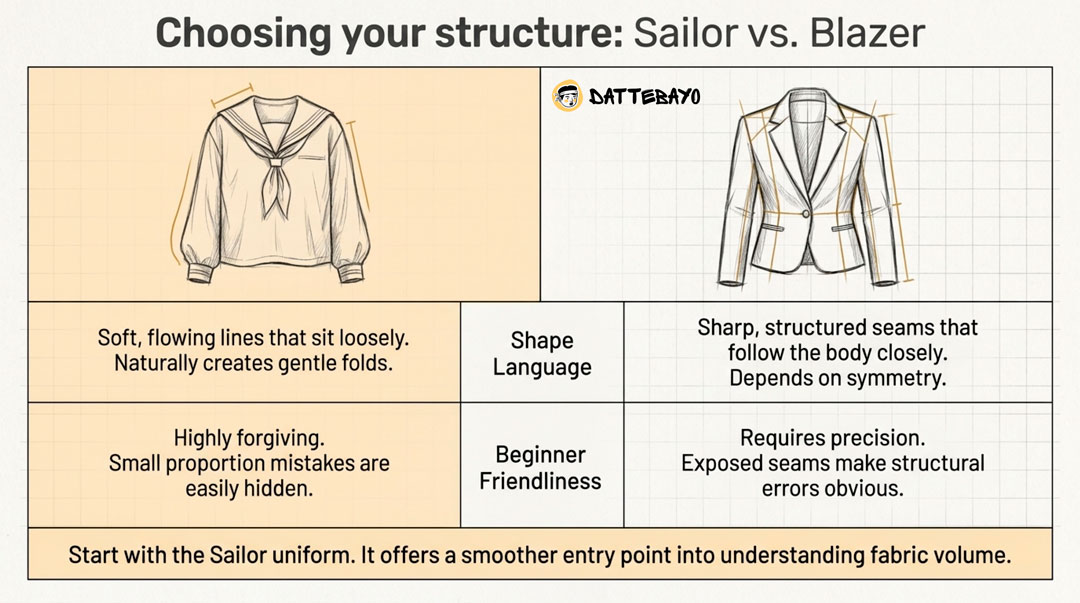
What’s the difference between sailor and blazer uniforms (and which is easier)?
Sailor uniforms are more forgiving; blazers require precision.
How sailor uniforms create soft, flowing shapes
Sailor uniforms:
- Sit loosely on the body
- Use softer, simpler lines
- Naturally create gentle folds
They’re great for beginners because small mistakes are less noticeable.
How blazer uniforms rely on structure and clean lines
Blazers:
- Follow the body more closely
- Have defined seams and edges
- Depend on symmetry and proportion
They look sharp—but also expose mistakes more easily. Gakuran uniforms are even more rigid.
If you’re just starting, sailor uniforms are usually the smoother entry point.
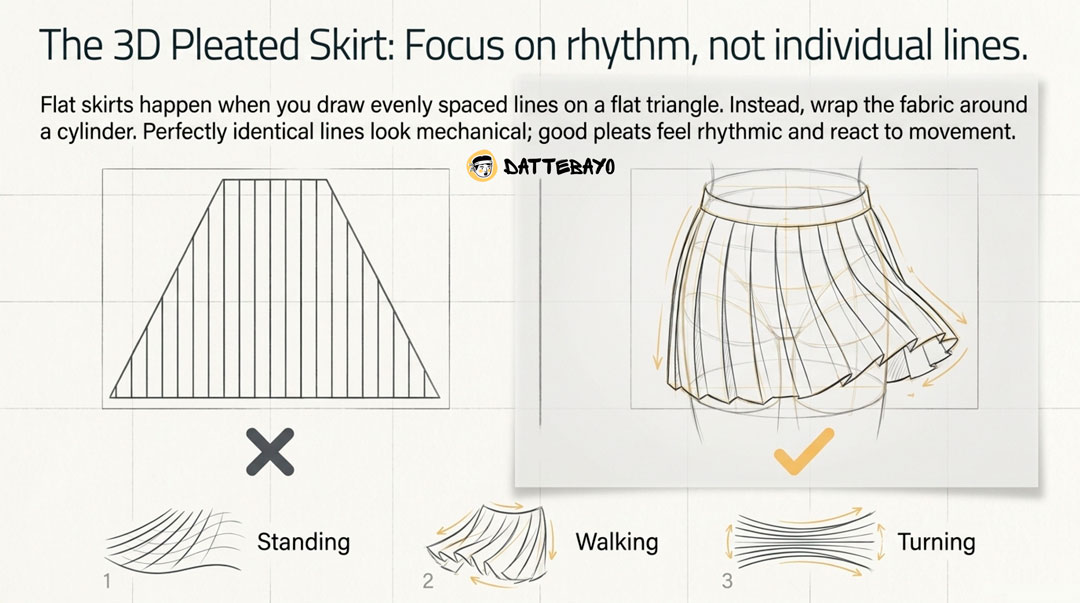
How to draw pleated skirts that don’t look flat or awkward
Focus on rhythm and volume, not individual lines.
Pleated skirts aren’t complicated—they just need to feel three-dimensional.
Why your skirt looks flat (and how to fix it)
Flat results usually come from:
- Straight, evenly spaced lines
- Ignoring the body’s roundness
- No overlap or depth
Instead, think of the skirt wrapping around a cylinder (the hips). The lines should subtly curve.
How pleats behave when the character moves
Pleats react to motion:
- Standing still → even and calm
- Walking → slight swing and overlap
- Turning → compressed on one side, stretched on the other
Good pleats feel rhythmic. Perfectly identical lines look mechanical.
How do you draw folds without overcomplicating them?
Place folds where tension exists—and stop there.
More folds don’t mean better drawings. In anime style, they often just create clutter.
Where folds naturally appear in school uniforms
Look for tension points:
- Elbows
- Waist
- Under collars
- Top of skirts
These areas tell the story of how the fabric behaves.
Why fewer folds often look better in anime style
Anime simplifies reality. A few intentional folds communicate more than dozens of random ones.
Focus on:
- Why the fold exists
- The direction it flows
- How it connects to the body
This “clarity over complexity” approach is a core idea in Dattebayo’s teaching style.
Why does your uniform look flat or lifeless?
Because the lighting isn’t clear or consistent.
Shading should support form, not overwhelm it.
Where to place shadows for instant depth
Start with obvious areas:
- Under the collar
- Beneath the chin
- Inside folds
- Under skirt layers
These quickly add dimension.
Common shading mistakes beginners make
- Shading everything equally
- Ignoring light direction
- Ignoring light direction
Pick one light source and stick to it. Simple and consistent always wins.
If you need a refresher, even basic shading fundamentals can help you stop guessing.
Common mistakes that make anime uniforms look “off”
Most issues come from weak structure or too much (or too little) detail.
Oversized collars, flat skirts, and floating clothing
- Oversized collars: throw off balance
- Flat skirts: ignore volume
- Floating clothing: not anchored to the body
These break the illusion quickly.
Too many details vs not enough structure
This is a common trap:
- Too many details → messy
- Not enough structure → bland
The goal is simple structure with selective detail.
Should you use references or draw from imagination?
Use references first—then simplify them into memory.
Jumping straight into imagination usually leads to guesswork.
How to study uniforms without copying
Focus on:
- Shapes instead of lines
- Proportions instead of decoration
- Patterns across designs
You’re learning how uniforms work, not memorizing one drawing.
When to start drawing from imagination
You’re ready when:
- You can recall basic structures
- You know where key elements go
- Your drawings feel consistent
This observe → simplify → internalize → create cycle is central to how Dattebayo teaches beginners.
How can you design your own anime school uniform?
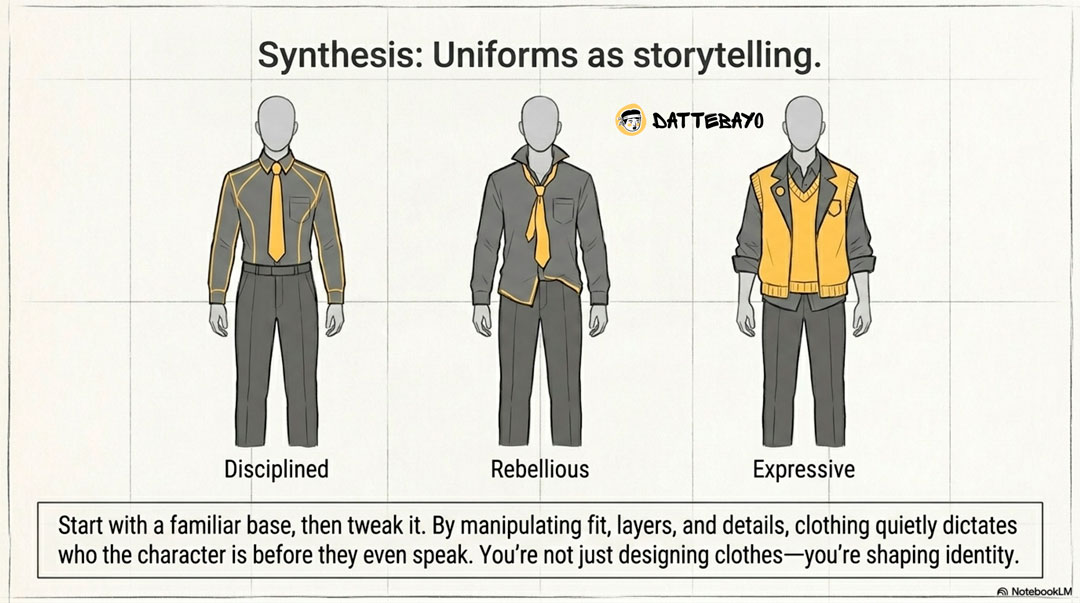
Start with a familiar base, then tweak it.
Trying to invent everything from scratch often leads to confusion. Build on what already works.
Easy ways to personalize a uniform
- Change the color palette
- Your drawings feel consistent
- Adjust the ribbon or tie
- Include small accessories
Small changes can make a design feel unique.
How uniforms reflect personality
Clothing can quietly tell a story:
- Clean and fitted → disciplined
- Loose or messy → relaxed or rebellious
- Layered and accessorized → expressive
You’re not just designing clothes—you’re shaping character identity.
What to remember when drawing anime school uniforms
Build from structure, keep details intentional, and think in layers.
- Start with the body
- Choose a clear uniform type
- Use key details for identity
- Add purposeful folds
- Apply simple, consistent shading
You don’t need to master everything at once—just improve each layer a little at a time.
FAQ
How do you draw pleated skirts in anime style?
Focus on curved volume and rhythm instead of straight, evenly spaced lines.
Why does my anime skirt look flat instead of flowing?
You’re likely ignoring the body’s round form and drawing pleats too rigidly.
How tight should an anime school uniform be?
It depends—sailor uniforms are looser, while blazers are more fitted but not tight.
How do I draw school uniforms in different poses?
Follow the body first, then adjust folds and skirt direction based on movement.
Why does my uniform look off even when I use references?
You may be copying details without understanding structure.
Do I need to memorize real Japanese uniforms?
No—focus on core elements, then simplify and stylize.
What’s the easiest uniform style for beginners?
Sailor uniforms are usually the most forgiving.
How do I avoid making clothing look stiff?
Build on the body and use fewer, more intentional folds.