
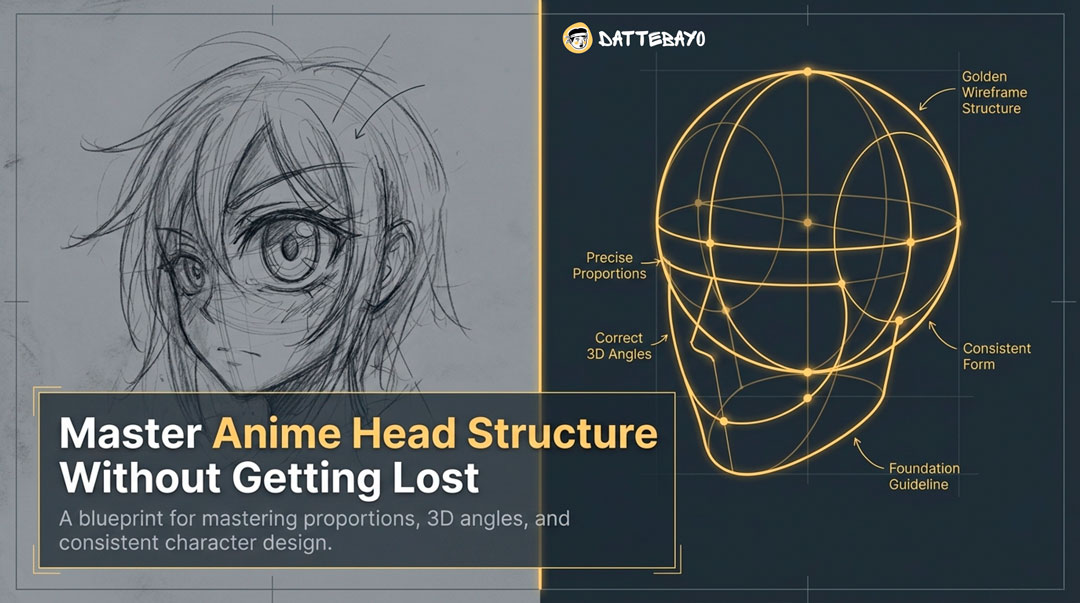
If drawing anime heads feels confusing, it’s usually not a lack of skill—it’s a missing mental model. Once you understand the underlying structure, everything else (eyes, expressions, angles) becomes more predictable and easier to control.
This guide isn’t about copying a perfect head. It’s about helping you understand what you’re doing so you can draw confidently from any angle, in your own style.
What’s the basic structure of an anime head?
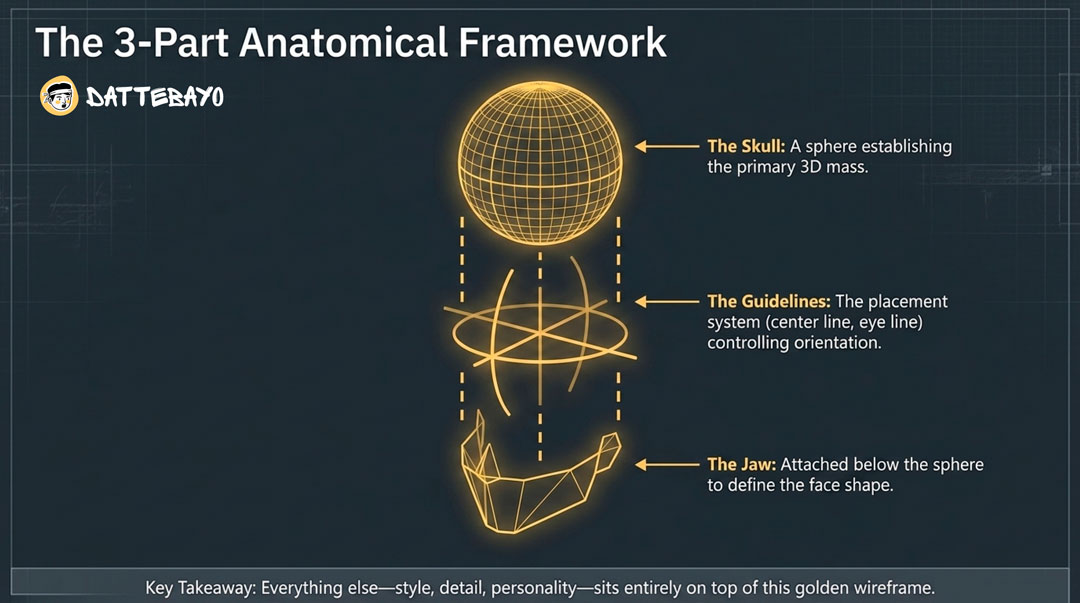
An anime head is built from three simple parts: a sphere for the skull, a jaw attached below it, and guidelines that control feature placement.
Everything else—style, detail, personality—sits on top of that.
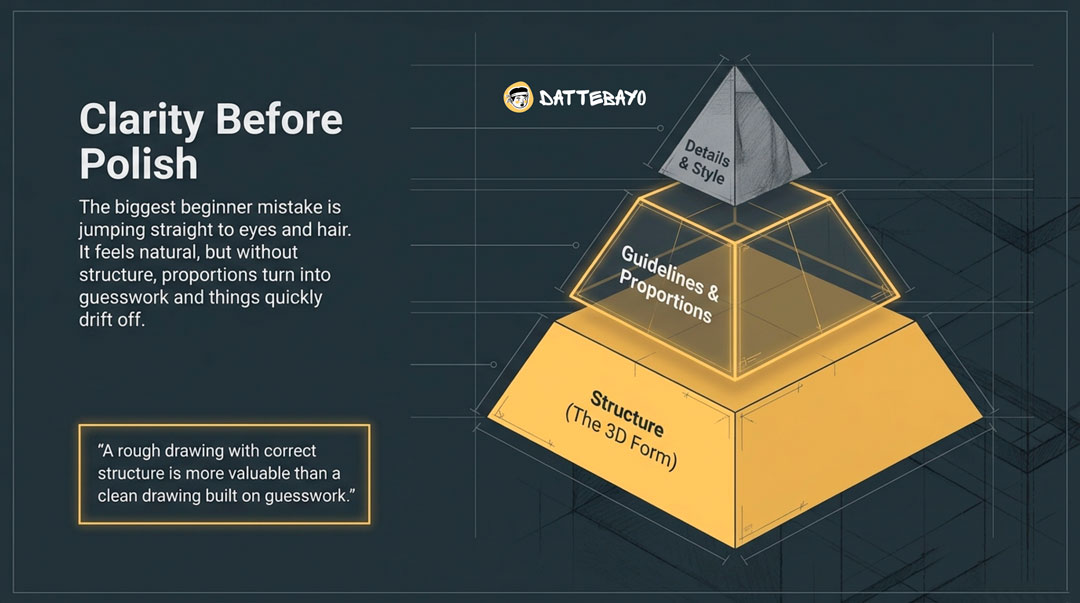
A common beginner mistake is jumping straight into eyes and hair. It feels natural, but without structure, proportions turn into guesswork and things quickly drift off.
Think of it as a simple hierarchy:
- Structure → the 3D form (sphere + jaw)
- Guidelines → the placement system (center line, eye line)
- Proportions → spacing between features
Keep that order in mind, and your drawings will hold together much more reliably.
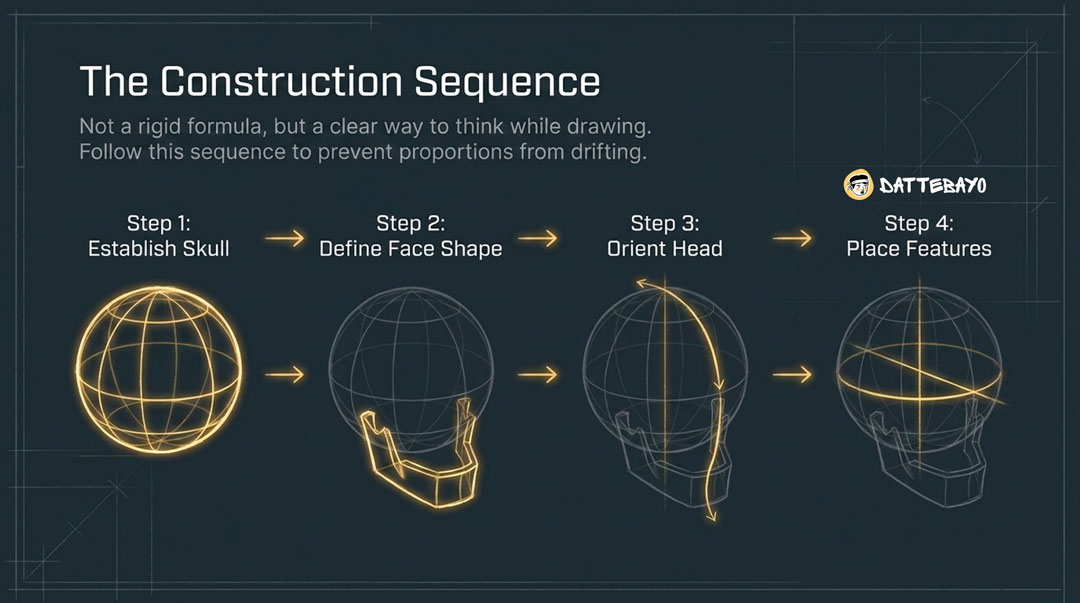
A useful mental flow:
- Establish the skull (sphere)
- Define the face shape (jaw)
- Orient the head (center line)
- Place features using consistent spacing
Not a rigid formula—just a clear way to think while drawing.
The simple drawing flow beginners should follow
Start with structure, not details. That one shift solves most beginner issues.
Trying to fix a drawing after adding details is frustrating. If the base is off, no amount of polishing will really fix it.
Instead, keep asking yourself:
- Where is the head facing?
- Does the skull feel solid?
- Is the jaw connected properly?
Then add features.
Why structure matters more than detail
Strong structure makes everything easier later.
Compare two approaches:
- One starts with detailed eyes
- The other starts with a rough sphere and guidelines
The second almost always ends up more accurate—even if it looks messy early on.
A rough drawing with correct structure is more valuable than a clean drawing built on guesswork.
At Dattebayo, this idea comes up often: clarity before polish. You’re building understanding first, not trying to make something look finished right away.
Where do the eyes, nose, and mouth actually go?
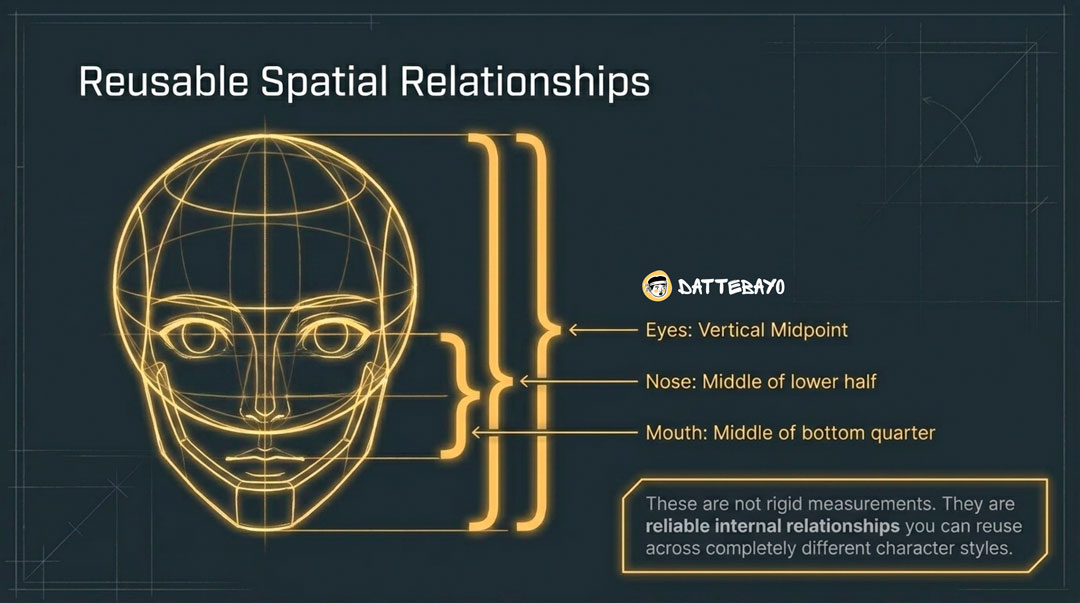
The eyes usually sit around the vertical midpoint of the head, with the nose and mouth spaced below using simple relationships.
This often feels wrong at first. Most beginners place the eyes too high because they underestimate how much skull sits above them.
A reliable way to think about placement:
- Eyes: around the vertical middle
- Nose: between eyes and chin
- Mouth: between nose and chin
These aren’t exact measurements—they’re relationships you can reuse across drawings.
If you want to go deeper into eye design, this guide to anime eye fundamentals pairs naturally with head structure.
Why beginners place the eyes too high
Because the cranium gets ignored.
The top of the head isn’t just hair—it’s part of the skull. When that space is missing, everything shifts upward.
That leads to:
- A cramped face
- A missing forehead
- An overly long jaw
A quick check while drawing
- Is there enough space above the eyes?
- Does the head still feel like a full sphere?
A quick self-check for correct proportions
You don’t need to guess—you can verify.
Pause and look for:
- Are the eyes near the vertical midpoint?
- Is the center line aligned properly?
- Does the jaw feel too long or too short?
- Are both eyes sitting on the same level?
These small checks prevent bigger problems later.
Why do anime head proportions feel so inconsistent?
Because anime simplifies reality—but it still follows internal rules.
It’s not random. It’s stylized.
Beginners often mix up:
- Stylization → simplifying reality intentionally
- Exaggeration → pushing features beyond realism
Anime uses both—but always on top of a solid structure.
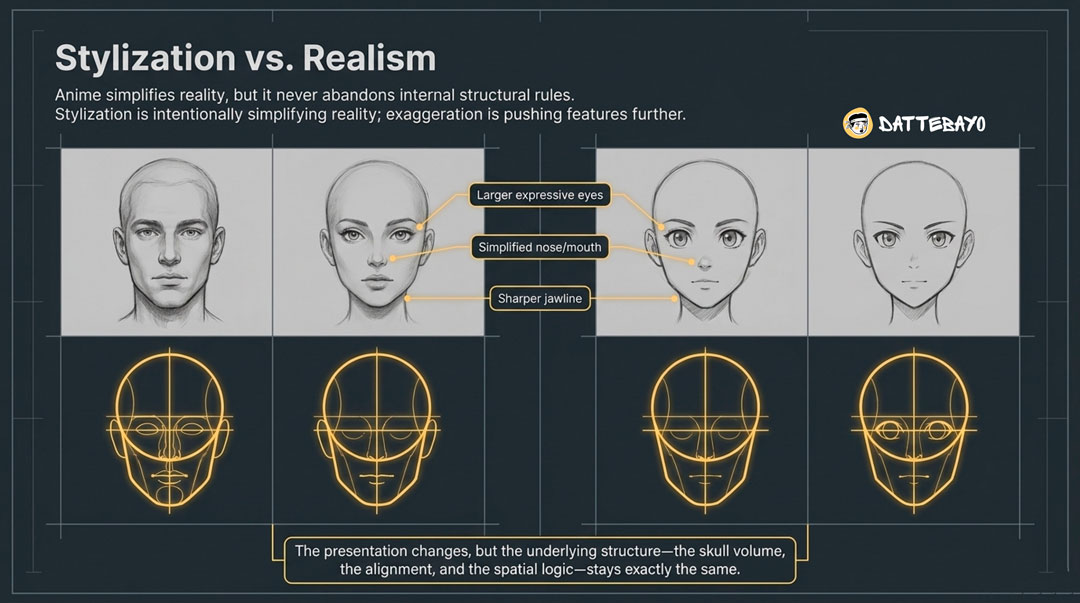
Anime vs realistic heads (what actually changes)
The structure stays the same. The presentation changes.
Common differences:
- Larger, more expressive eyes
- Simplified nose and mouth
- Cleaner, sharper jawlines
But underneath:
- Same skull
- Same alignment
- Same spatial logic
That’s why learning structure once carries across styles.
The hidden consistency across anime styles
Even very different styles follow similar placement rules.
Whether it’s a soft slice-of-life design or a sharp shonen character:
- Eyes align consistently
- Features stay centered
- The head reads as a 3D form
Style works best when it sits on top of something stable.
What are the most common mistakes when drawing anime heads?
Most issues come from broken structure—misplaced features, weak symmetry, or ignoring 3D form.
Here are the ones that show up most often.
Eyes that don’t line up (symmetry problems)
If the eyes feel off, it’s usually a guideline issue—not an eye issue.
Typical causes:
- One eye higher than the other
- Unintentional size differences
- Misaligned angles
Fix the guideline, not just the eye.
The “flat head” problem
If the head looks flat, the sphere isn’t doing its job.
This happens when:
- The back of the skull is missing
- The face is treated like a flat surface
Think in volume, not outlines.
A drifting center line (and why it breaks everything)
The center line shows where the face is pointing. If it’s off, everything feels disconnected.
Even well-drawn features won’t sit correctly without it.
Check:
- Does the center line curve naturally?
- Does it pass through the nose and chin?
Skipping construction lines too early
Drawing clean too soon removes flexibility.
It might feel satisfying, but it makes corrections harder.
At Dattebayo, this is taught early: rough is smart. Clean comes later.
How do you draw anime heads from different angles?
Treat the head as a 3D form and rotate it—don’t memorize separate drawings.
Memorizing angles works short-term, but it doesn’t scale.
Instead, think:
- The sphere rotates
- The center line curves with it
- The features follow that rotation
What changes in a 3/4 view (simple breakdown)
Nothing new is added—the same structure is just rotated.
You’ll notice:
- The center line curves across the face
- One side becomes narrower
- The far eye appears slightly compressed
It’s the same system, seen from a different angle.
Why memorizing angles slows you down
Because it replaces understanding with repetition.
You might get comfortable with one angle, then struggle with others.
Understanding lets you adapt. Memorization limits you.
A better way to practice angles
Draw the same head from multiple directions.
This builds:
- Spatial awareness
- Consistency
- Confidence
If you want structured practice, Dattebayo’s anime drawing course focuses on rotating forms instead of copying poses, which makes a big difference over time.
How should you use references without becoming dependent on them?
Use references to understand patterns—not to copy lines.
They’re most useful when you stay active while observing.
The difference between copying and learning
Copying captures appearance. Understanding captures structure.
- Copying: “What does this look like?”
- Learning: “Why does this work?”
Only one helps you draw without a reference later.
A simple reference practice method
Observe → simplify → redraw from memory.
Instead of tracing:
- Identify the sphere and jaw
- Notice feature placement
- Rebuild it without looking
You can explore more practice approaches at Dattebayo, where reference use is treated as a skill, not a shortcut.
Do male, female, and child anime heads follow different rules?
They share the same base structure—differences come from proportions and shape.
You don’t need separate systems.
How proportions change with age (child vs teen vs adult)
Younger characters have larger craniums and smaller lower faces.
Typical patterns:
- Children: bigger head, softer shapes, lower facial features
- Teens: more balanced proportions
- Adults: longer faces, more defined structure
Male vs female differences (kept simple)
It’s mostly about shape, not structure.
- Male: sharper jaw, more angular features
- Female: softer lines, smoother transitions
Keep it subtle—small shifts are more convincing than extreme ones.
Do you need special tools to draw anime heads?
No—basic tools are enough. Structure matters more than equipment.
You don’t need anything fancy to improve.
The best simple setup for beginners
- HB pencil
- Any sketch paper
That’s all you need to build solid fundamentals.
When to start inking
Only when your structure is consistent.
If the base isn’t stable, inking just locks in mistakes.
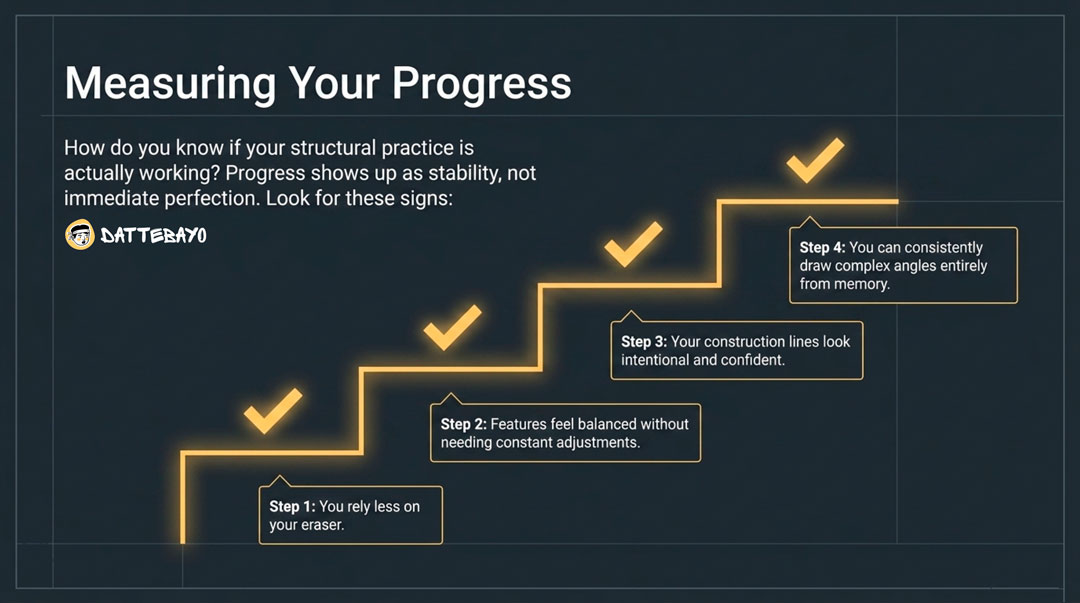
How do you know if your anime head drawings are improving?
You’ll notice more consistency, better proportions, and more confident lines.
Progress shows up as stability, not perfection.
Clear signs you're improving
- Features feel balanced without constant fixing
- You erase less
- Lines look more intentional
- You can draw from memory more often
What to focus on next
Once the basics feel solid:
- Angles and rotation
- Facial expressions
- Full face construction
This is where structured learning helps most. Instead of guessing what to practice next, following a clear path—like the one at Dattebayo—keeps your progress steady.
FAQ
What is the easiest way to start drawing an anime head?
Start with a sphere and jaw, then add guidelines before any features.
Where exactly should anime eyes be placed on the head?
Around the vertical midpoint, aligned along a guideline.
Why does my anime face look flat?
You’re likely ignoring skull volume or not thinking in 3D.
How do you draw a clean anime jawline?
Attach it to the sphere smoothly instead of treating it as a separate shape.
Why do my anime heads look off even with references?
You’re copying shapes instead of understanding structure and alignment.
Do I need to learn real anatomy to draw anime heads?
Basic structure helps, but you don’t need deep anatomy knowledge.
How can I quickly check if my proportions are correct?
Use simple checks: eye line midpoint, centered features, balanced spacing.
How do I draw anime heads from different angles easily?
Rotate the sphere and center line instead of memorizing angles.
What’s the most common beginner mistake?
Misplacing the eyes and skipping construction.
How long does it take to get better at drawing anime heads?
With consistent, structured practice, you can see noticeable improvement within weeks.
If you remember one thing, make it this: structure first, always. Once that clicks, drawing anime heads stops feeling like guesswork—and starts feeling reliable in the best way.