
If you’ve been trying to learn how to draw an anime girl and your faces keep looking slightly off, you’re in very familiar territory. Most beginners don’t struggle because of talent—they struggle because they’re focusing on details before the foundation is solid.
This guide isn’t about copying a finished piece. It’s about understanding why anime faces work so you can create your own characters with confidence.
What should you learn first when drawing an anime girl?
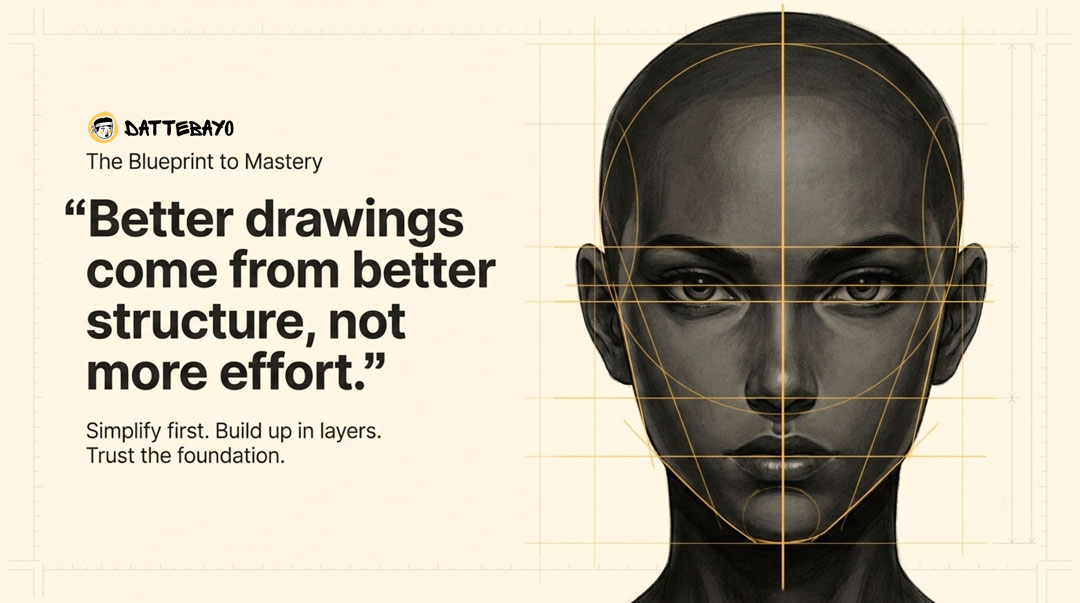
Start with head construction, proportions, and feature placement—these control everything else.
Before worrying about pretty eyes or detailed hair, your priority is understanding how the head is built. Anime may look simple, but it follows a consistent, stylized structure.
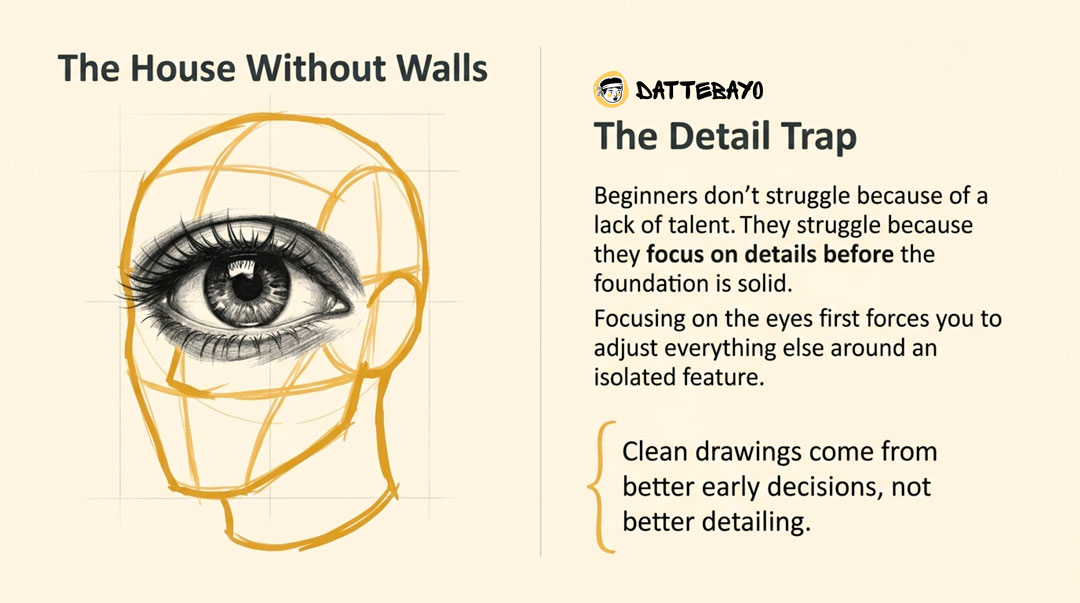
When things feel “off,” it’s usually because details were added before the base was clear. It’s like trying to decorate a house that doesn’t have walls yet.
At its core, drawing an anime girl comes down to:
- The overall head shape
- The direction the head is facing
- Where the features sit
Get those right, and everything else becomes much easier to manage.
Why starting with details slows you down
Focusing on details too early almost always creates imbalance.
It’s tempting to start with the eyes—they’re the most expressive part. But once you draw one eye in isolation, you end up trying to adjust everything else around it.
That’s when problems show up:
- One eye looks better than the other
- The face feels tilted
- Proportions drift without you noticing
This isn’t a lack of skill—it’s just the wrong order.
Clean drawings come from better early decisions, not better detailing.
The 3 fundamentals that fix most drawings
If you keep coming back to these, your progress will speed up quickly:
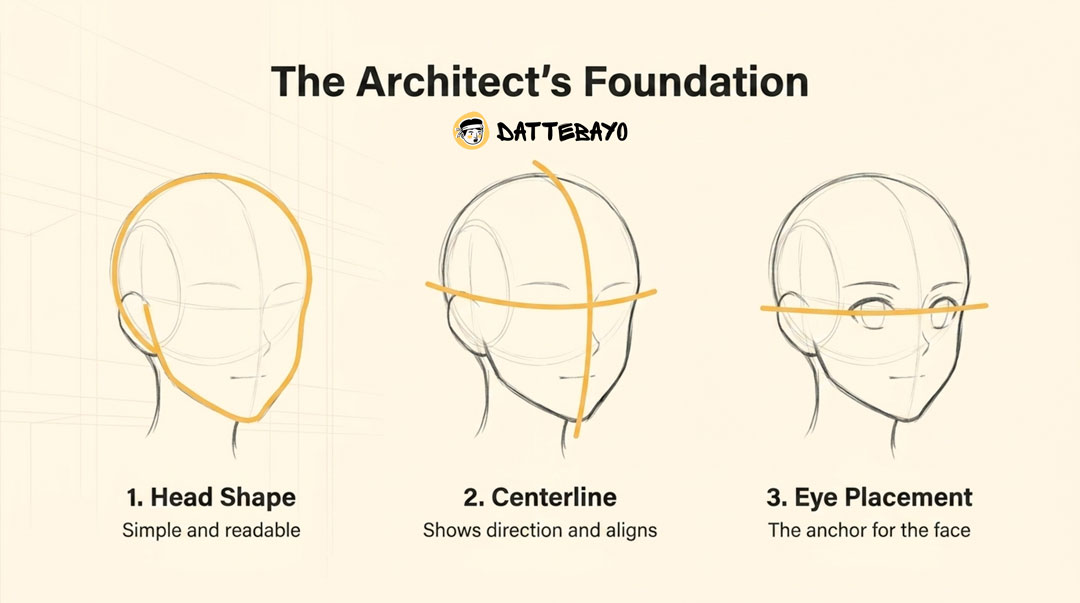
- Head shape – Keep it simple and readable
- Centerline – Shows direction and keeps things aligned]
- Eye placement – Acts as the anchor for the face
These are basic, but they’re often skipped—and that’s exactly why they matter.
Basic face proportions every beginner should know
Anime simplifies reality, but it still follows consistent patterns.
A few helpful anchors:
- Eyes usually sit around the halfway point of the head
- The gap between the eyes is about one eye width
- The face can be loosely divided into thirds
Think of these as guidelines, not strict rules. They help you stay consistent while you’re learning.
If you want to explore this further, this kind of thinking is expanded in resources like this anime face proportions overview.
If you feel stuck, spend a week focusing only on these fundamentals. Structured approaches like Dattebayo are built around exactly this idea—simplify first, then build up.
What is the basic process for drawing an anime girl’s face?
Think in layers: base shape → structure → guidelines → features → hair → clean lines.
Instead of treating drawing like one big task, it helps to see it as a sequence of decisions. Not rigid steps—just a logical order.
A simple construction flow (from blank page to face)
Most drawings naturally move through phases like:
- Establishing a basic head shape
- Defining the jaw or chin
- Adding a centerline for direction
- Placing a guide for the eyes
- Positioning facial features
- Framing everything with hair
Each phase answers a simple question:
- Where is the head?
- Which way is it facing?
- Where do the features go?
You’re not chasing details—you’re solving structure first.
Why this order makes drawing easier
Because it prevents small mistakes from compounding.
When structure is skipped:
- Proportions become guesswork
- You keep correcting things mid-drawing
- Lines start to feel uncertain
When you build in layers:
- Everything stays aligned
- Adjustments are easier
- Your lines look more confident
This shift—from guessing to building—is one of the biggest breakthroughs for beginners, and it’s a core idea behind how Dattebayo teaches drawing.
How are anime girl faces different from realistic faces?
Anime simplifies real anatomy to make characters clearer and more expressive.
It’s not about copying reality—it’s about selecting what matters and simplifying the rest.
What gets simplified (and why it works)
Less detail leads to better readability.
Compared to realistic faces:
- The nose is minimal or implied
- The mouth is small and subtle
- The jawline is smoother
Your brain fills in the missing information, which is why the style feels clean instead of empty.
Why anime eyes are bigger (and not random)
Eyes are emphasized because they carry emotion.
In anime:
- Larger eyes make expressions easier to read
- Simpler shapes keep things clear
- Highlights add life and focus
But exaggeration still needs structure. A common issue is placing the eyes too high or spacing them too far apart.
If you want to connect eye design with expression, studying a focused anime eyes guide can help clarify what actually matters.
Why do anime drawings look “off” even when you copy them?
It usually comes down to misaligned structure, not missing detail.
If something feels wrong but you can’t explain it, there’s almost always an underlying proportion issue.
The hidden role of the centerline
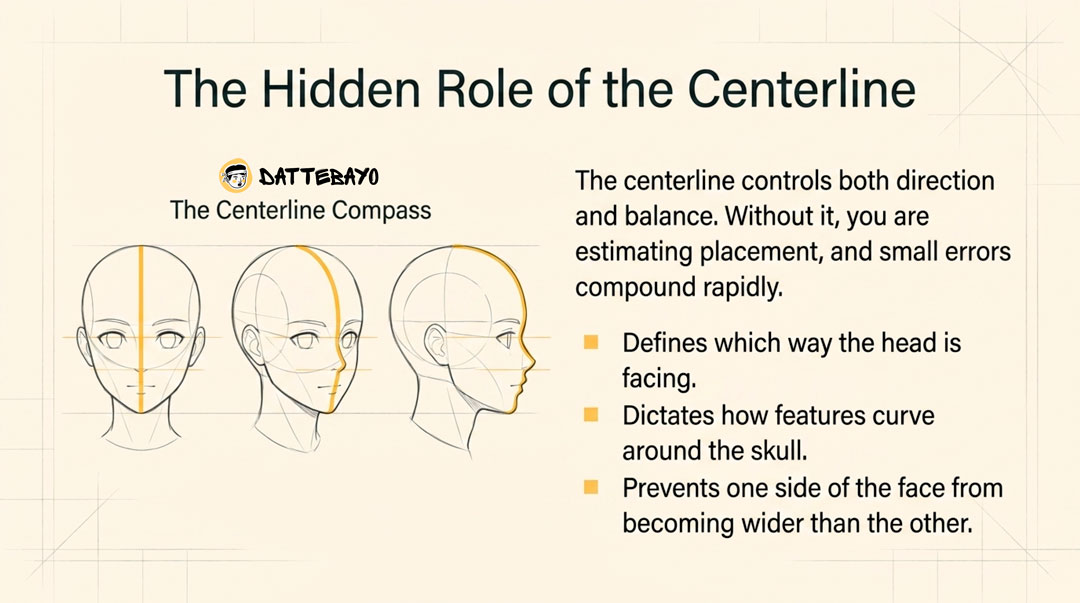
The centerline controls both direction and balance.
It tells you:
- Which way the head is facing
- How features should align
Without it, you’re estimating—and small errors quickly add up.
The most common proportion mistakes
These show up in almost every beginner sketch:
- Eyes at slightly different heights
- One side of the face wider than the other
- Features drifting off-center
- Faces stretched too long or too short
These aren’t random—they’re signs the structure wasn’t clearly defined.
Why light sketching fixes most problems
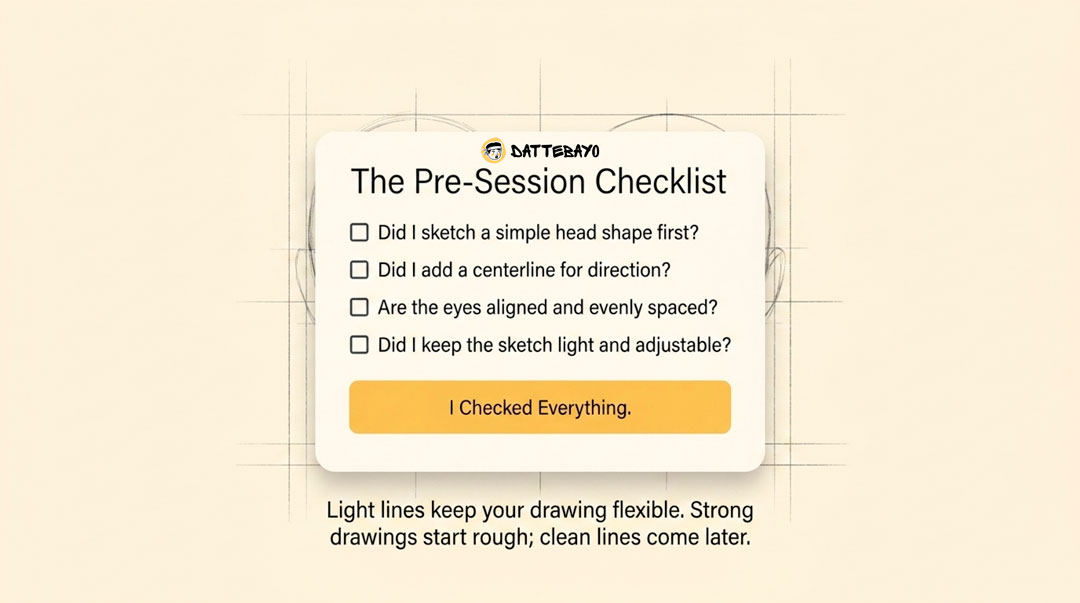
Light lines keep your drawing flexible.
They let you:
- Adjust without damaging the drawing
- Focus on placement instead of perfection
- Stay loose instead of tense
Strong drawings usually start rough. Clean lines come later.
How do you draw anime hair without it looking messy?
Focus on large shapes and flow—hair should support the head, not fight it.
Hair looks complex, so beginners often overdraw it. That’s what creates the “messy” look.
Think in clumps, not strands
Hair reads better when grouped into simple shapes.
Instead of drawing every strand:
- Break hair into sections
- Follow a clear direction of flow
- Keep the shapes readable
This avoids the tangled, noisy look that comes from too many lines.
How hair supports the character design
Hair plays a big role in how a character feels.
It influences:
- The silhouette
- The personality
- The overall balance
Soft, rounded shapes feel gentle. Sharp, angular shapes feel more intense. Even simple changes can shift the entire character.
How do you make anime eyes look expressive?
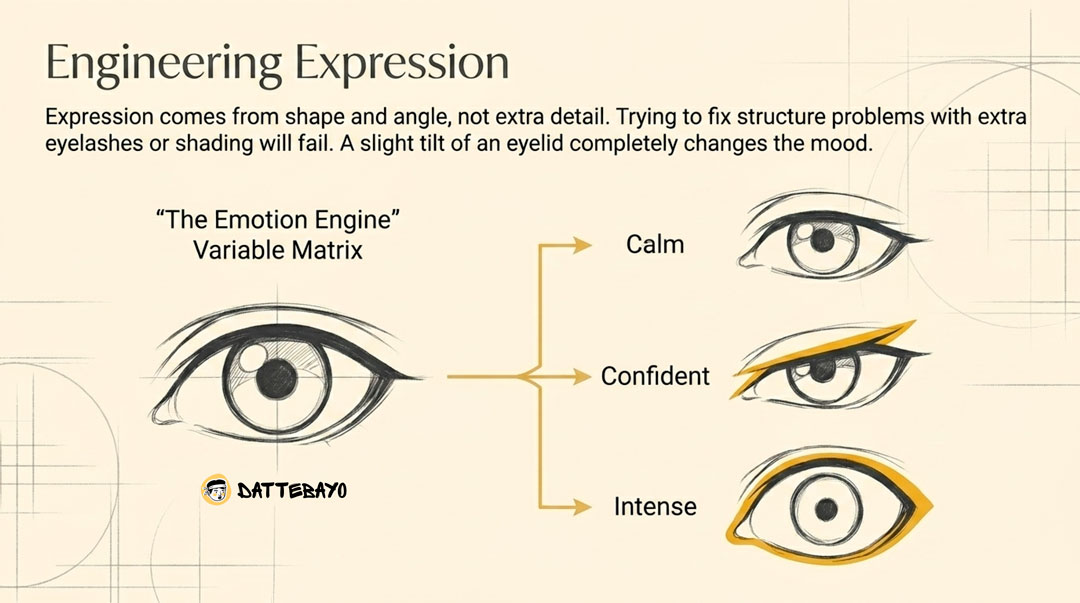
Expression comes from shape and angle—not extra detail.
You don’t need to add more—you need to adjust what’s already there.
What actually changes an eye’s emotion
Small structural changes make a big difference:
- How open or closed the eye is
- The tilt of the upper eyelid
- The position of the pupil
A slight tilt can completely change the mood—from calm to confident to intense.
The biggest beginner mistake with eyes
Trying to fix structure problems with detail.
If the base shape is off:
- Extra eyelashes won’t help
- More shading won’t fix it
Always go back to the underlying shape first.
What tools do you actually need to start?
Just a few basics are enough—tools don’t determine your progress.
You don’t need expensive equipment. What matters is consistency.
The simplest beginner setup
A minimal setup works because it:
- Keeps your focus on fundamentals
- Removes unnecessary decisions
- Makes daily practice easier
A mechanical pencil and a kneaded eraser are more than enough to get started.
Traditional vs digital (quick decision guide)
Traditional:
- Simple and distraction-free
- Great for building core skills
Digital (Clip Studio Paint, Procreate):
- Easier corrections
- Helpful tools like layers and undo
There’s no “better” option—just what helps you practice regularly.
Should you use references or draw from memory?
Use references early—they build the foundation for drawing from imagination.
Avoiding references might feel more creative, but it usually slows your progress.
Why references don’t limit creativity
They train your visual understanding.
With references:
- You learn proportions faster
- You start recognizing patterns
- You build a mental library of shapes
That’s what eventually allows you to draw freely.
When to start drawing from memory
Gradually, not all at once.
A simple approach:
- Study from a reference
- Try drawing it again from memory
- Compare and adjust
This loop builds both accuracy and independence over time.
How should beginners practice drawing anime girls?
Keep your practice short, focused, and consistent.
Drawing randomly can feel productive, but it’s not very efficient. Targeted practice leads to clearer improvement.
A simple daily practice routine
Even a short session works:
- 10–15 minutes of head structure
- 10 minutes focusing on one feature
- One quick sketch using a reference
Consistency matters more than duration.
Why structured practice works better than random drawing
Because it removes guesswork.
You:
- Repeat the right fundamentals
- Spot mistakes earlier
- Improve without burning out
If you want a clearer path instead of figuring everything out alone, Dattebayo is designed to guide beginners through this progression in a practical, manageable way.
How long does it take to get good at drawing anime girls?
With consistent, focused practice, you’ll see real improvement within weeks.
Not perfection—but noticeable progress.
What improvement looks like early on
You’ll start to see:
- Better proportions
- More balanced faces
- Cleaner, more confident lines
These are the signs that your fundamentals are improving.
How structured learning speeds things up
Because it removes confusion and wasted effort.
Instead of guessing:
- You follow a clear path
- You build skills in the right order
- You reinforce what actually matters
That clarity is what helps beginners improve faster—something Dattebayo is built to support.
FAQ: Common Beginner Questions
What are the correct proportions for an anime girl’s face?
Use simple guidelines: eyes near the middle, one eye-width spacing, and balanced thirds. Consistency matters more than precision.
How do you draw anime hair for beginners?
Focus on overall shape and flow. Group hair into sections instead of drawing individual strands.
Why do my anime faces look flat?
Usually because the head structure or centerline isn’t clear, which removes the sense of volume.
Should I trace to learn anime drawing?
Tracing can help you understand shapes, but you should always follow it by redrawing without it.
How do I fix uneven or crooked anime eyes?
Use guidelines early and keep your sketch light so you can adjust before committing.
Can I learn anime drawing without digital tools?
Yes. Traditional tools are more than enough for building strong fundamentals.
How do I make my anime drawings look cleaner?
Focus on structure first, then improve line confidence. Clean results come from clarity.
How often should I practice drawing anime characters?
Short, consistent sessions are far more effective than long, irregular ones.
If there’s one idea to keep in mind, it’s this: better drawings come from better structure, not more effort. Once you understand that, everything starts to feel more manageable—and a lot more enjoyable.