Finding the right anime drawing course online isn’t about chasing popularity—it’s about choosing something that actually helps you improve. Once you know what to look for, the choice becomes much clearer.
What actually makes a good anime drawing course?

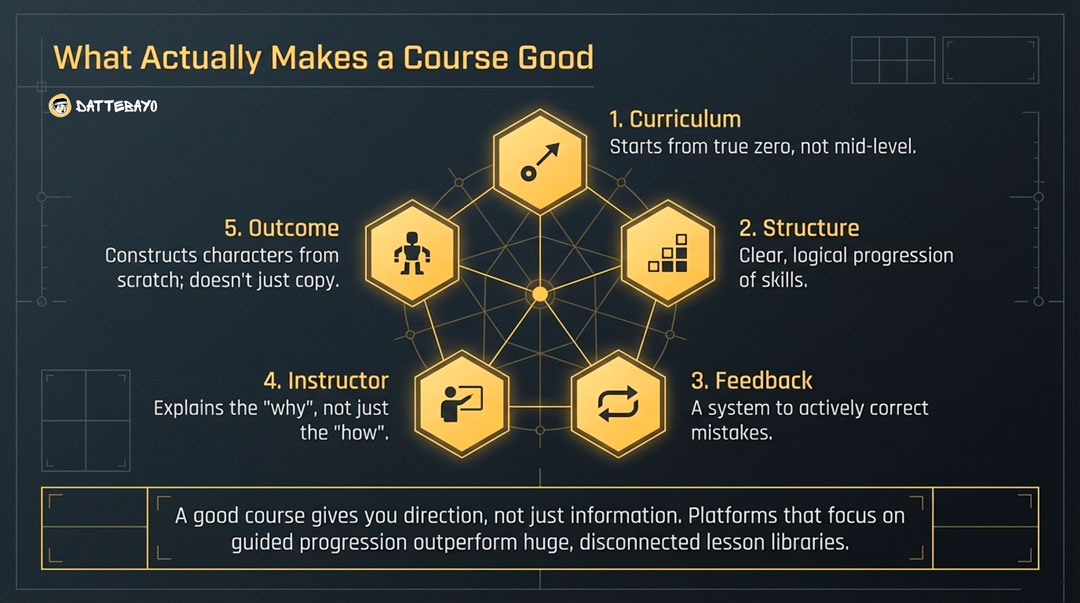
A good course gives you direction, not just information. It should guide you from beginner basics to drawing characters with understanding—not leave you hopping between random lessons.
A common mistake is thinking “more lessons = better.” What really matters is how those lessons connect and build toward real skills.
Here’s a quick way to evaluate any course:
- Curriculum — Does it truly start from zero?
- Structure — Is there a clear progression?
- Feedback — Will someone correct your mistakes?
- Instructor credibility — Can they explain, not just draw?
- Outcome — What will you actually be able to create?
Instead of guessing, you can score a course using this:
Think of this as a quick reality check. If a course scores low on structure or feedback, it’ll probably feel frustrating once the initial excitement fades.
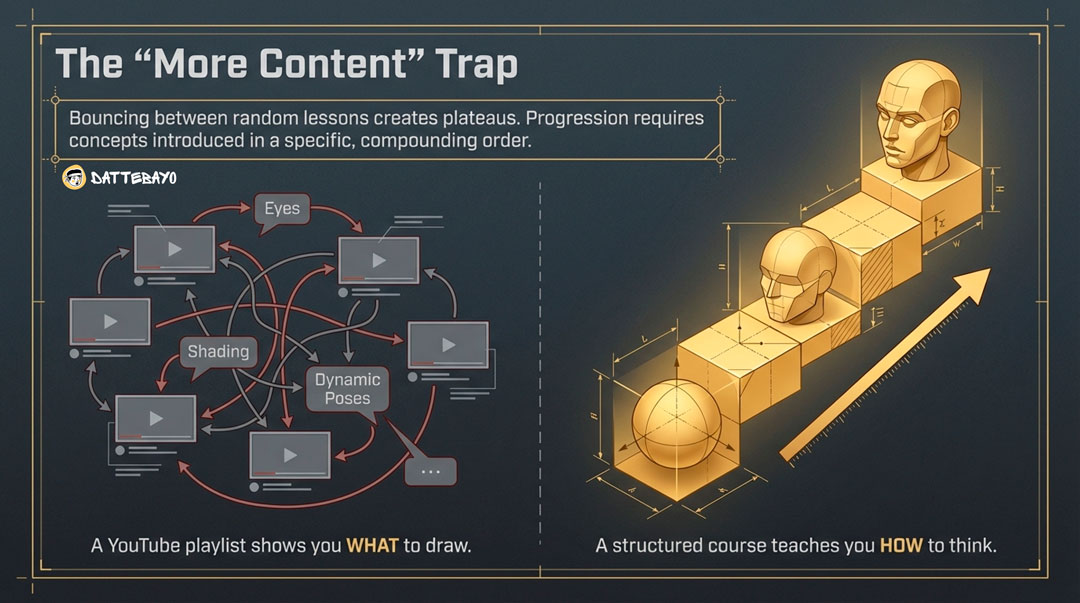
A YouTube playlist shows you what to draw. A structured course teaches you how to think while drawing.
Why structure matters more than “more content”
Structure gives you a path. Without it, you end up bouncing between topics—eyes one day, full characters the next, then random poses—without building real consistency.
A well-designed course:
- Introduces concepts in the right order
- Reinforces them through practice
- Gradually builds toward full characters
That’s why platforms like Dattebayofocus on guided progression instead of huge, disconnected lesson libraries.
What kind of feedback actually helps you improve?
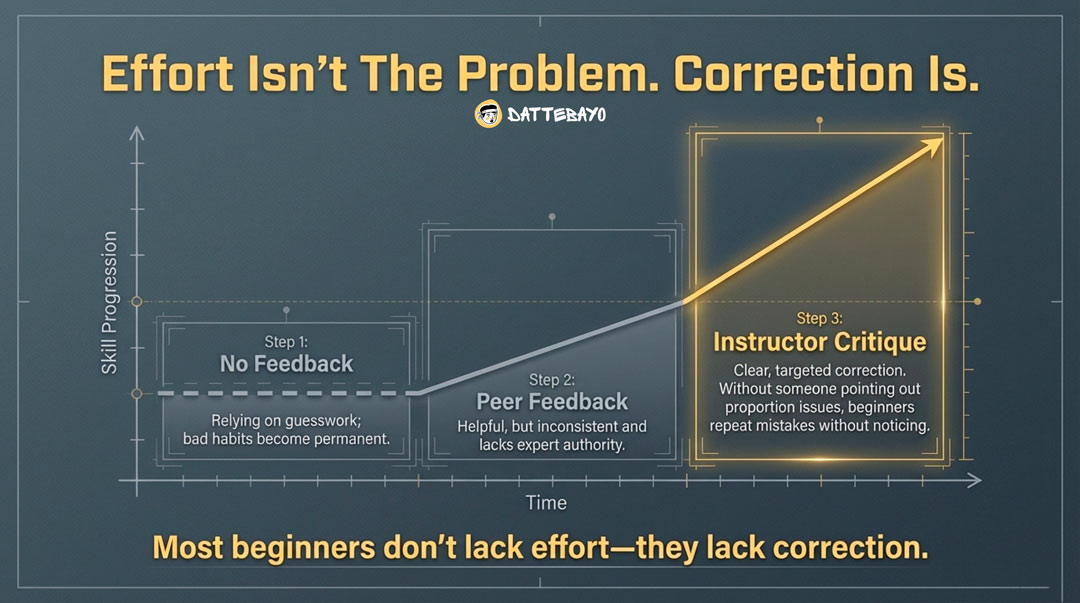
Feedback is where real improvement happens. Without it, it’s easy to repeat the same mistakes without noticing.
- No feedback — You rely on guesswork
- Peer feedback — Helpful, but inconsistent
- Instructor critique — Clear, targeted, and much faster for progress
If no one points out issues with proportions or structure, those habits stick.
Most beginners don’t lack effort—they lack correction.
How to tell if an instructor is legit
A great instructor makes things click. That’s different from just being good at drawing.
Look for:
- Clear explanations (not just speed drawings or time-lapses)
- Visible construction thinking, not only polished results
- Lessons that explain decisions, not just outcomes
Marketplace platforms like Udemy or Skillshare can be hit-or-miss. A structured school like Dattebayo tends to feel more cohesive because the curriculum is designed as a full learning path.
Can you really learn anime drawing online as a complete beginner?
Yes—if the course is built for true beginners and doesn’t skip foundations.
You don’t need prior experience. You need the right concepts, introduced in the right order.
Modern courses now combine:
- Video lessons
- Guided practice
- Feedback or community support
As of 2026, more platforms are moving toward interactive learning and critique systems, because passive watching alone just doesn’t lead to strong results anymore.
What a true beginner-friendly course includes
A beginner course should slow things down and build from the ground up.
Expect:
- simple shapes and construction
- proportion awareness
- basic character structure
It should also include practice that helps you understand, not just copy what you see.
If everything looks polished from the start, it’s likely skipping the foundation you actually need.
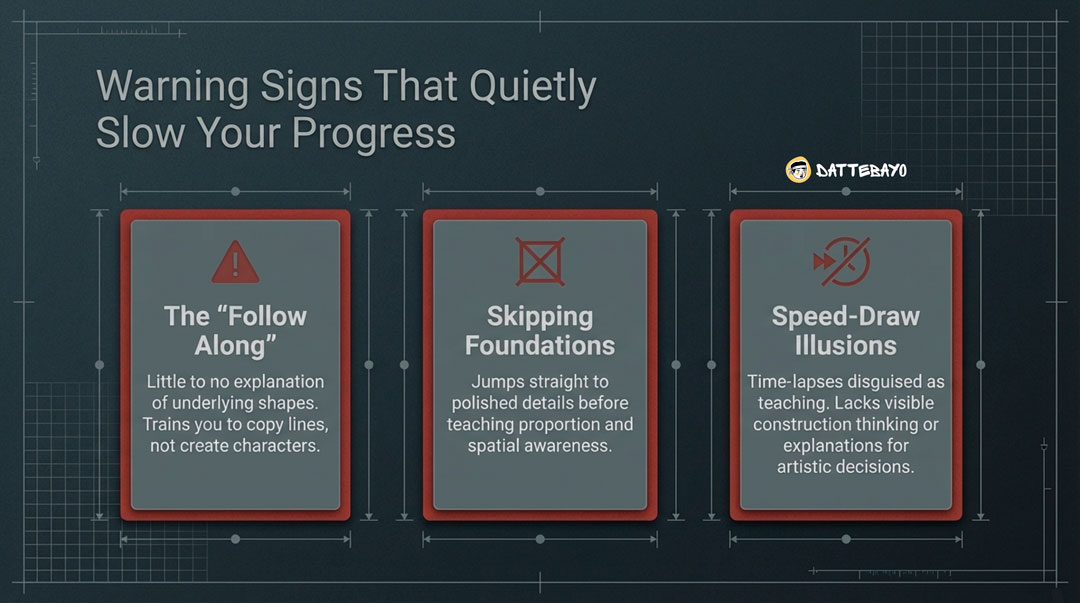
Red flags that will slow your progress
Some courses feel helpful at first but quietly hold you back.
Watch for:
- “just follow along” teaching with little explanation
- skipping core fundamentals
- focusing on perfect results too early
These approaches train you to copy—not to create.
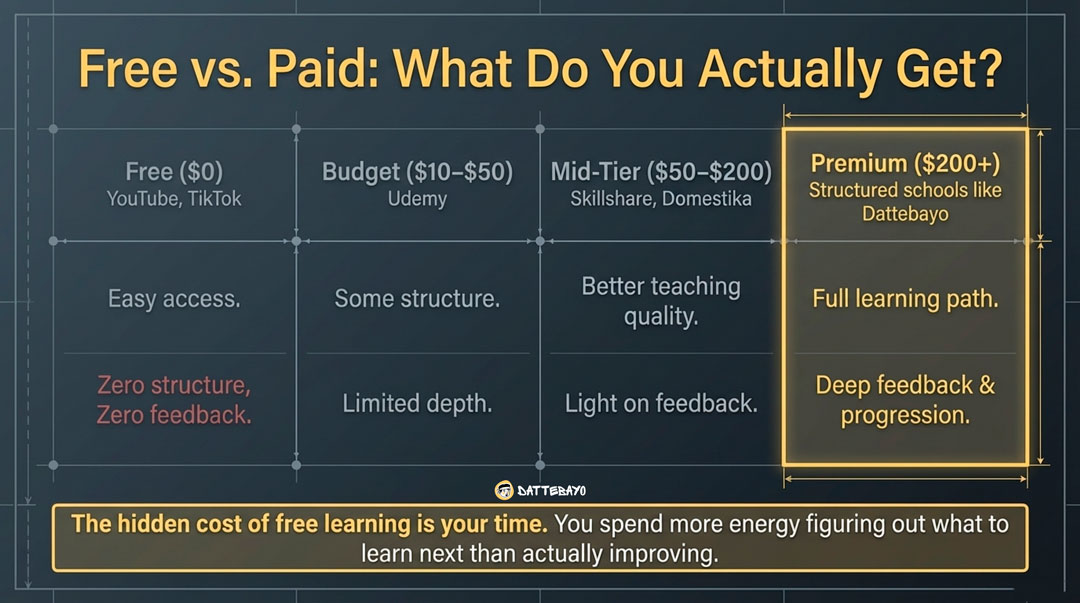
Free vs paid anime drawing courses — what do you actually get?
Free content is great for exploring. Paid courses are where structure and consistency usually show up.
Here’s the difference in practice:
Free ($0) — YouTube, TikTok
- easy to access
- no structure, no feedback
Budget ($10–$50) — Udemy
- some structure
- limited depth
Mid-tier ($50–$200) — Skillshare, Domestika
- better teaching quality
- still light on feedback
Premium ($200+) — structured schools like Dattebayo
- full learning path
- feedback and progression
The hidden cost of free learning is time. You spend more energy figuring out what to learn next than actually improving.
When free resources are enough
Free works well if you:
- are just exploring
- draw casually
- don’t mind slower progress
When paying for a course is worth it
A paid course makes sense if:
- you feel stuck copying
- your progress is inconsistent
- you want clearer direction
If you want a structured starting point, the Dattebayo beginner course is designed to guide you step by step without overwhelming you.
Course formats explained (and which one fits you)
The best format depends less on skill level and more on how you stay consistent.
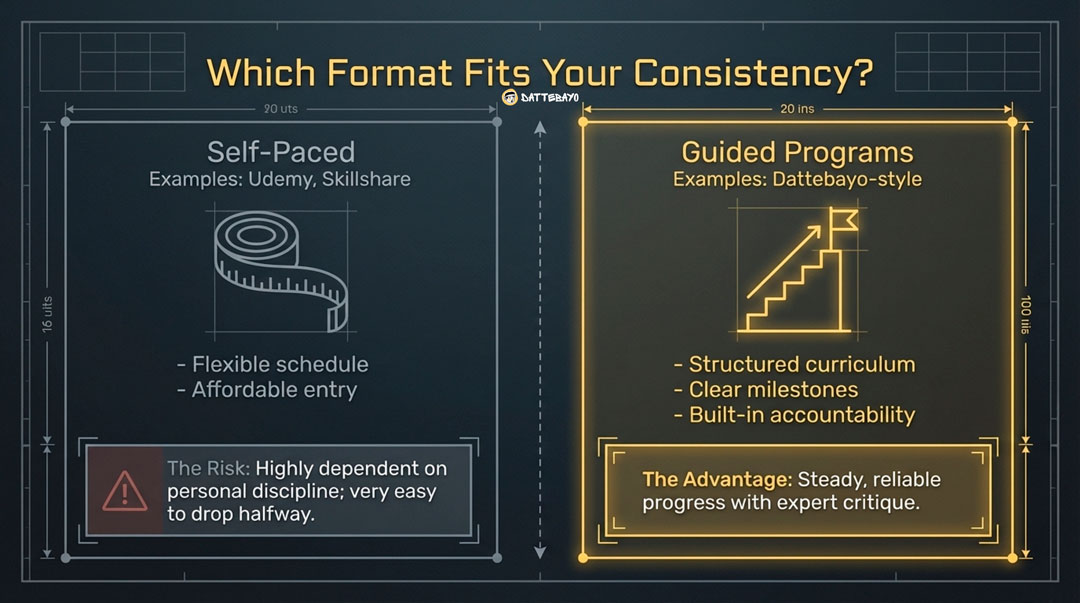
Self-paced vs guided courses
Self-paced (Udemy, Skillshare)
Flexible and affordable—but easy to drop halfway
Guided programs (Dattebayo-style)
Structured, with milestones and accountability
If you’re disciplined, self-paced can work. If you want steady progress, guided tends to be more reliable.
Do you need feedback or can you learn solo?
Some people can improve alone—but most beginners benefit a lot from feedback.
You’ll likely need it if:
- your drawings feel “off” but you can’t explain why
- you repeat the same mistakes
- you’ve stopped improving
That’s why newer learning platforms increasingly build in critique systems and community features.
What do you actually need to start?
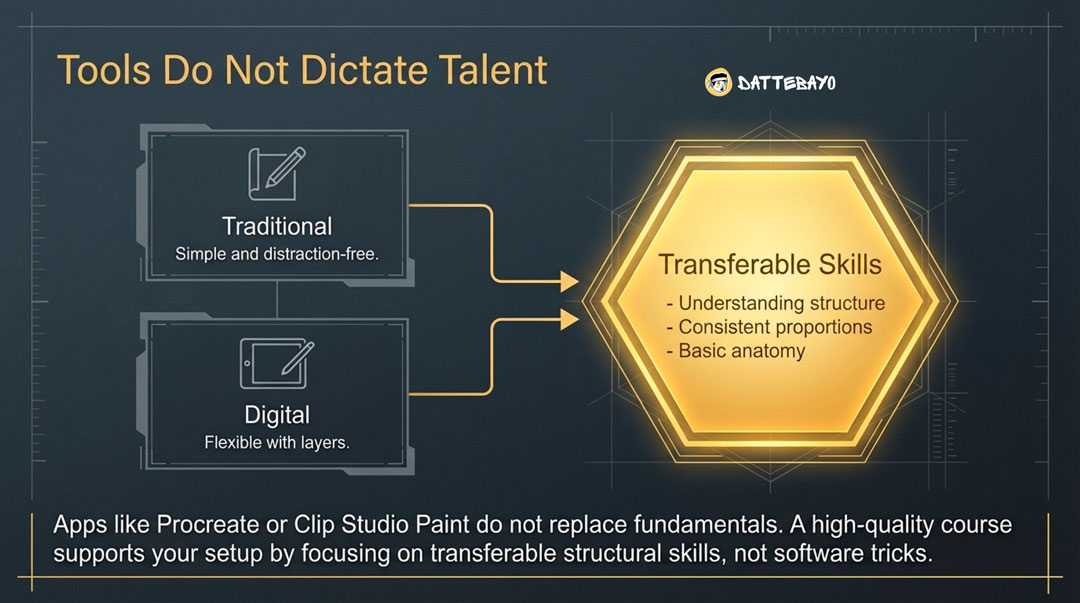
You can start with almost nothing. Tools aren’t the limiting factor—your learning approach is.
Traditional vs digital drawing for beginners
Both are valid:
- Traditional — simple and distraction-free
- Digital — flexible with undo and layers
Apps like Clip Studio Paint or Procreate are helpful, but they don’t replace fundamentals.
Will your course support your setup?
A good course should work regardless of tools. Dattebayo, for example, focuses on transferable skills, so you’re not locked into a specific setup.
What will you be able to draw after a beginner course?
You should be able to construct simple characters from scratch—not just copy finished artwork.
That’s the real benchmark.
Skills you should gain
Look for outcomes like:
- basic anatomy awareness
- consistent proportions
- understanding structure, not just outlines
If a course promises polished illustrations quickly, it’s likely skipping essential groundwork.
Signs a course is actually working
You’ll notice small but meaningful shifts:
- you depend less on references
- your drawings feel more stable
- you can spot your own mistakes
Progress doesn’t always feel dramatic—but it builds.
How long does it take to improve—and what affects it?
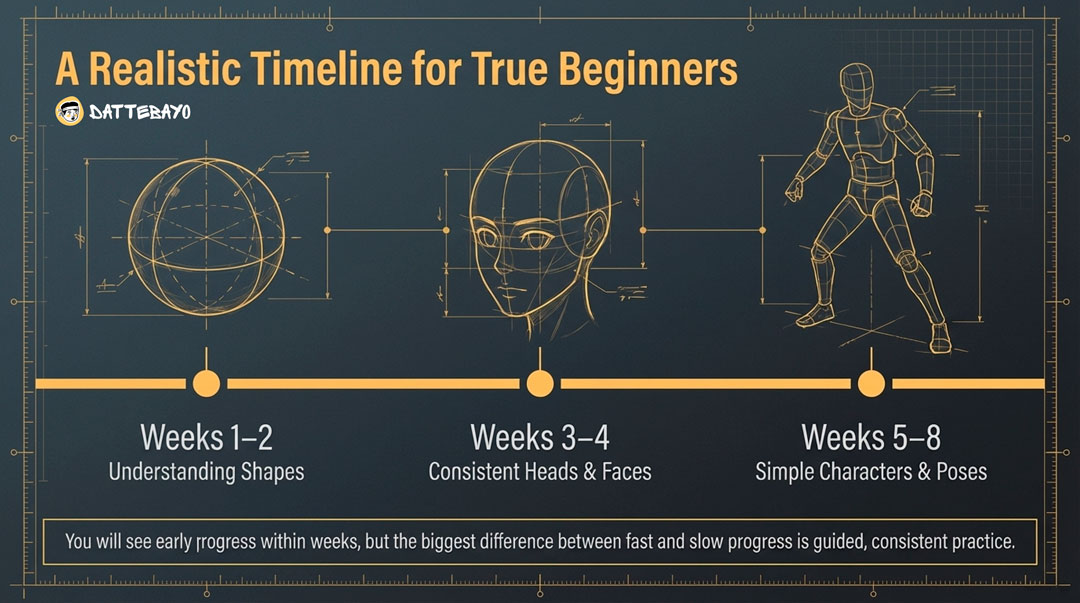
You’ll usually see early progress within weeks, but consistency and feedback shape long-term results.
A realistic 4–8 week progression
- Weeks 1–2 — understanding shapes and proportions
- Weeks 3–4 — more consistent heads and faces
- Weeks 5–8 — simple characters and poses
The biggest difference between fast and slow progress isn’t talent—it’s guided practice.
Why people plateau (and how courses can prevent it)
Plateaus often come from:
- lack of structure
- no feedback
- repeating familiar habits
A strong course keeps you moving by introducing new challenges, correcting mistakes early, and reinforcing fundamentals.
How to choose the right anime drawing course (quick decision guide)
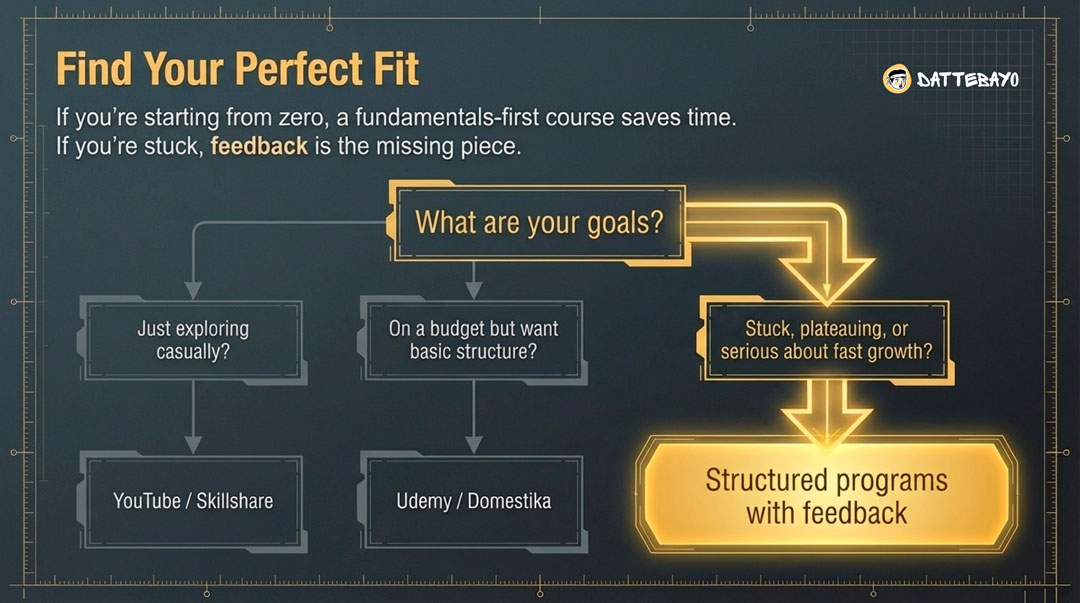
Choose based on your goals—not just what’s popular.
Just exploring
→ Start with YouTube or Skillshare
On a budget but want structure
→ Try Udemy or Domestika
Serious about improving fast
→ Choose a structured program with feedback (like Dattebayo)
Stuck and not improving
→ Prioritize critique-based courses
If you’re starting from zero, a fundamentals-first course will save you the most time. If you’re stuck, feedback—not more content—is usually the missing piece.
Best choice if you're starting from zero
Look for:
- a clear beginner curriculum
- structured progression
- simple, repeatable practice
Best choice if you're stuck or plateauing
You need:
- instructor critique
- targeted correction
- a system that shows your weak points
That’s where structured platforms like Dattebayo stand out—they’re built around progress, not just content.
FAQ
What is the best anime drawing course online for beginners?
There’s no single best option, but courses with clear structure and feedback—like Dattebayo or similar guided programs—tend to be more effective.
Are Udemy or Skillshare anime courses worth it?
Yes, especially for affordability and basics. Just expect limited feedback and structure.
How much should an anime drawing course cost?
Anywhere from free to $200+, depending on structure and whether feedback is included.
Can I learn anime drawing online with no experience?
Yes, as long as the course starts with fundamentals and builds gradually.
Do anime drawing courses include anatomy and character design?
Good ones do—these are essential skills.
Do I need a drawing tablet to start?
No. Pencil and paper are enough.
Do online courses give feedback on your drawings?
Some do. Structured platforms like Dattebayo emphasize critique, while many marketplace courses don’t.
Can I build a portfolio from an online course?
Yes—especially with structured or project-based programs.
What if I start a course and lose motivation?
Courses with milestones, structure, and community support make consistency much easier.
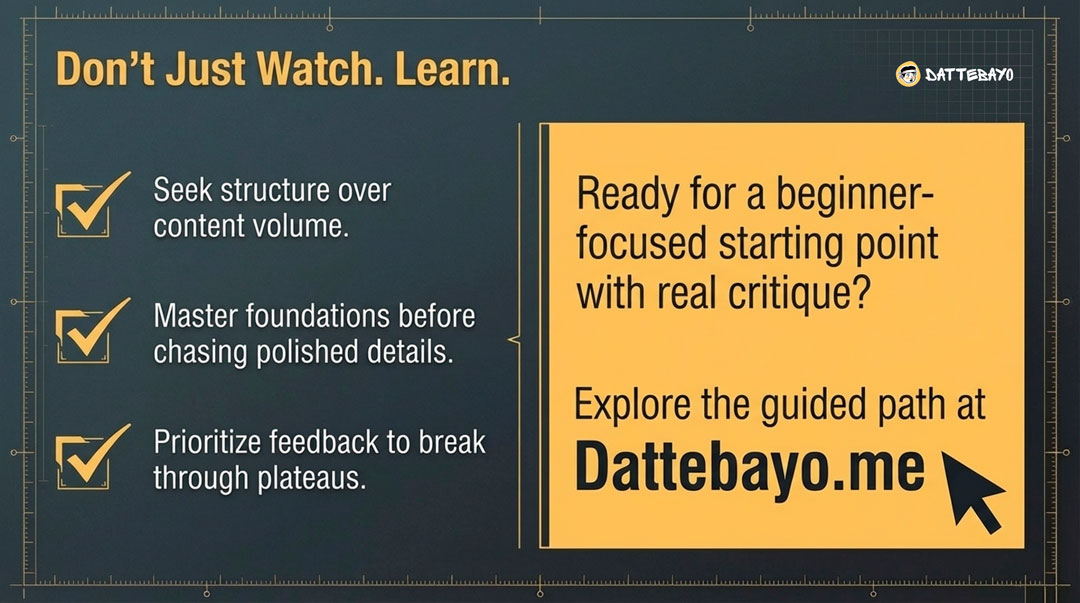
Choosing an anime drawing course online isn’t about finding a “perfect” option—it’s about finding one that actually moves you forward. If a course gives you structure, feedback, and a clear path, you’ll feel the difference quickly.
If you want a beginner-focused starting point, you can explore Dattebayo here:
The key is simple: don’t just watch—learn in a way that makes your next drawing better than your last.