
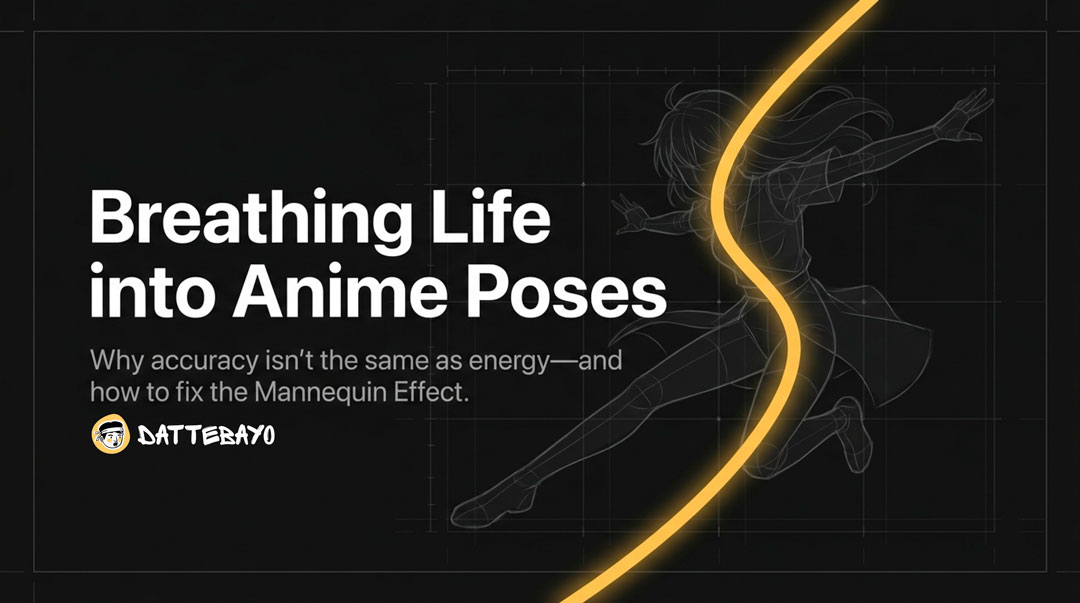
If your characters look “correct” but somehow lifeless, the issue usually isn’t skill—it’s decision-making. Dynamic anime poses aren’t about complexity; they’re about direction, balance, and clarity. Once those click, your drawings start to feel alive surprisingly fast.
Let’s break it down in a way you can actually use.
Why your anime poses still look stiff (even after practice)
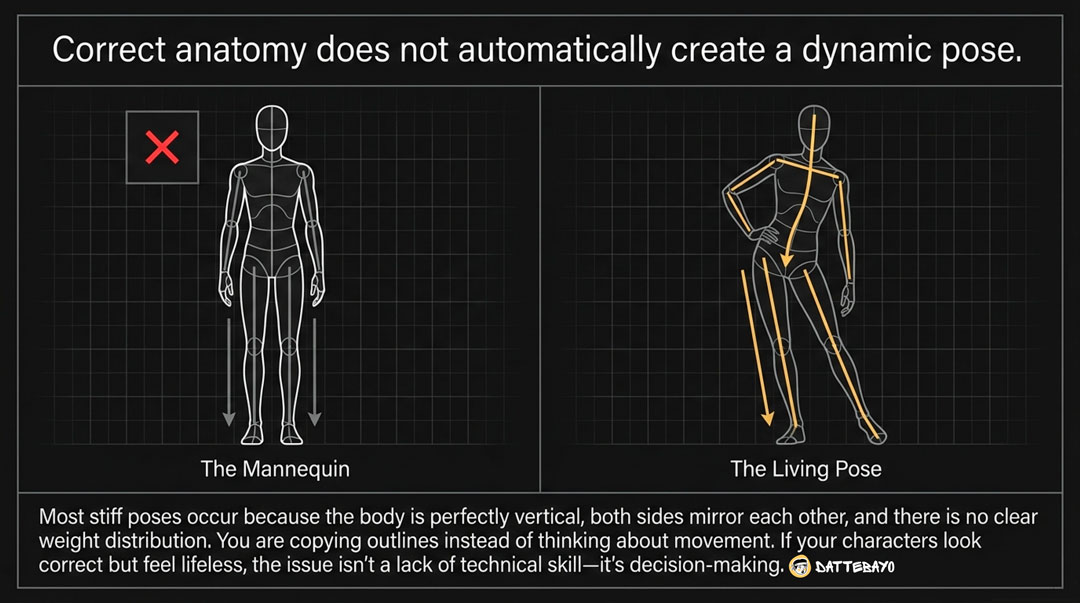
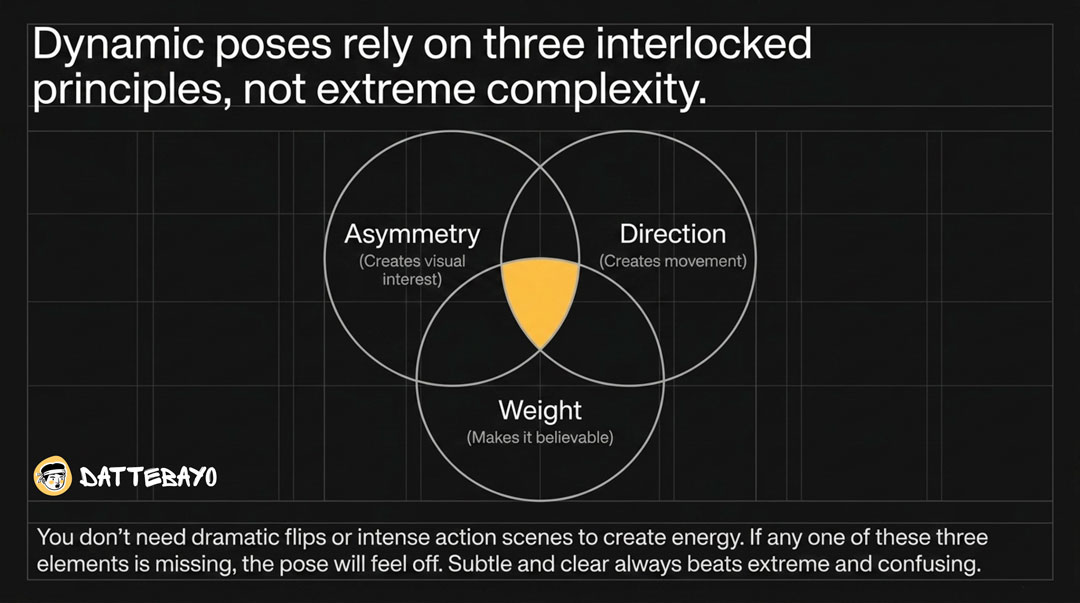
Most stiff poses come from upright, symmetrical drawings with no clear sense of movement or weight.
You’ve probably seen this in your own work: the anatomy checks out, proportions look fine… but the pose feels like a mannequin. That’s because accuracy isn’t the same as energy.
Here’s what usually causes stiffness:
- The body is too vertical (no tilt or lean)
- Both sides mirror each other
- There’s no clear weight distribution
- You’re copying outlines instead of thinking about movement
A stiff pose often has lots of small decisions but no strong idea. A dynamic pose is the opposite—it commits to one clear direction.
Think of it like this:
- A stiff pose = “everything is correct”
- A dynamic pose = “something is happening”
That “something” starts with one key idea.
The fastest way to fix a stiff pose: start with a line of action
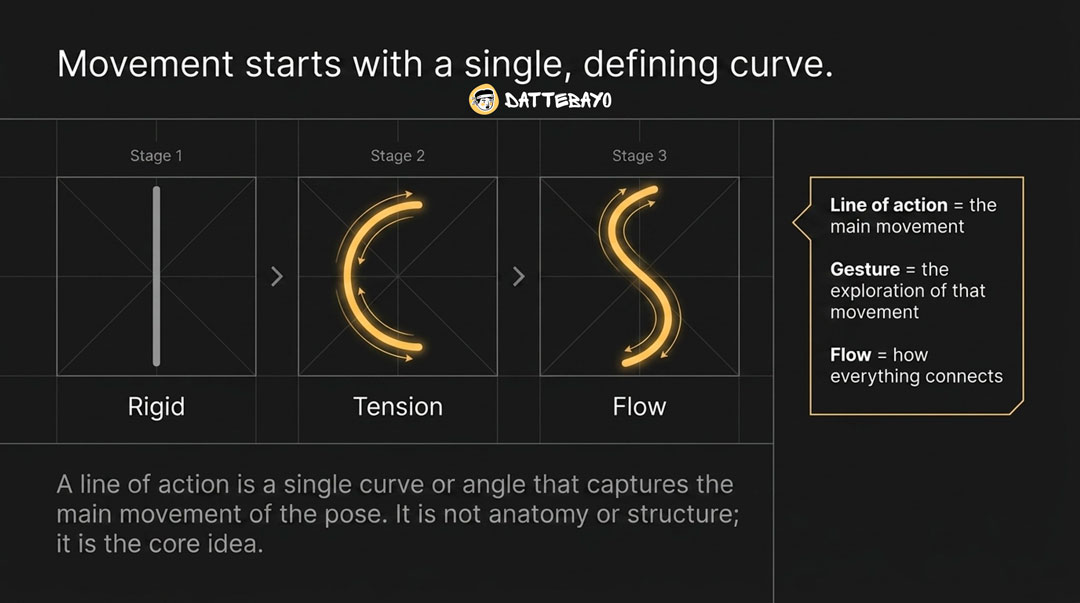
A line of action is a single curve or angle that captures the main movement of the pose—and it instantly adds life.
Instead of starting with details, think in terms of direction. The line of action isn’t anatomy or structure—it’s the core idea behind the pose.
- Line of action = main movement
- Gesture = exploration of that movement
- Flow = how everything connects
If your pose feels stiff, the line of action is often either too straight… or missing entirely.
One strong curve will do more for your pose than perfect anatomy ever will.
Straight vs curved lines: why curves feel more alive
Straight lines feel stable and rigid. That’s useful sometimes—but it often reads as stiff.
Curves suggest motion, tension, and personality. Even a slight bend can make a big difference.
Anime leans heavily into this. Whether a character is jumping, twisting, or just standing confidently, the pose usually follows a C-curve or S-curve, not a straight line.
How to check if your pose has a clear direction
Ask yourself:
“Where is this pose going?”
If you can’t answer immediately, the direction isn’t clear enough yet.
Quick fixes you can apply to any pose in seconds
Small adjustments—like tilting, shifting, or offsetting—can instantly make a pose feel more dynamic.
You don’t need to redraw everything. Think of these as quick levers:
- Tilt the torso slightly
- Shift weight onto one leg (or support point)
- Angle shoulders differently from hips
- Push one side more than the other
- Avoid mirrored limbs
These aren’t rules—they’re easy ways to inject life into a pose without overthinking it.
Here’s a simple interactive way to see that contrast:
The goal isn’t perfection—it’s clear intention.
What makes an anime pose look dynamic instead of stiff?
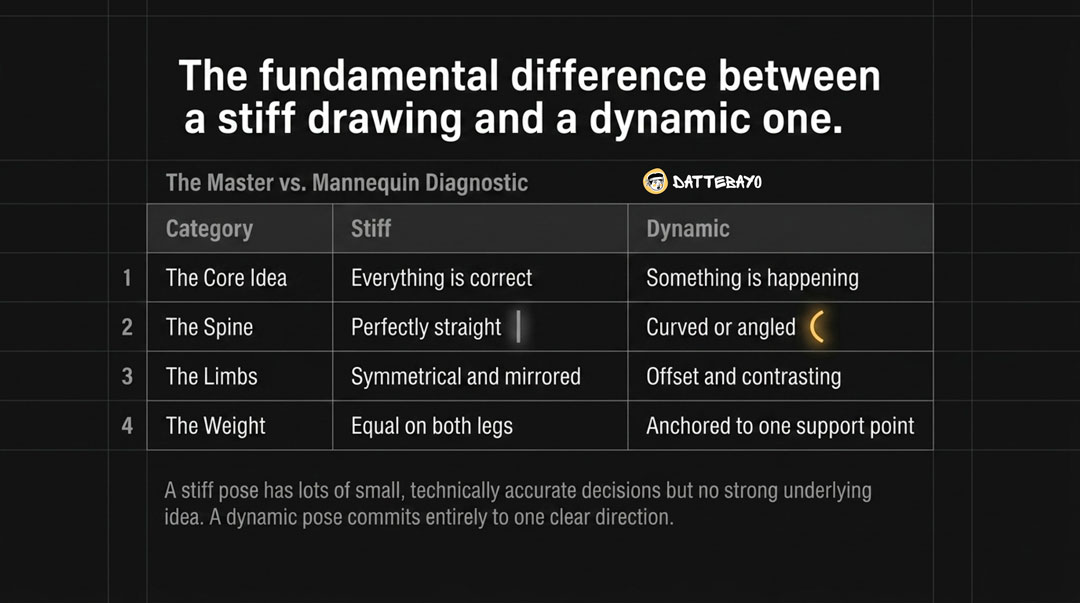
Dynamic poses come down to three things: asymmetry, direction, and weight.
That’s it. Not complexity. Not extreme action. Just those working together.
- Asymmetry creates visual interest
- Direction creates movement
- Weight makes it believable
If one is missing, the pose feels off.
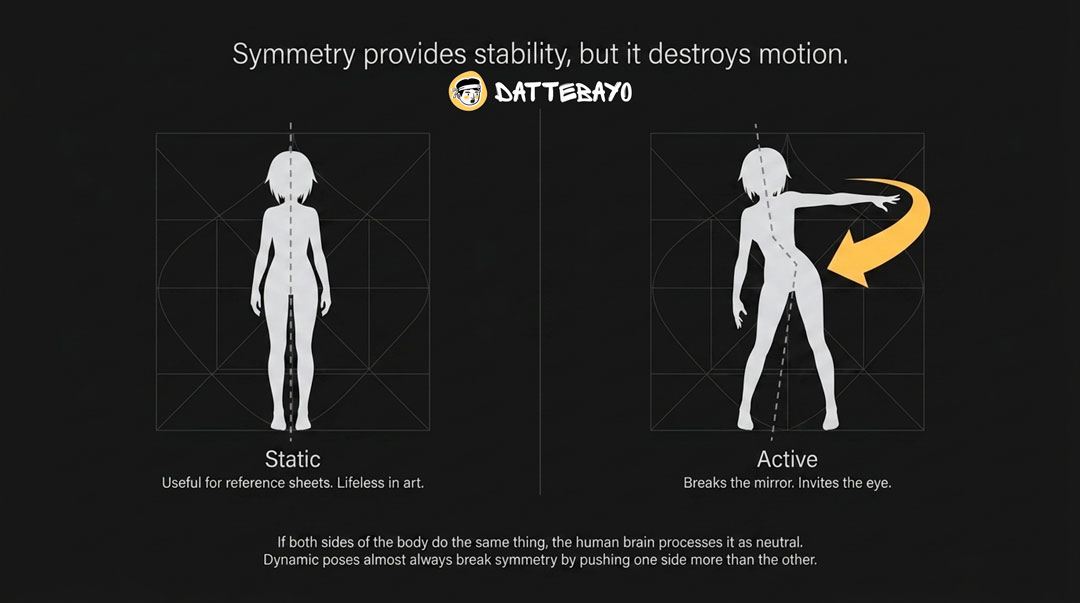
Why symmetry makes poses feel lifeless
Symmetry feels stable—but also static.
If both sides of the body do the same thing, your brain reads it as neutral. That’s useful for reference sheets, not expressive artwork.
Dynamic poses almost always break symmetry somewhere.
Why small angles matter more than extreme action
You don’t need dramatic flips or action scenes to create energy.
A slight tilt in the shoulders or a small shift in the hips can be enough. Beginners often push poses too far too early, which can make them look forced or unbalanced.
Subtle and clear beats extreme and confusing.
Why copying references doesn’t fix stiffness (and what to do instead)
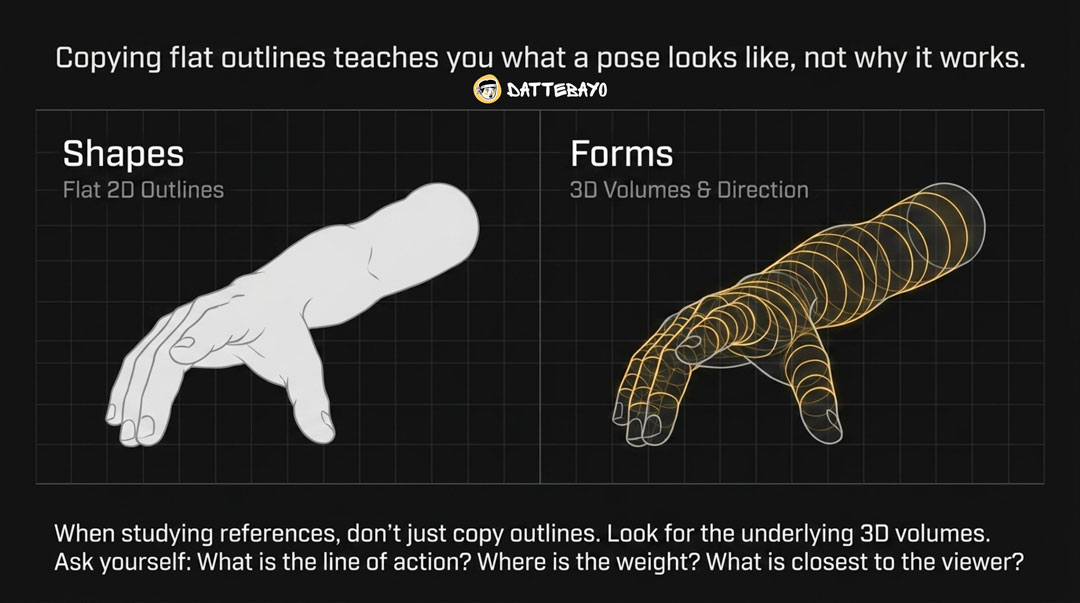
Copying outlines without understanding form, angle, and weight leads to flat poses.
References are powerful—but only if you study them actively.
If you’re just copying contours, you’re learning what it looks like, not why it works.
The difference between drawing shapes and drawing forms
- Shapes = flat outlines
- Forms = 3D volumes with direction
Dynamic anime poses come from thinking in forms—even in stylized art.
This is also where perspective and camera angle start to matter in a practical way.
How to actually learn from references
When studying a pose, ask:
- What’s the line of action?
- Where is the weight?
- What’s tilted vs straight?
- What’s closest to the viewer?
This kind of thinking is exactly what platforms like Dattebayo focus on—helping you understand drawings instead of just copying them.
If you want a structured path, their anime drawing course builds these skills step by step without overwhelming you.
How balance and weight make poses believable
A pose feels right when the character’s weight is clearly supported.
Even stylized anime characters follow a simple rule:
If they would fall over in real life, the pose will feel wrong on paper.
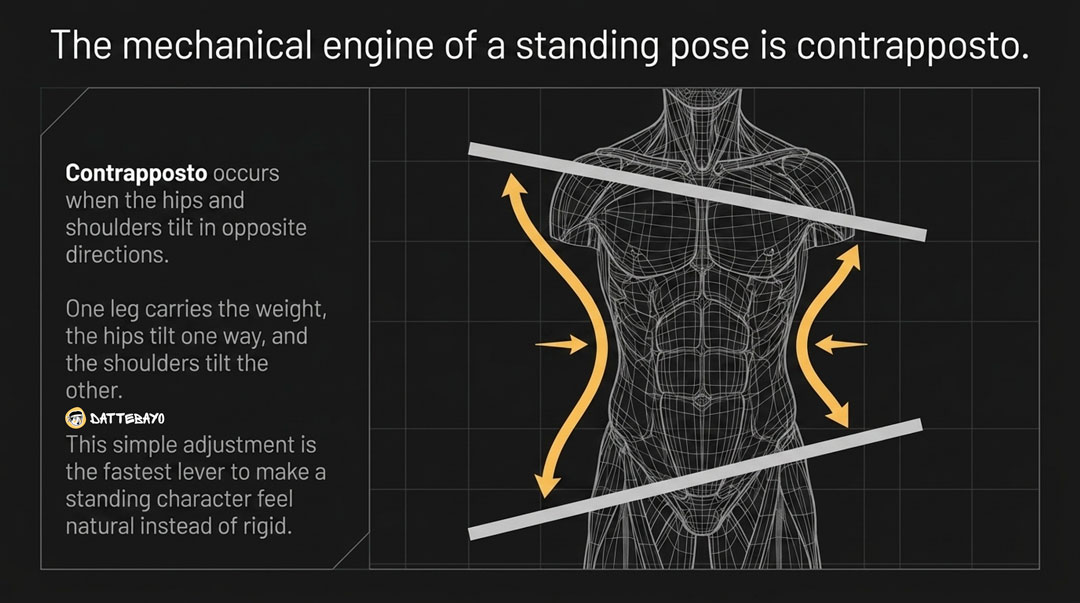
What is contrapposto (in simple anime terms)
Contrapposto is when the hips and shoulders tilt in opposite directions.
In anime terms, it’s what makes a standing pose feel natural instead of stiff.
- One leg carries more weight
- Hips tilt one way
- Shoulders tilt the other
This creates a natural S-curve and adds instant life.
Signs your pose doesn’t “stand” correctly
- Both legs carry equal weight
- The body leans without support
- The character looks like they’re floating
- Everything is centered and rigid
Fixing weight often has a bigger impact than fixing anatomy.
Camera angle and perspective: adding depth without complexity
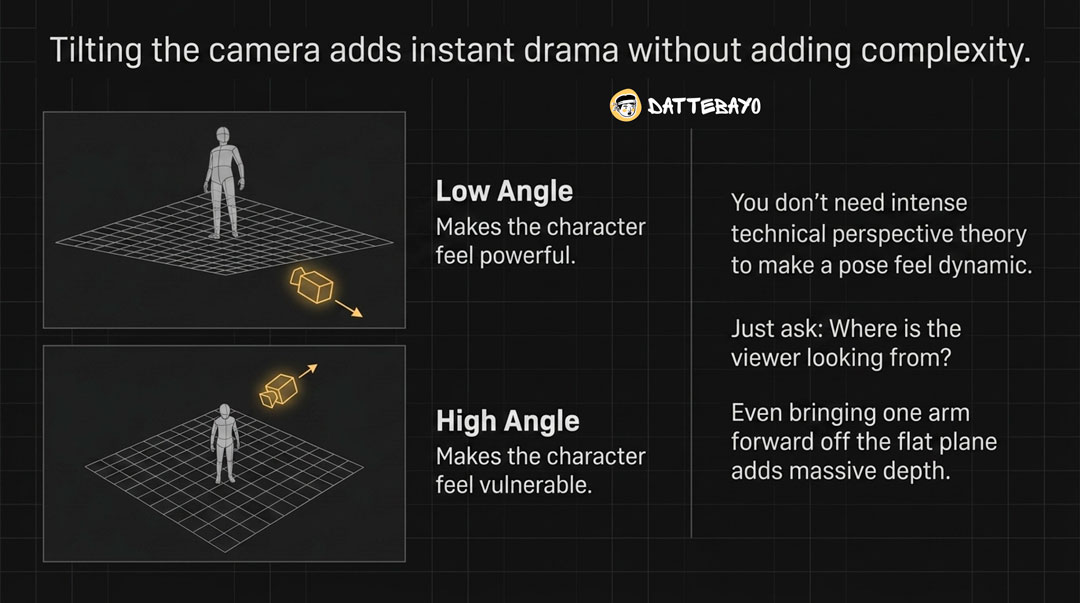
Changing the viewing angle makes poses feel more dynamic—even without advanced perspective.
You don’t need technical theory. Just ask:
Where is the viewer looking from?
Low vs high angle: simple ways to add drama
- Low angle (looking up): makes the character feel powerful
- High angle (looking down): makes them feel smaller or vulnerable
You’ll see this constantly in anime cinematography and modern digital illustration trends.
Why even slight perspective makes poses feel less flat
Even a small shift—like bringing one arm forward—adds depth.
Everything doesn’t need to sit on the same flat plane.
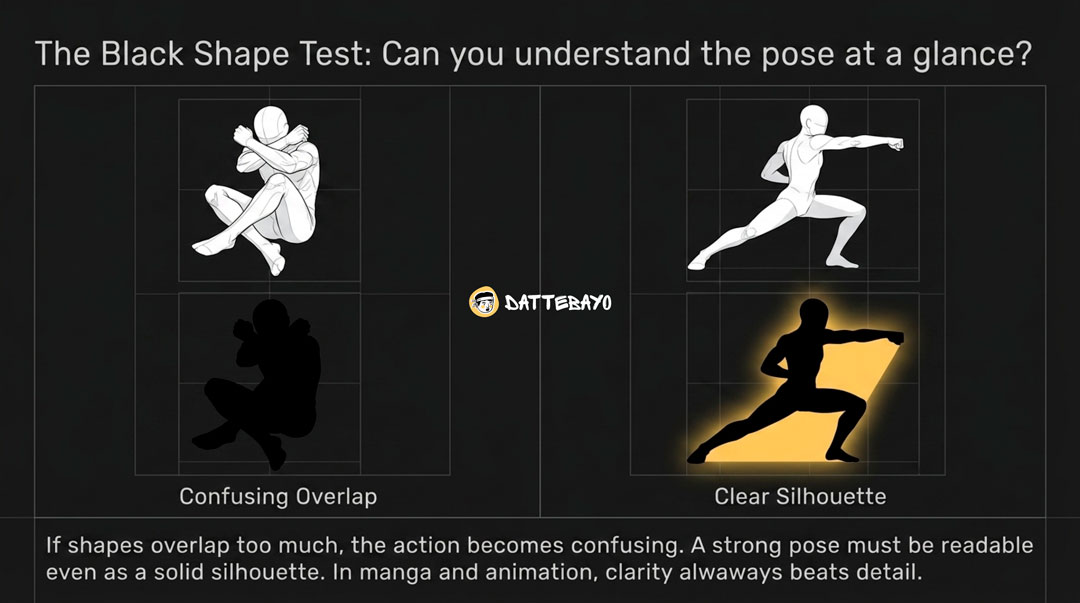
Silhouette and readability: can you understand the pose at a glance?
A strong pose should be readable even as a simple silhouette.
If shapes overlap too much, the pose becomes confusing.
The “black shape test” for your pose
Imagine your character as a solid black shape.
Can you still tell:
- what they’re doing?
- where the limbs are?
- the overall action?
If not, the pose needs clearer separation.
This idea shows up everywhere—from manga panels to animation keyframes. Clarity always beats detail.
How much exaggeration is too much in anime poses?
Exaggeration works when it supports movement and balance—not when it breaks them.
Anime thrives on stylization, but structure still matters.
- Good exaggeration = pushes the line of action
- Bad exaggeration = ignores weight and balance
Foreshortening can help, but it’s optional. Many strong poses don’t rely on it at all.
Exaggerate with purpose.
Common mistakes that make poses look stiff
Most stiffness comes from a few repeatable issues:
- perfectly straight spine
- equal weight on both legs
- no twist between shoulders and hips
- unclear or missing line of action
- copying outlines only
- overly symmetrical limbs
If a pose feels off, it’s usually one of these—not something complicated.
How to practice dynamic poses without getting overwhelmed
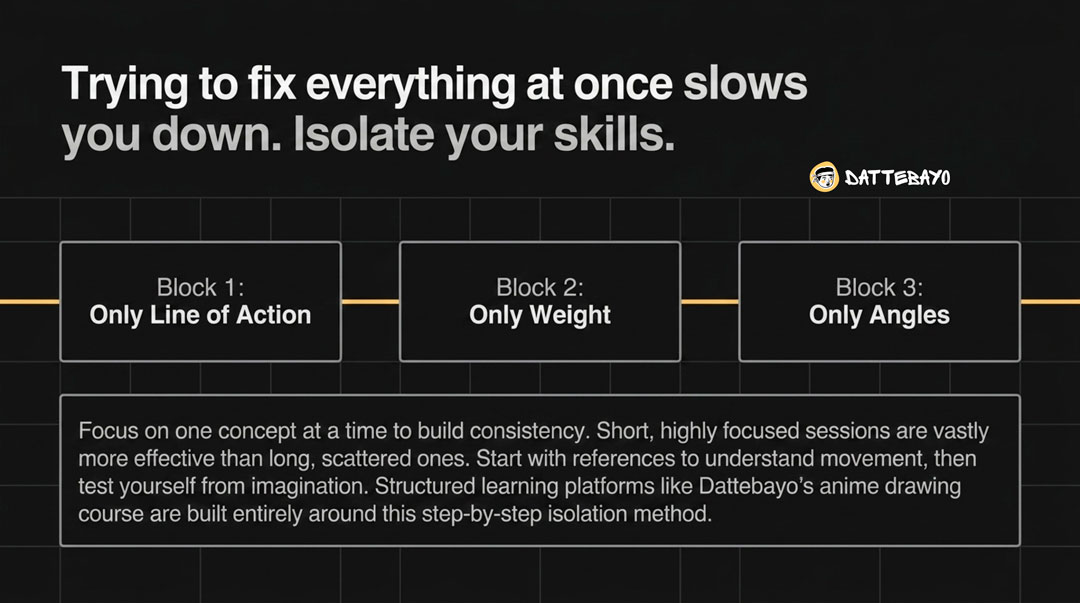
Focus on one concept at a time and build consistency.
Trying to fix everything at once slows you down. Isolate skills instead.
A simple way to structure your practice
- One session = one focus
- Example: only line of action, or only weight, or only angles
Short, focused sessions are more effective than long, scattered ones.
If you want a clear progression without guessing what to do next, Dattebayo is built around that idea—structured learning, beginner-friendly pacing, and practical results.
When to move from references to imagination
Start with references to understand movement, then test yourself:
- Can you recall the line of action from memory?
- Can you invent a pose that still feels balanced?
That transition is where real improvement happens.
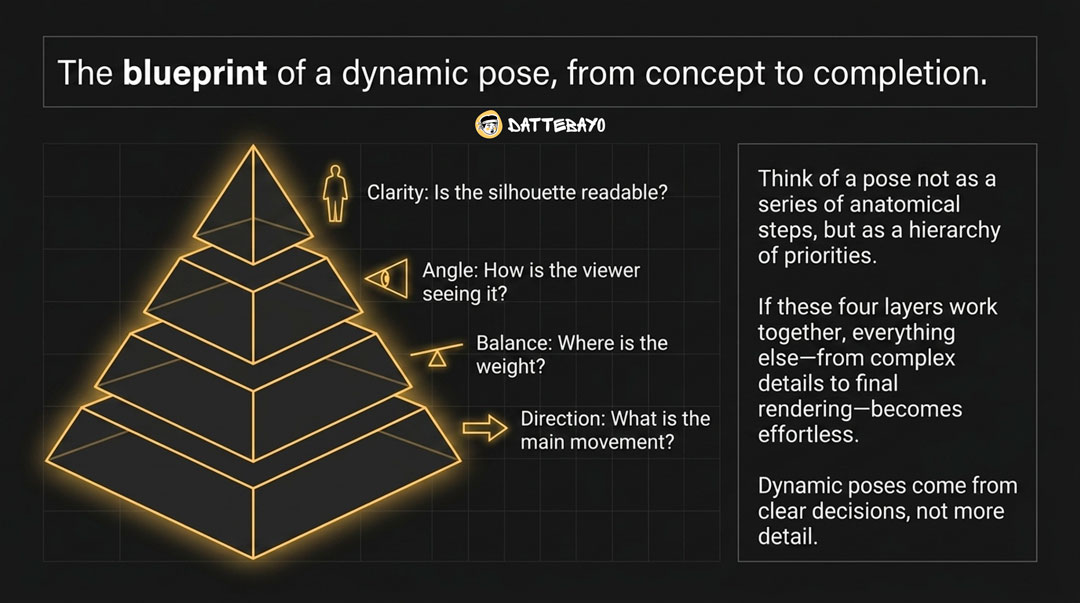
A simple breakdown of a dynamic pose (from idea to final)
Think of a pose in layers: direction, balance, angle, and clarity.
Not steps—just priorities.
- Direction – What’s the main movement?
- Balance – Where is the weight?
- Angle – How is the viewer seeing it?
- Clarity – Is the silhouette readable?
If these four work, everything else becomes much easier.
FAQ: Dynamic Anime Poses
What is a line of action in anime poses?
It’s a single line that represents the main direction of a pose. It’s the fastest way to add movement and avoid stiffness.
Why do my poses look stiff even if my anatomy is correct?
Because stiffness usually comes from symmetry, unclear direction, and weak weight distribution—not anatomy.
How do you make a standing pose look less boring?
Shift the weight, tilt the hips and shoulders, and break symmetry.
How much exaggeration should I use in anime poses?
Enough to enhance movement, but not so much that balance breaks.
Do dynamic poses require foreshortening?
No. It helps, but strong direction and flow matter more.
How long does it take to improve pose drawing?
With consistent, focused practice, you can see noticeable improvement within weeks.
Should I learn anatomy before dynamic poses?
Basic anatomy helps, but you don’t need to wait. Practice movement early.
What’s the easiest way to practice dynamic poses daily?
Short sessions focused on one idea, like line of action or weight.
Why do my poses look flat even when I use references?
Because copying outlines doesn’t teach 3D thinking. Focus on form and direction.
How can I tell if my pose is working?
Check for a clear line of action and test the silhouette.
If there’s one idea to keep in mind, it’s this:
Dynamic anime poses come from clear decisions—not more detail.
Once you start thinking in direction, weight, and flow, your characters stop feeling like drawings—and start feeling alive.