
Quick Start: How to Use a Pose Reference (Beginner Workflow)
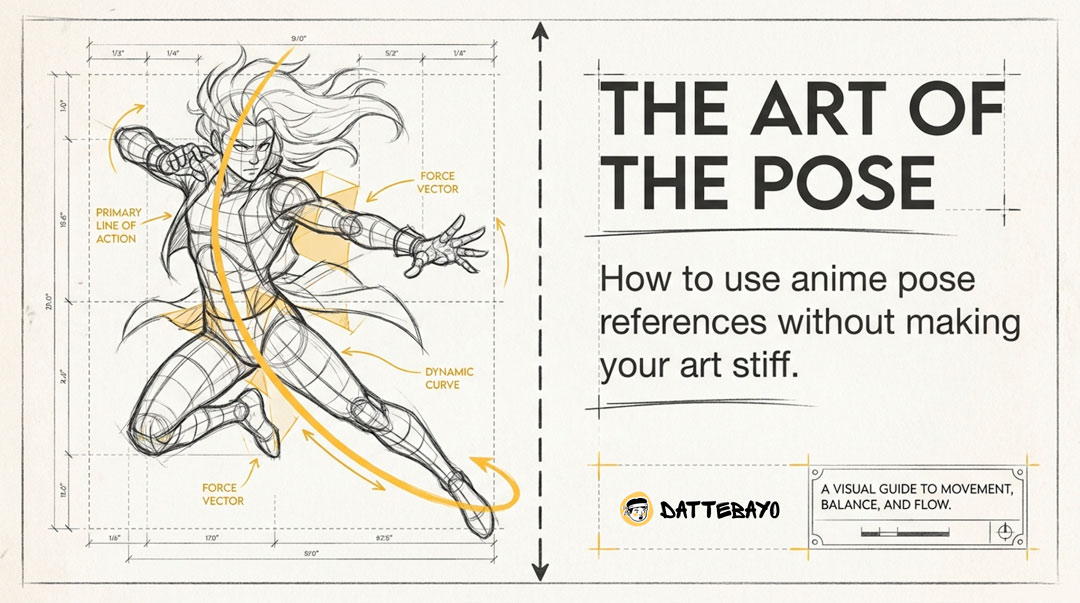
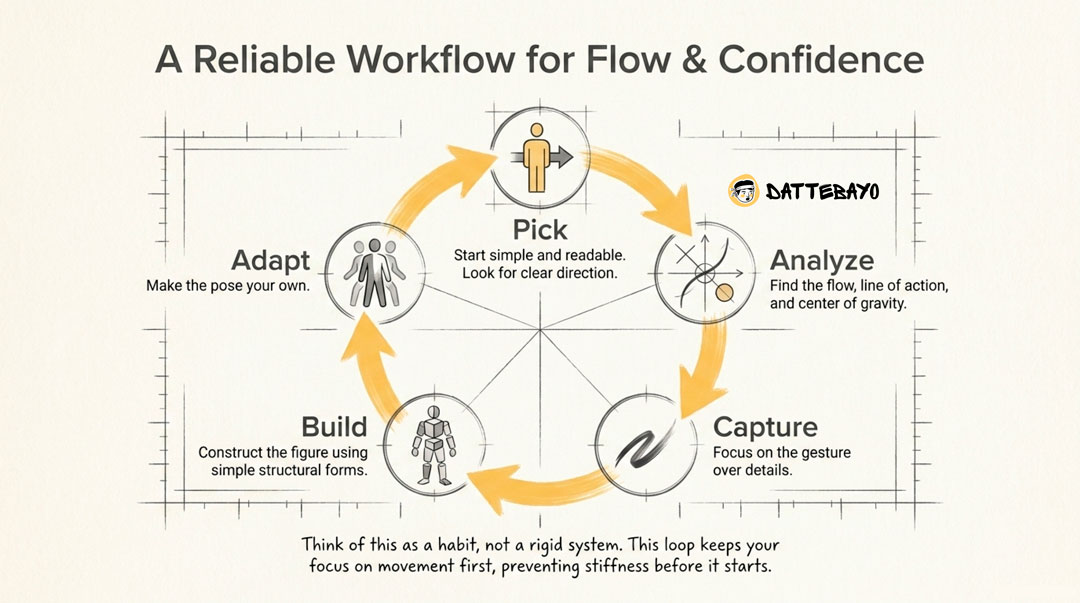
Use a simple mental loop: observe the pose’s flow, understand its balance, then adapt it to your character. That’s what turns stiff copies into believable movement.
Most beginners try to redraw exactly what they see. That usually leads to rigid, slightly off poses. The shift that helps is focusing less on lines and more on movement.
Think of it like this:
- Observe: What direction is the body moving? Is it relaxed, tense, playful?
- Understand: Where is the weight? Which part of the body is doing the work?
- Adapt: How would your character exist in that same pose?
Don’t copy the outline. Follow the energy.
A quick comparison:
- What beginners do: copy the silhouette exactly
- What works: reinterpret the pose based on flow and intent
This “observe → understand → adapt” loop quietly underpins everything else in this guide.
What Are Anime Reference Poses (and Why They Matter)?
Anime reference poses are visual guides that help you understand movement, balance, and expression—so your drawings feel alive instead of stiff.
They’re not shortcuts—they’re tools for training your eye.
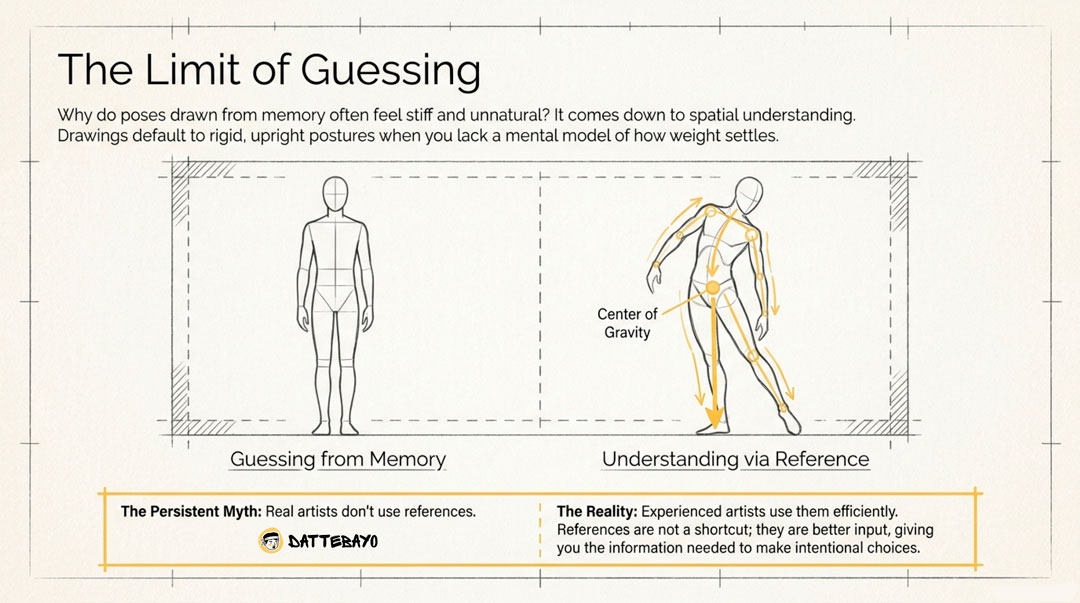
Even experienced artists rely on references. The human body is too complex to guess consistently, especially when you’re pushing stylization. References keep your work grounded while you exaggerate.
At their core, pose references teach:
- Gesture (the flow of movement)
- Weight (how the body stays balanced)
Everything else builds on those.
Why Drawing Without References Creates Stiff Poses
Because your brain defaults to simplified symbols instead of real movement.
Without references, you tend to draw what you think a pose looks like:
- standing = straight spine, evenly planted feet
- sitting = stiff angles and symmetry
Real bodies don’t behave like that. They lean, shift, and constantly adjust.
There’s also a common myth that “good artists don’t use references.” In reality, they use them all the time—they’re just more intentional about it.
What Pose References Actually Teach You
They train you to see relationships, not just shapes.
A strong reference shows:
- how the spine flows through the pose
- how weight shifts across the body
- how small tilts change the mood entirely
You stop thinking in parts and start thinking in systems.
Where to Find Good Anime Pose References (Without Getting Overwhelmed)
You can find references almost anywhere—but picking the right ones matters more than collecting lots of them.
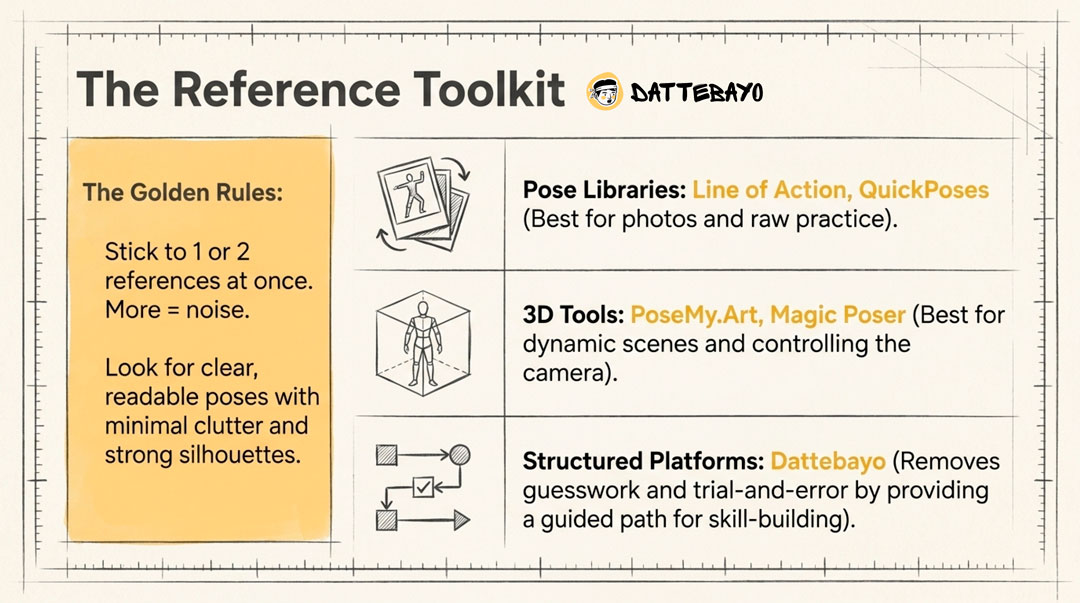
It’s easy to fall into endless scrolling. Platforms like Pinterest or Pixiv offer huge libraries, while structured platforms like Dattebayo give you more guided practice.
Other solid sources:
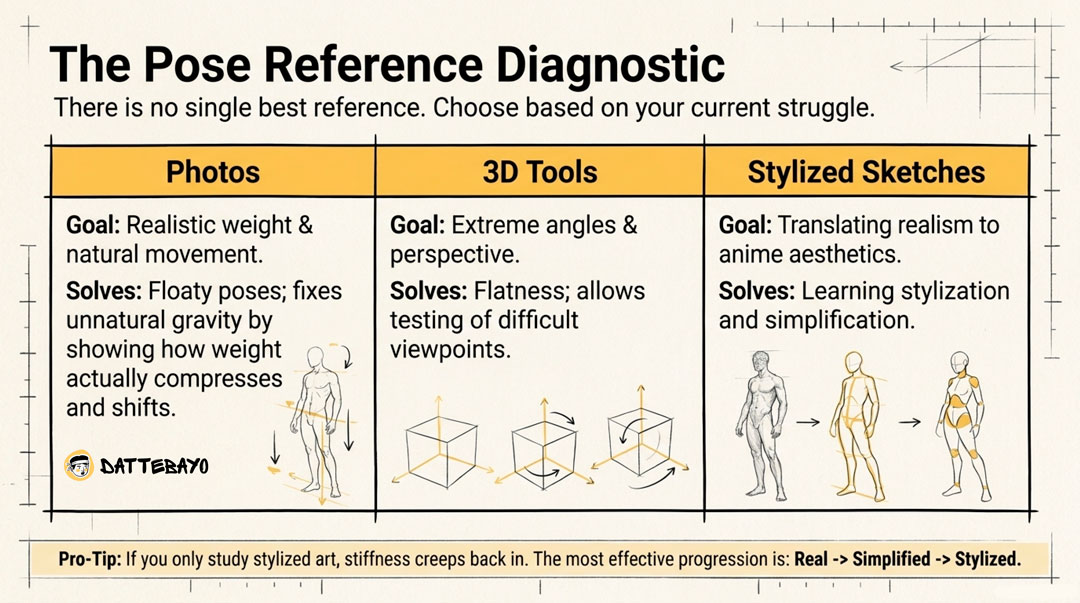
- Photo references (sports, fashion, candid shots)
- 3D pose tools
- Newer AI-generated pose tools
But more isn’t better. What matters is clarity.
How to Tell if a Pose Reference Is Actually Good
A good pose is clear, balanced, and readable at a glance.
Look for:
- a strong silhouette
- clear weight distribution
- natural, believable positioning
- no obvious anatomy issues
If you have to squint to understand what’s happening, it’s not a great study reference.
Are Pinterest, Pixiv, and AI Tools Reliable?
They’re useful—but inconsistent, so you need to filter.
Pros:
- huge variety
- quick inspiration
- exposure to different styles
Cons:
- anatomy mistakes (especially in AI-generated images)
- overly exaggerated or unclear poses
- no built-in learning structure
As of 2026, AI-generated references are everywhere. They’re great for ideas, but not always reliable for learning fundamentals—so treat them carefully.
How to Choose the Right Pose for Your Character
Start with intent, not the pose. A pose should express something—not just look interesting.
A simple way to think about it:
- What is your character feeling?
- How does that affect their posture?
- What angle best supports that feeling?
- How does lighting reinforce it?
That’s where pose becomes storytelling.
How Pose Instantly Changes Personality
Posture is personality made visible.
- A confident character takes up space
- A shy character folds inward
- An energetic character rarely stays upright or still
Even small adjustments—like a tilted head or shifted hip—can change the entire impression.
Camera Angle and Lighting (Made Simple)
Angle and lighting amplify what the pose is already saying.
- Low angle → power
- Eye level → neutral
- High angle → vulnerability
Lighting follows the same idea:
- top-down → dramatic
- soft front → calm
- strong side → tension
Keep it simple—just make sure it supports the pose.
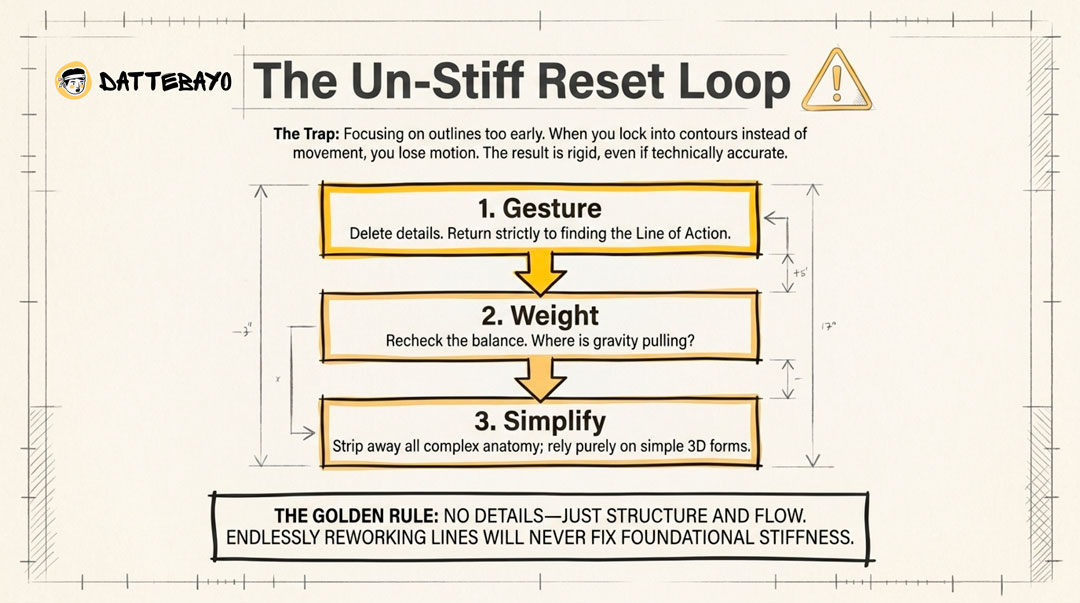
Why Your Poses Still Look Stiff (Even With References)
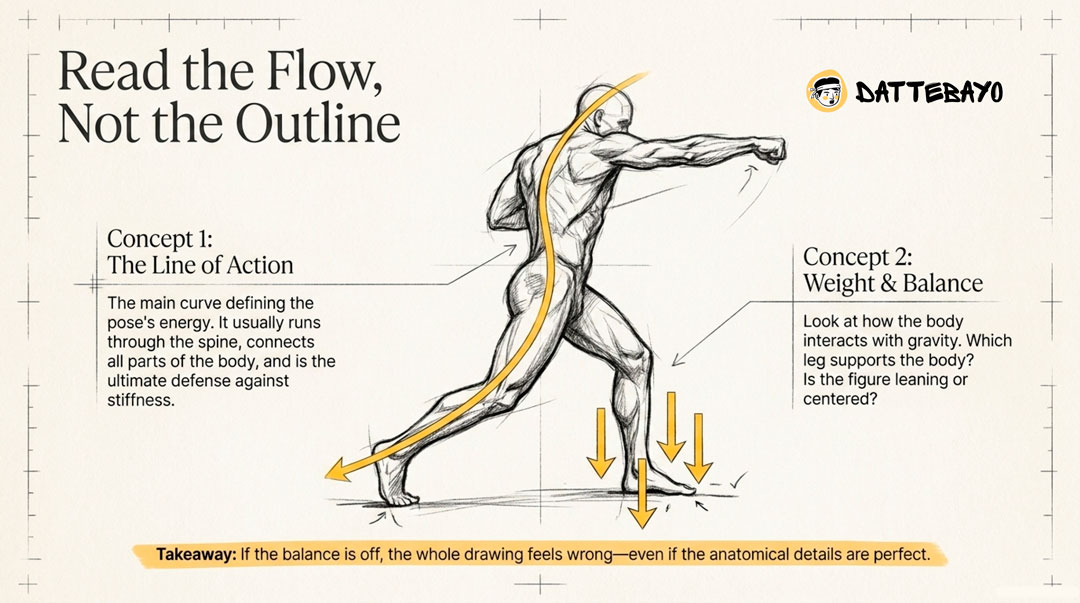
Because you’re focusing on outlines instead of movement and balance.
This is where most frustration comes from.
Even with a strong reference, your drawing can feel rigid if you prioritize:
- contours over flow
- details over structure
Gesture and weight aren’t separate—they work together.
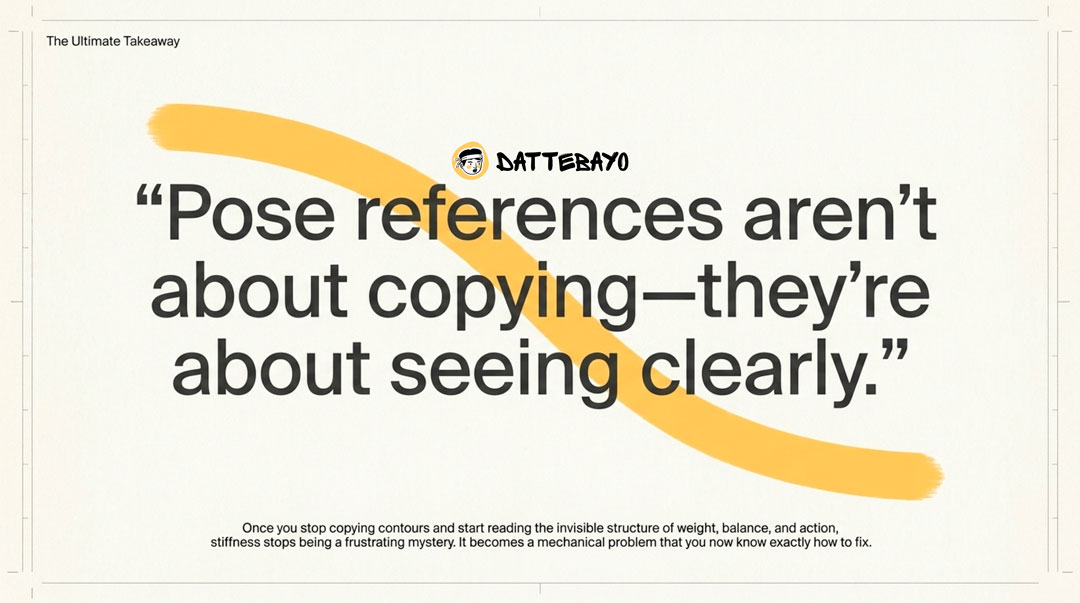
Copying vs Understanding: The Real Difference
Copying focuses on appearance. Understanding focuses on structure.
You can copy a pose and make it look “correct,” but still not understand it. That’s why it’s hard to draw original poses afterward.
At Dattebayo, this shift—from copying to understanding—is treated as a key turning point for beginners.
What Makes a Pose Feel Natural vs Awkward
Natural poses feel balanced and connected.
Ask yourself:
- Where is the center of gravity?
- Could this pose actually hold its weight?
- Is there a clear flow through the body?
If one of those breaks, the pose starts to feel off.
Common Beginner Mistakes When Using Pose References
The problem usually isn’t the reference—it’s how it’s used.
Common patterns:
- copying too literally
- jumping into details too early
- ignoring perspective
- mixing references without a clear role
- choosing overly complex poses
Why “Perfect Copying” Slows Your Progress
Because it feels like improvement without building real understanding.
You might get a clean result—but you won’t know how to recreate it from scratch.
That becomes frustrating when you try to draw your own characters.
Using Multiple References Without Making a Mess
Give each reference a clear purpose.
For example:
- one for pose
- one for details (clothing, hands, etc.)
Too many inputs without structure quickly turns into confusion.
Can You Trace Pose References (And When Should You Stop)?
Yes—tracing can help early on, but it shouldn’t be the end goal.
Used well, tracing helps you notice:
- proportions
- flow
- structure
Used poorly, it becomes a habit that blocks growth.
How to Use Tracing as a Study Tool
Focus on what’s happening, not just what you’re outlining.
Pay attention to:
- the line of action
- how weight is distributed
- the major forms underneath
That’s where the learning happens.
When to Transition to Drawing Without Tracing
When you can roughly reconstruct poses from memory and modify them.
Good signs:
- you can simplify complex poses
- you understand balance
- you can make small changes confidently
That’s your cue to move toward interpretation.
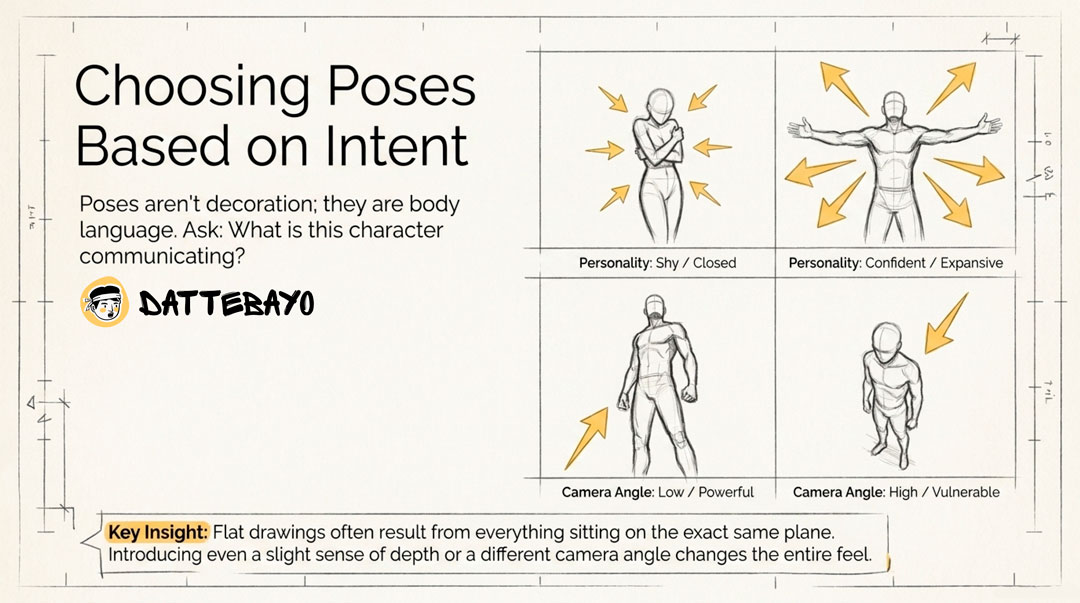
Photo vs Anime References: When to Use Each
Use photos for realism and anime references for stylization—they complement each other.
Each fills a gap the other leaves.
Why Photos Improve Your Poses Faster
Because they show how bodies actually behave.
Photos capture:
- subtle weight shifts
- natural asymmetry
- believable movement
They build a strong foundation.
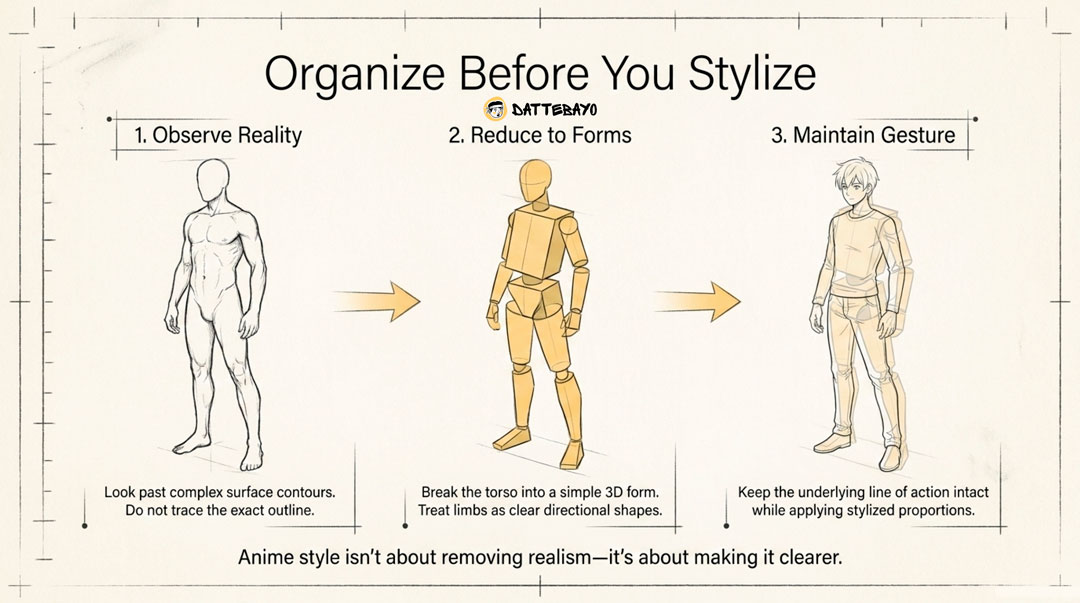
How Anime References Simplify and Stylize Movement
They show how to exaggerate and clarify.
Anime references:
- simplify anatomy
- emphasize gesture
- create cleaner silhouettes
If you only use anime references, poses can feel repetitive. If you only use photos, your style may feel stiff. The balance matters.
How to Create Original Poses Using References
Originality comes from combining and adjusting—not inventing from nothing.
Think of references as building blocks.
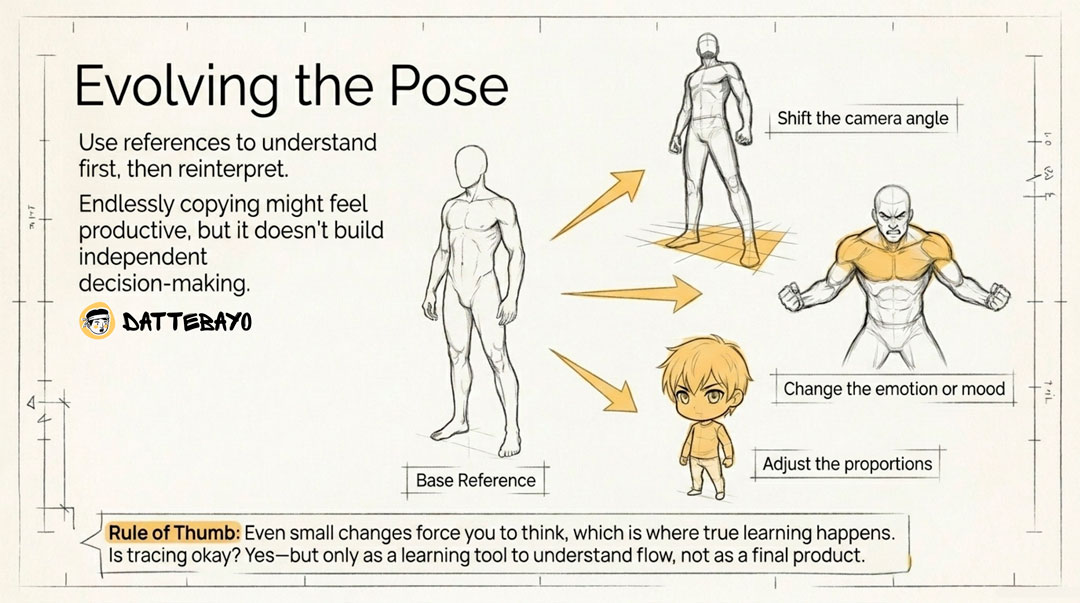
The “Mix and Modify” Approach to References
Pull specific elements and recombine them intentionally.
- pose from one reference
- expression from another
- angle from a third
Then adjust to fit your character.
Why Iterating Multiple Poses Improves Results
Your first idea is rarely your strongest.
Try small variations:
- push the gesture further
- shift the angle
- adjust timing or weight
These tweaks often lead to much better results.
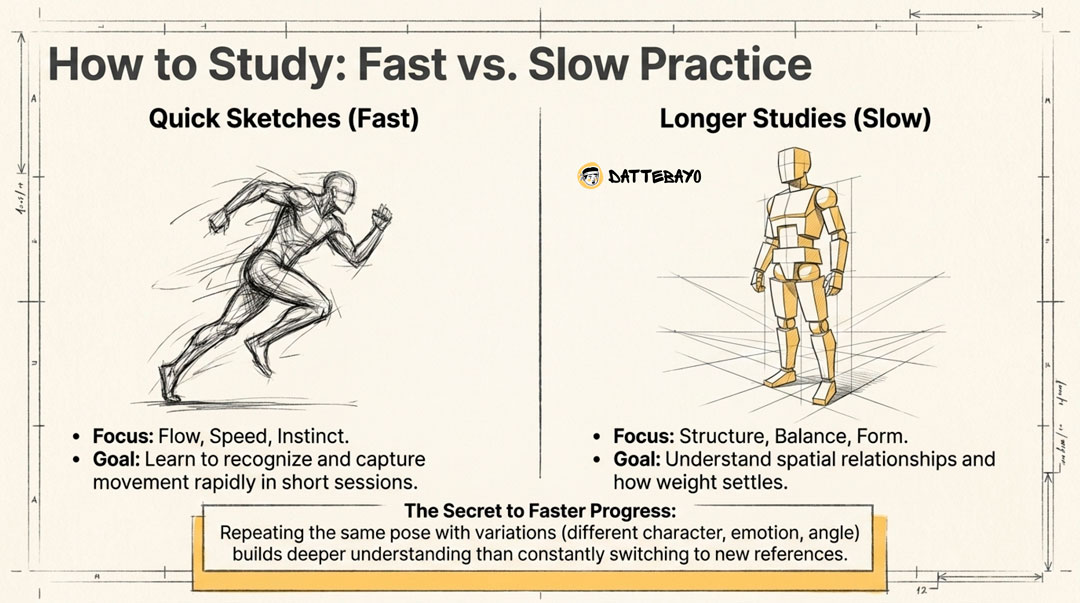
How to Practice Pose Drawing Without Wasting Time
Short, focused practice beats long, unfocused sessions.
You don’t need hours—you need direction.
A simple structure:
- quick gesture studies to build flow
- longer studies to build understanding
Consistency matters more than intensity.
How Often Should You Practice Pose Drawing?
10–20 minutes regularly is enough to see progress.
Daily helps, but consistency is what really moves things forward.
Structured Practice vs Random Practice
Structure speeds everything up.
Random scrolling:
- feels productive
- rarely builds skills
Structured learning—like the guided approach on Dattebayo—walks you through:
- gesture
- anatomy
- character design
That progression removes guesswork and keeps you improving steadily.
What to Do Next (Simple Progression Plan)
Focus on movement first, then layer in complexity.
If there’s one idea to keep, it’s this:
Don’t copy poses—understand them.
A simple path forward:
- gesture (flow and rhythm)
- basic anatomy (structure)
- character design (expression and storytelling)
If you want guidance instead of guessing your way through, Dattebayo organizes this progression in a beginner-friendly way.
You don’t need better references—you need a better way to use them.
FAQ
Can I use multiple pose references for one drawing?
Yes—just give each one a clear role.
How do I make a pose look less copied?
Change the angle, exaggerate the gesture, or adjust proportions.
What makes a pose look natural instead of awkward?
Clear balance, believable weight, and smooth flow.
Are 3D pose tools better than photo references?
They’re flexible, but photos usually show more natural movement.
Do professional artists still use pose references?
Yes—it’s a normal part of the workflow.
How often should I practice pose drawing?
Short, consistent sessions (10–20 minutes) work well.
Is tracing bad if I want to improve?
No—if you use it to understand, not just copy.
Why do my poses look stiff even when I follow a reference?
Because you’re likely focusing on outlines instead of gesture and weight.