
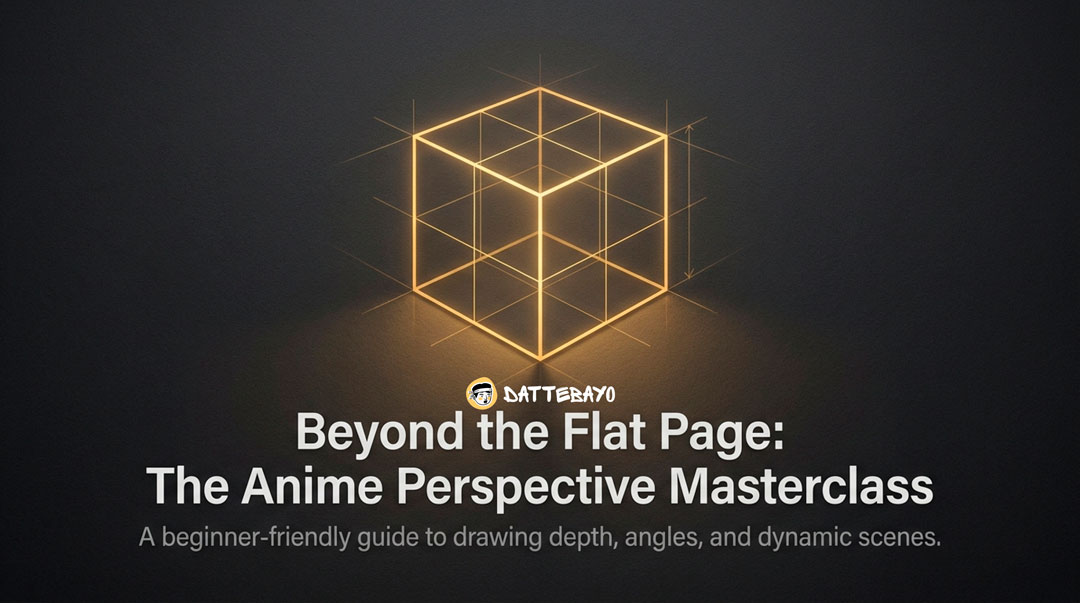
If your anime drawings feel flat, stiff, or slightly “off,” it’s usually not a talent issue—it’s a perspective issue. The good news: perspective isn’t as technical as it sounds. It’s really just learning to think about your drawing as something that exists in space.
Once that clicks, everything starts to feel more solid and intentional.
What is perspective in anime drawing (in simple terms)?
Perspective is how objects change in size and position based on distance, making your drawing feel like it exists in real space.
In anime, this applies to everything—not just backgrounds. A hand reaching toward the viewer should feel closer than the face. A character farther away shouldn’t be the same size as one in front.
A simple mindset shift helps a lot: you’re not just drawing a character—you’re choosing a camera view.
Where is the viewer? Are they looking up, down, or straight ahead? That choice shapes the entire drawing.
When perspective is missing, characters often look like they’re pasted onto the page instead of existing inside it.
Why do flat anime drawings happen so often?
Flat drawings usually come from ignoring distance and depth cues.
You’ll often see:
- Characters staying the same size regardless of position
- No overlap between objects
- Even spacing everywhere
- Detail used to “fake” depth instead of building it
The lines might look clean—but the scene feels lifeless.
Is perspective different in anime vs realistic art?
The rules are the same—anime just simplifies and exaggerates them.
Most anime artists follow a pattern:
Learn the rule → simplify it → push it for style
That’s why you’ll see dramatic angles, oversized hands, or extreme camera views. It’s not breaking perspective—it’s using it creatively.
The simple mental model: thinking in 3D (even if you draw in 2D)
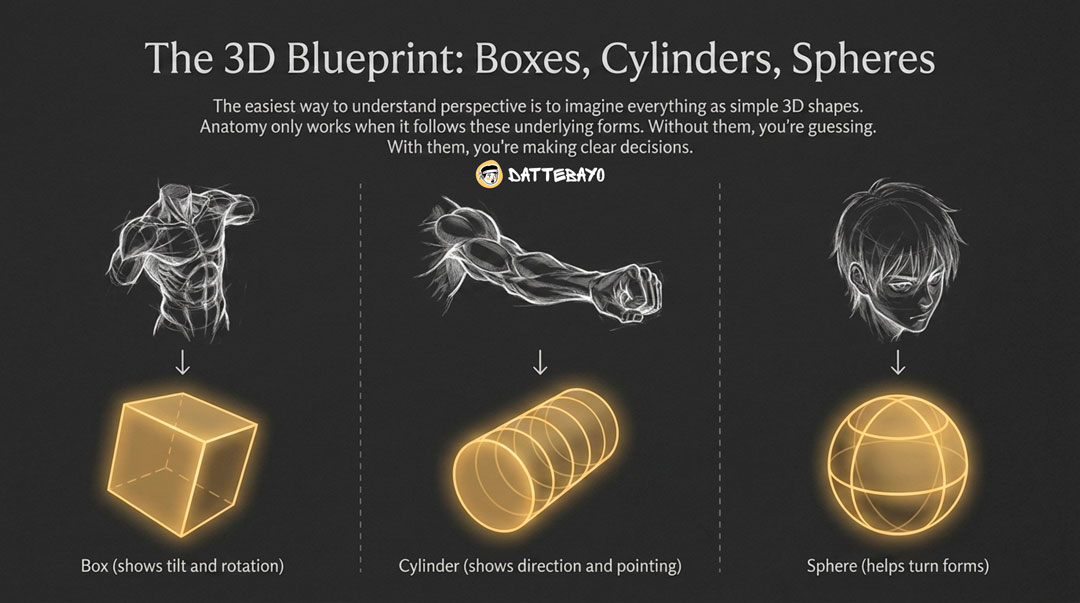
The easiest way to understand perspective is to imagine everything as simple 3D shapes.
Instead of thinking “arm” or “head,” think:
- box
- cylinder
- sphere
Anime characters are basically built from these forms. Once you start seeing that, perspective becomes much easier to control.
At Dattebayo, this shift is introduced early because it removes a lot of guesswork right away.
Why boxes and cylinders fix most perspective problems
Simple shapes give you clarity about direction and orientation.
- A box shows how something is tilted or rotated
- A cylinder shows where something is pointing
- A sphere helps with turning forms like the head
Without these, you’re guessing. With them, you’re making clear decisions.
How perspective connects to anime anatomy
Anatomy only works when it follows perspective.
For example:
- A tilted torso changes how shoulders align
- A rotated head shifts where features sit
- A forward arm appears larger because it’s closer
So if a drawing looks “off,” it’s often a perspective issue—not an anatomy one.
Do you really need perspective to draw anime characters?
Yes—perspective is what makes characters feel grounded and believable.
Even if you never draw backgrounds, perspective is still shaping every pose.
How perspective affects anime poses (the key idea)
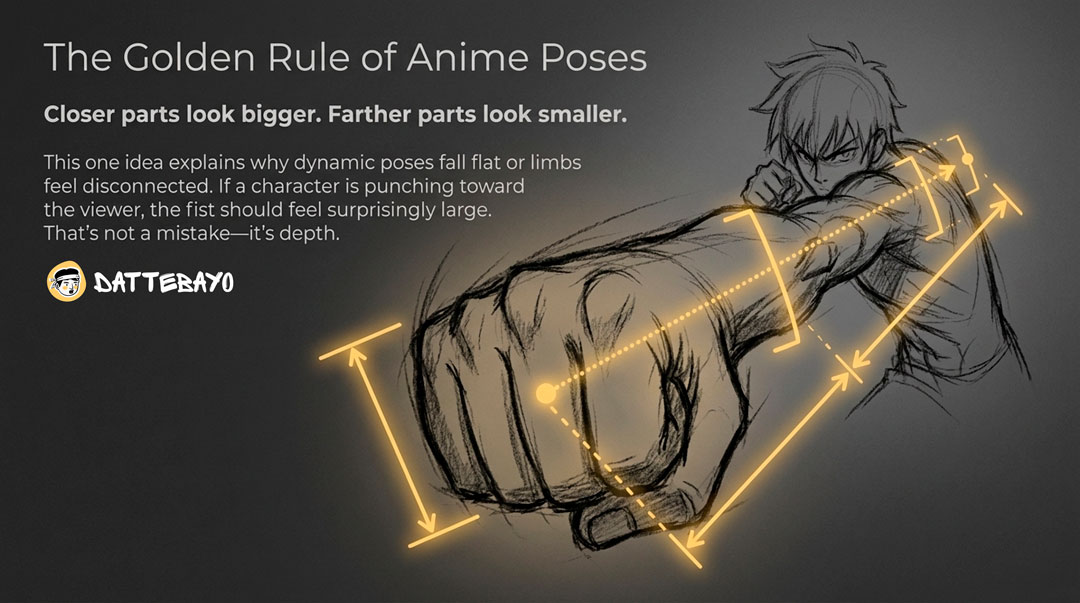
Closer parts look bigger. Farther parts look smaller.
That one idea explains a lot:
- why hands look too small in action poses
- why limbs feel disconnected
- why dynamic poses fall flat
If a character is punching toward the viewer, the fist should feel surprisingly large. That’s not a mistake—it’s depth.
Why characters look “off” without perspective
It’s usually inconsistent spatial logic, not bad drawing.
Watch for:
- Body parts following different angles
- Size relationships that don’t match distance
- Characters that feel like they’re floating
Fix the perspective, and the drawing often improves immediately.
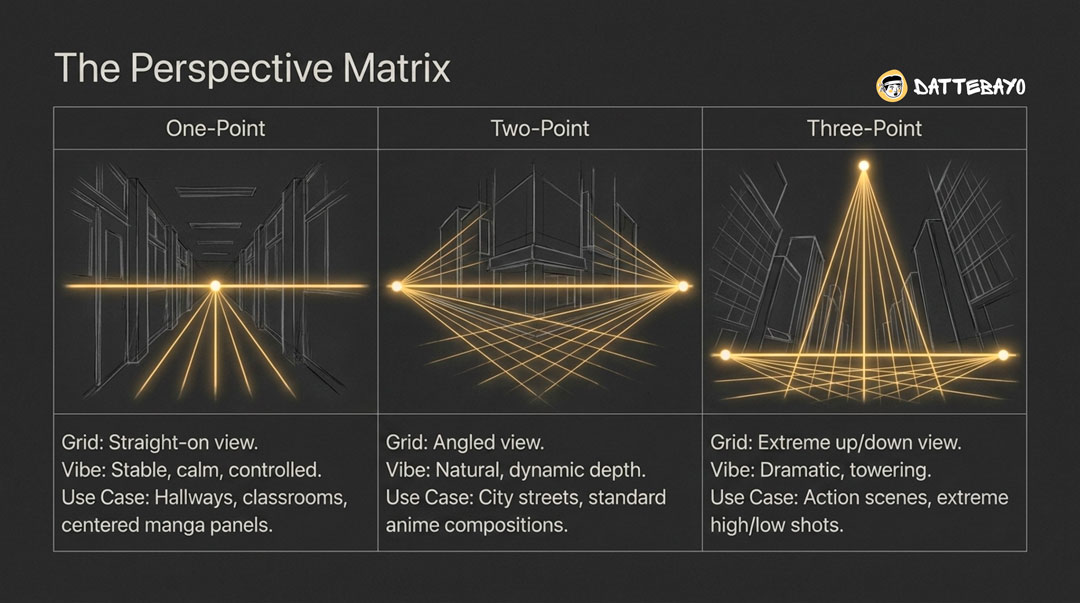
One-point vs two-point perspective (and when to use each)
One-point is best for straight-on views, while two-point creates more natural, angled scenes.
You don’t need heavy theory—just understand how they affect the “camera.”
- Horizon line = eye level
- Vanishing points = where lines converge
Think of them as rules for how your scene is being viewed.
Here’s a simple visual tool to help you feel the difference:
When to use one-point perspective (simple and stable)
Use one-point for scenes facing the viewer directly.
Common examples:
- hallways
- classrooms
- centered manga panels
It creates a calm, controlled feeling.
When to use two-point perspective (dynamic and natural)
Use two-point when your scene is angled.
Examples:
- city streets
- rooms viewed from a corner
- most anime compositions
This is what gives scenes a more natural sense of depth.
When you’ll encounter three-point perspective (beginner awareness)
Three-point shows up in extreme angles—looking far up or down.
Think dramatic shots like:
- towering characters viewed from below
- top-down action scenes
You don’t need to master it yet—just recognize it.
Camera angles in anime: eye-level, low angle, and high angle
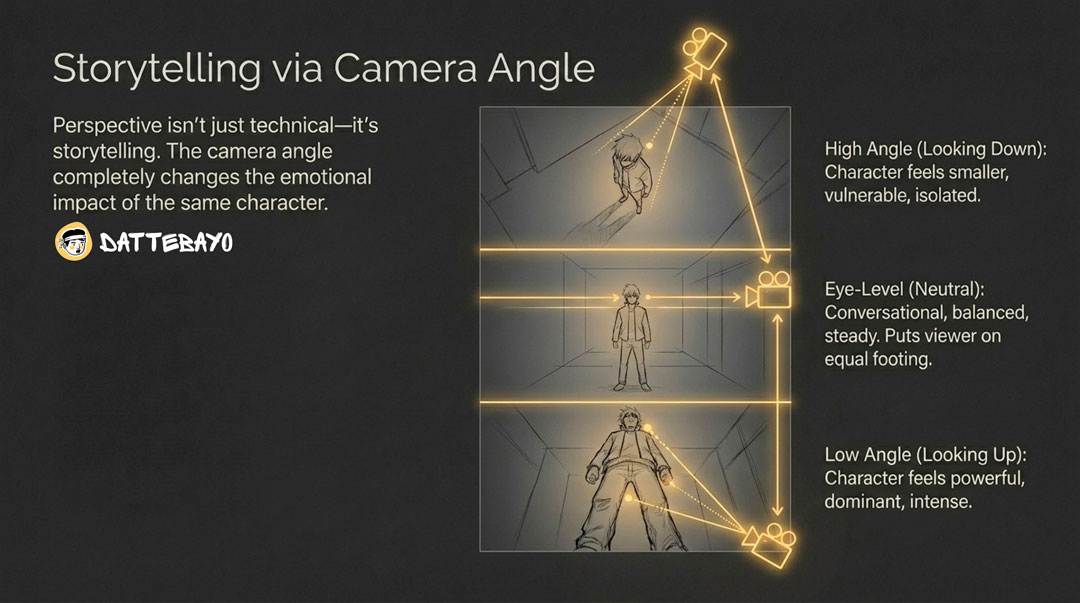
Camera angle changes how a scene feels emotionally.
Perspective isn’t just technical—it’s storytelling.
Eye-level (neutral and balanced)
Feels natural and steady.
Used for:
- conversations
- everyday moments
It puts the viewer on equal footing with the character.
Low angle (powerful and dramatic)
Looking up makes characters feel strong or dominant.
Common in:
- action scenes
- hero shots
It adds intensity and presence.
High angle (vulnerable or distant)
Looking down makes characters feel smaller or isolated.
Used for:
- emotional scenes
- quieter moments
Same character, completely different impact.
How to create depth in anime scenes (without overcomplicating it)
Depth comes from layering and size relationships—not complex grids.
You can create space even with very simple backgrounds.
The 3-layer idea (foreground, midground, background)
Divide your scene into three zones:
- Foreground (closest)
- Midground (main subject)
- Background (furthest)
Even a small foreground element can instantly add depth.
How to make simple backgrounds feel alive
Variation matters more than detail.
Instead of spacing everything evenly:
- change sizes based on distance
- overlap elements
- avoid perfect alignment
This makes scenes feel more natural and less staged.
Foreshortening made simple (the most useful anime perspective skill)
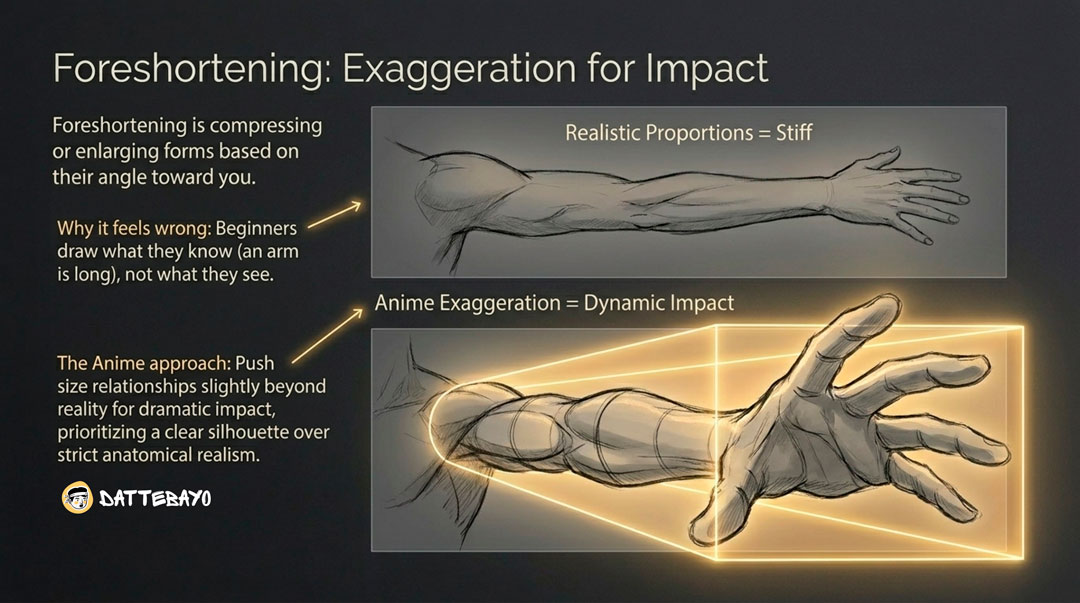
Foreshortening is when forms appear compressed or enlarged based on their angle toward you.
It’s a big part of what makes anime poses feel dynamic.
Why foreshortening looks wrong when you draw it
Because you draw what you know, not what you see.
You know an arm is long—so you draw it long, even when perspective says it should look shorter.
That mismatch creates the “off” feeling.
How anime artists exaggerate foreshortening for impact
They push it slightly beyond reality while keeping it readable.
- larger hands in action shots
- compressed limbs to show motion
- clear silhouettes over strict realism
That balance is what makes it feel intentional, not distorted.
Why beginners struggle with perspective (and how to fix it)
Most beginners focus on details before understanding space.
That’s completely normal—but it slows progress.
The most common perspective mistakes in anime art
- Same size regardless of distance
- Floating characters
- Misaligned angles across the body
These all point back to one thing: missing 3D thinking.
Why starting simple actually speeds up progress
Simple forms give faster feedback and build confidence.
Instead of polishing one drawing for hours, you improve more by exploring many quick spatial ideas.
That’s why structured learning paths—like the ones at Dattebayo—focus on fundamentals early. It saves you time later.
What’s the fastest way to improve perspective in anime drawing?
Practice simple forms, observe real scenes, and gradually apply perspective to characters.
Short, consistent sessions work better than long, occasional ones.
A solid progression looks like:
- Simple 3D shapes
- Basic environments
- Characters placed in space
- Dynamic angles and poses
Use references to speed things up:
- anime frames
- real-life photos
- 3D pose apps (now a standard part of many artists’ workflows in 2026)
Most modern drawing apps also include built-in perspective guides. They’re not shortcuts—they help train your eye.
If you want a clear structure without guessing what to practice next, Dattebayo organizes this progression in a beginner-friendly way.
A simple weekly practice approach (no overwhelm)
- Short sessions (15–30 minutes)
- One focus per session
- Mix observation with imagination
Consistency matters more than intensity.
Should you use digital perspective tools or draw freehand?
Use both—they build different skills.
- Tools improve accuracy
- Freehand builds intuition
Together, they make progress faster.
Perspective cheat sheet (if you only remember 3 things)
You don’t need everything—just the core ideas:
- Think in 3D shapes, not outlines
- Closer = bigger, farther = smaller
- Use camera angle to shape the scene
Apply just these, and your drawings will already feel more alive.
FAQ
Do I need to learn perspective before anatomy?
No—learn them together. Perspective helps anatomy make sense in different angles.
What’s the easiest perspective type for beginners?
One-point is the simplest to understand, but two-point is used more often in real scenes.
Why does foreshortening look wrong when I draw it?
Because of incorrect size relationships—you’re drawing what you expect instead of what you see.
How long does it take to get good at perspective?
You’ll see improvement within weeks of consistent practice. The basics click faster than you might expect.
What apps or tools help with perspective drawing?
Most modern apps include perspective guides, and many artists use 3D pose tools for reference.
How do I practice perspective without getting overwhelmed?
Keep sessions short, focus on simple forms, and follow a structured path—like the approach used at Dattebayo.
Why do my anime characters still look flat?
You’re likely missing size variation, overlap, or a clear camera angle.
Can I skip perspective if I only draw characters?
No—perspective directly affects how believable your characters feel.
Perspective isn’t about memorizing rules—it’s about learning to see space. Once you start thinking in 3D, your drawings naturally gain depth, energy, and clarity.
Stick with it, keep it simple, and that “flat” feeling will fade faster than you think.