If hands make you hesitate, erase, or abandon a drawing halfway through—you’re not alone. This isn’t about memorizing a rigid method. It’s about learning to see hands in a way that makes them manageable. Once that clicks, you can rotate them, simplify them, and keep them expressive without getting stuck.
Why anime hands feel so hard (and what actually fixes it)
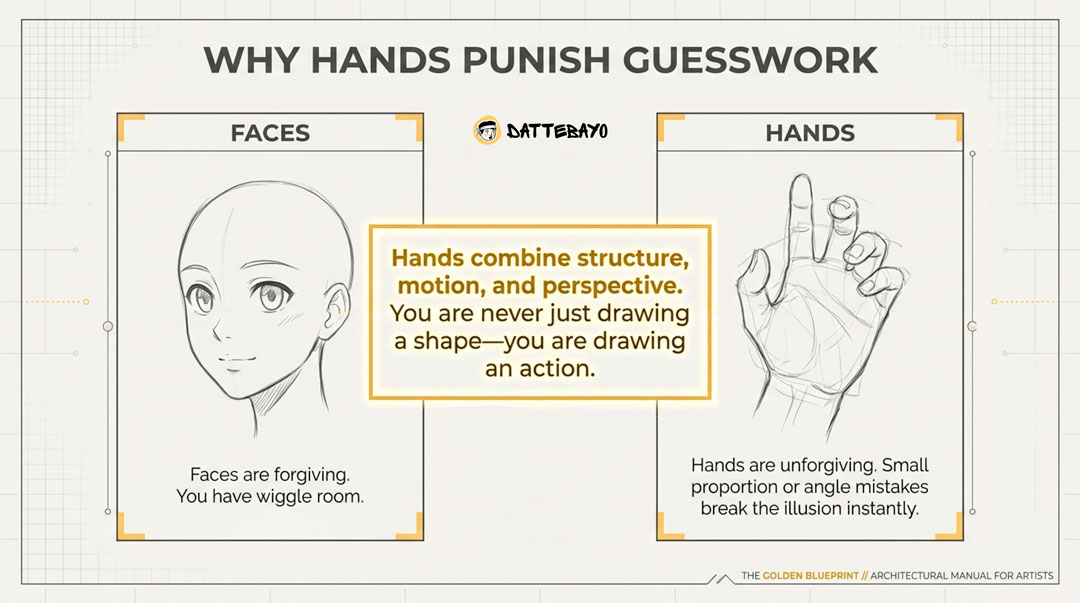
Hands are tricky because they combine structure, motion, and perspective—but most beginners rely on outlines instead of building forms.
Faces give you some wiggle room. Hands don’t. Even small proportion or angle mistakes stand out immediately. On top of that, hands are rarely static—they’re pointing, gripping, reacting—so you’re always drawing both a shape and an action.
The real shift is simple: stop starting with the outline and start thinking in 3D forms. When you build a hand from basic volumes, it becomes something you can rotate and adjust instead of guessing each line.
“If you can picture the hand as a solid object, it stops fighting you on the page.”
The most common beginner mistakes (and why they happen)
- Drawing fingers separately without a solid base
- Jumping into details like nails too early
- Treating the hand like a flat shape
These all come from the same place: outlines feel easier, but they don’t give you control.
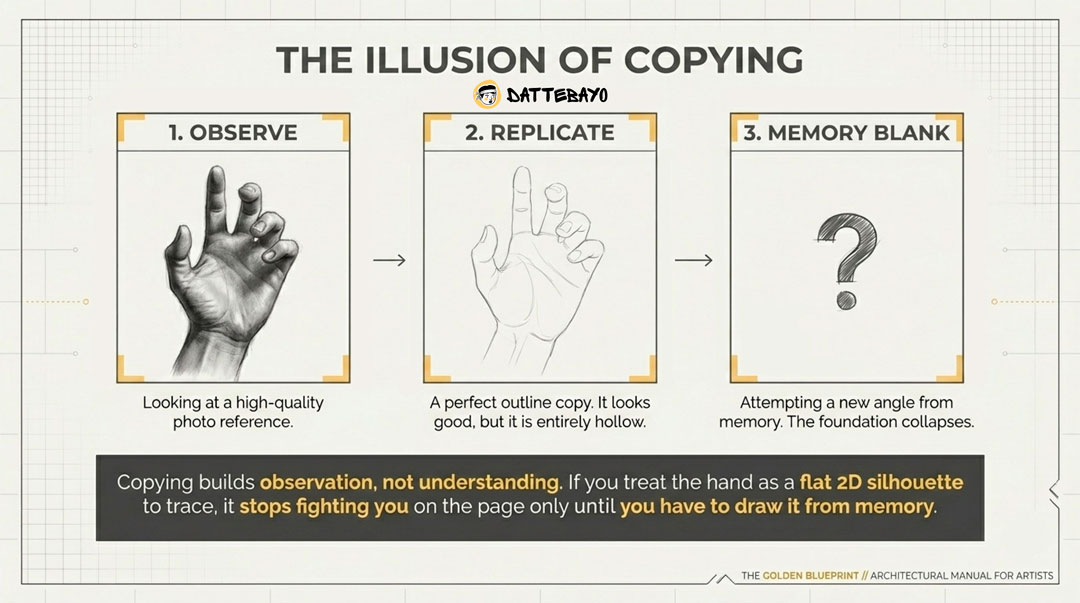
Why copying references alone doesn’t work
Copying helps your observation, but it doesn’t automatically build understanding. If you’ve ever copied a hand perfectly and then couldn’t redraw it later, you’ve seen this firsthand.
Real progress comes from simplifying what you see into forms. That’s a core idea in structured learning spaces like Dattebayo, where the focus is on building drawings—not just replicating them.
The simplest way to understand anime hand structure
Think of the hand as a block (palm) with cylinders (fingers), not a flat silhouette.
This single idea clears up a lot of confusion. Instead of five disconnected fingers, you’re working with one main mass and attached forms.
- The palm acts like a slightly flattened box
- The fingers are segmented cylinders
- The thumb sits at an angle, almost like its own mini-structure
Once you see this, proportion issues become easier to catch and fix.
How long should fingers be relative to the palm?
You don’t need exact measurements. A simple guide:
- The middle finger is roughly similar in length to the palm
- Other fingers taper shorter
- The thumb starts lower and moves differently
Consistency matters more than precision. If your internal logic stays stable, your hands will feel intentional—even when stylized.
Why simple shapes fix most beginner mistakes
Simple forms give you something outlines can’t: volume and orientation. You can tilt a box or rotate a cylinder. A flat outline doesn’t give you that flexibility.
That’s why beginner-focused programs like Dattebayo’s drawing course emphasize construction early—it removes guesswork later.
Hand Proportion Visualizer
Adjust palm and finger lengths to see how proportions change.