
Starting anime drawing can feel surprisingly confusing. You love anime, you want to create your own characters, and you open a tutorial… only to realize you’re copying lines without really understanding what’s happening.
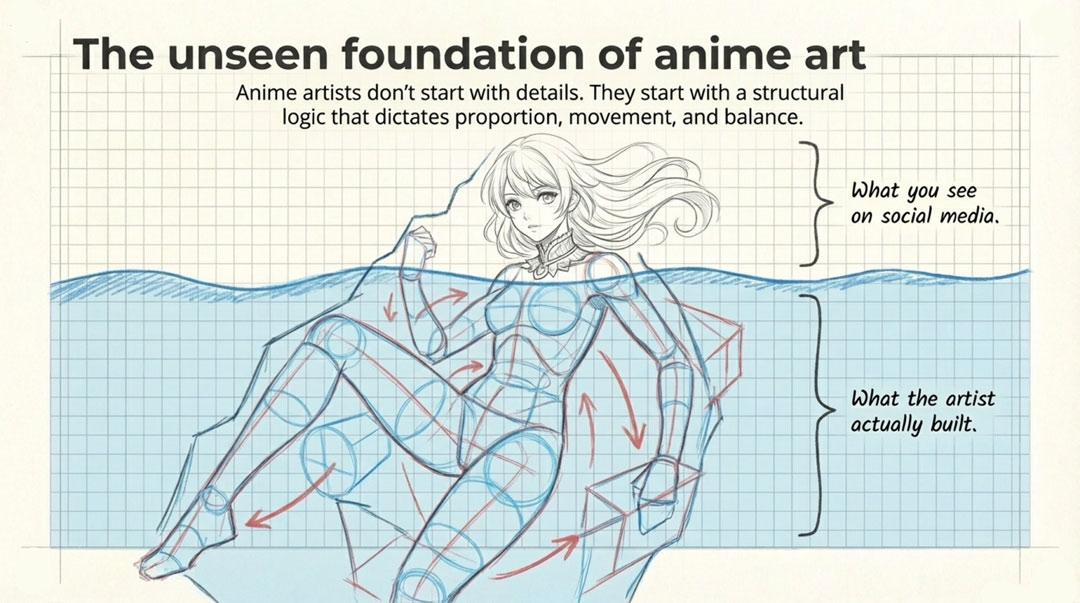
The key is realizing that anime artists don’t start with details—they start with structure. Instead of focusing on eyes, hair, or clothing right away, experienced artists think about proportions, movement, and how the character is built.
This guide introduces the beginner roadmap many anime artists follow. Rather than overwhelming tutorials, you’ll learn the core ideas behind anime character drawing and how to practice in a way that actually helps you improve.
How should beginners start learning anime drawing?

The best way to start anime drawing is by learning how characters are constructed—using simple shapes, balanced proportions, and loose sketches before any details appear.
Many beginners assume anime drawings begin with carefully placed features. In reality, if you watch professional illustrators or manga artists work, you’ll notice something interesting: the earliest version of the drawing looks extremely simple.
Artists begin with a structural framework.
Think of it as the character’s foundation. Before personality, hairstyle, or costume design appears, the drawing needs a base that makes the pose and proportions feel believable.
That base usually comes from three ideas:
- simple construction shapes
- consistent proportions
- a loose sketch capturing the pose
Once that structure works, refining the drawing becomes much easier.
For beginners, this mindset shift is huge. Instead of trying to perfectly copy finished anime artwork, you start understanding how it was built.
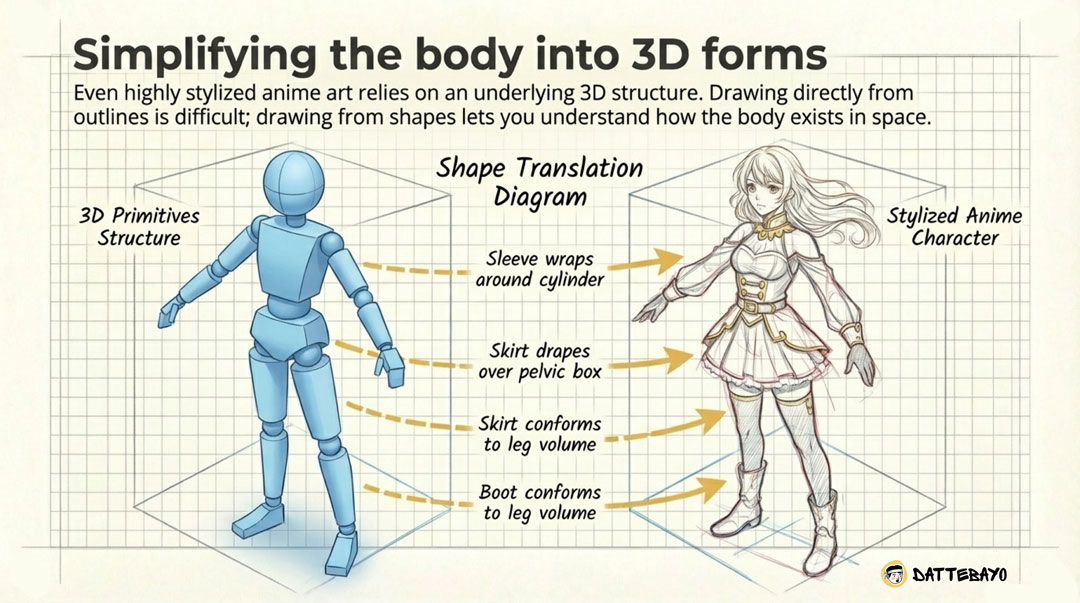
Anime characters may look complex, but underneath the style they are constructed from surprisingly simple forms.
Beginner-focused learning platforms—including courses from Dattebayo—often emphasize this construction-first approach because it removes a lot of early frustration.
Why anime characters are built from simple shapes
Anime designs may look stylized, but their underlying structure is usually built from basic forms.
Artists often think in shapes such as:
These shapes simplify the body into manageable pieces.
- circles for the head
- cylinders for arms and legs
- boxes or tapered blocks for the torso and hips
These shapes simplify the body into manageable pieces.
Why does that help? Because drawing a human figure directly from outlines is difficult. Shapes let you understand how the body exists in three-dimensional space.
Once those forms are established, placing facial features, adjusting proportions, and designing clothing becomes much more manageable.
Even very stylized anime—from energetic shōnen characters to calm slice‑of‑life designs—usually follows this same structural logic.
What does the typical anime drawing workflow look like?

Most anime illustrations develop through several stages rather than appearing as a single perfect drawing.
The process usually moves through three phases:
- Loose sketch to explore pose and structure
- Refinement to adjust proportions and character design
- Line art to create confident final lines
Beginners rarely see these earlier stages because social media usually shows finished artwork. But the real thinking happens during the sketch phase.
Digital art apps like Clip Studio Paint or Procreate make this process easier to see because artists separate stages using layers. The same idea still applies when sketching with pencil and paper.
Why focusing on details too early slows beginners down
One of the biggest beginner traps in anime drawing is starting with the most exciting parts.
Eyes, hair, and clothing designs are fun—but they depend heavily on the structure underneath.
When the structure isn’t solid, you often get issues like:
When you start with structure instead, details suddenly become easier because they have a stable foundation.
- uneven head shapes
- eyes that don’t align correctly
- awkward posture
- limbs that feel disconnected
When you start with structure instead, details suddenly become easier because they have a stable foundation.
What drawing fundamentals matter most for anime beginners?
The most important fundamentals for anime drawing are construction shapes, proportions, pose flow (gesture), and observation through references.
You don’t need complex art theory to start drawing anime characters. In fact, beginners often improve faster when they focus on a few core skills rather than trying to learn everything at once.
These fundamentals support almost every character drawing you’ll create.
Why are construction shapes so important?
Construction shapes help you organize the body before details appear.
Instead of guessing where things go, you create a simple framework that guides the drawing.
This makes it easier to:
Even highly stylized anime art relies on structure underneath the design.
- place the head and torso correctly
- align shoulders and hips
- understand how limbs attach to the body
Even highly stylized anime art relies on structure underneath the design.
How do proportions affect anime characters?
Proportions describe how different parts of the body relate to each other.
Anime styles vary widely—compare a chibi character with a tall fantasy hero—but each style still follows consistent internal proportions.
Important relationships include:
- head size relative to the body
- arm length compared to the torso
- spacing between facial features
When these relationships stay consistent, characters feel balanced and intentional.
If you want to explore this topic further later, studying resources about anime head proportions can help clarify how artists keep faces visually balanced.
Why does gesture matter in anime drawing?
Gesture focuses on movement and energy rather than details.
Instead of carefully outlining every part of the body, gesture captures the direction and flow of a pose.
This is why gesture practice is so valuable: it trains you to see the overall motion of the body first.
Without gesture, characters often look stiff or mannequin-like. With it, even simple sketches can feel lively.
How do references help beginners improve faster?
References train your observation skills and expand your visual understanding.
Useful references might include:
Studying them helps build what artists call a visual library—a mental collection of poses, shapes, and design ideas you can draw from later.
- anime screenshots
- character design sheets
- pose photography
- manga panels
Studying them helps build what artists call a visual library—a mental collection of poses, shapes, and design ideas you can draw from later.
Do you need to learn real anatomy to draw anime characters?
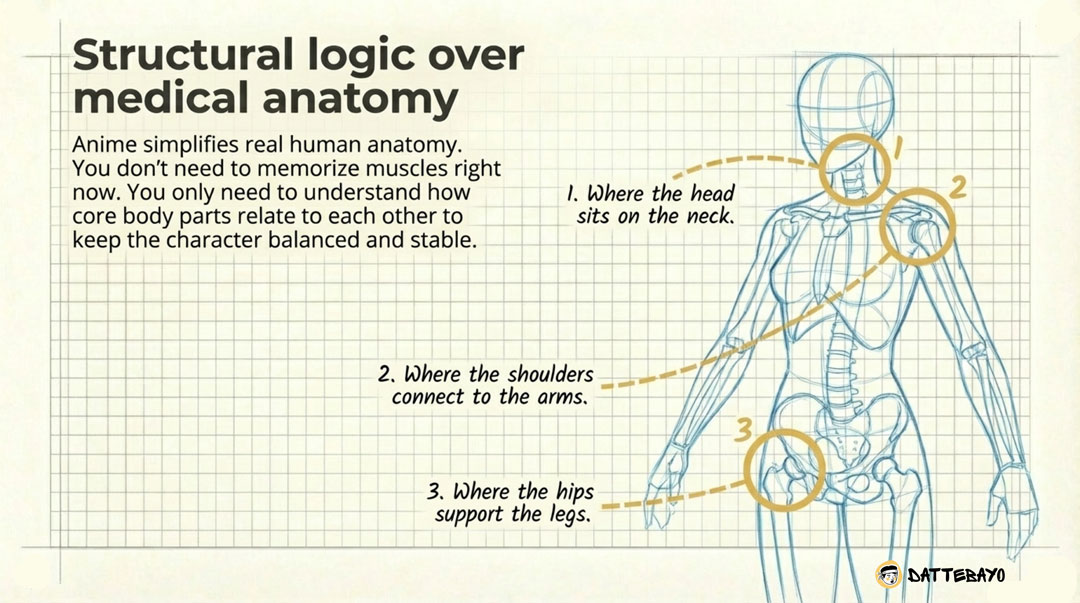
Yes, but only at a basic level. Anime simplifies real anatomy, so understanding how the body connects and balances is usually enough.
Some beginners worry that anatomy study means memorizing muscles or medical diagrams. That’s not necessary when you’re starting.
What matters most is understanding how body parts relate to each other.
How does anime simplify human anatomy?
Anime art intentionally exaggerates and simplifies certain features.
Common examples include:
- large expressive eyes
- simplified noses and mouths
- stylized hair shapes
- minimal muscle detail
These choices make characters easier to read visually and easier to animate.
However, the underlying body still follows human logic.
What anatomy knowledge do beginners actually need?
At the start, a few key ideas go a long way:
Understanding these connections helps your characters look balanced instead of awkward.
- how the head sits on the neck
- how shoulders connect to the arms
- how hips support the legs
Understanding these connections helps your characters look balanced instead of awkward.
What happens when anatomy is ignored?
When anatomy is completely ignored, characters often feel unstable.
Typical problems include:
Even stylized anime designs need structural logic underneath.
- arms attached too high or too low
- shoulders angled unnaturally
- legs that don’t support the character’s weight
Even stylized anime designs need structural logic underneath.
Should beginners draw with pencil or digital tools?
Most beginners start with pencil and paper because it’s simple and flexible, but digital tools can work just as well if they help you practice consistently.
The best tool is the one that keeps you drawing regularly.
Why do many artists start with pencil?
Traditional sketching has several beginner-friendly advantages:
- quick corrections with an eraser
- direct control over line pressure
- no technical setup
It also encourages loose drawing, which helps build confident sketching habits.
What are the benefits of digital drawing?
Digital tools have become extremely accessible for beginners.
Many drawing apps include features that make learning easier:
Popular beginner options include Procreate and Clip Studio Paint, often used with drawing tablets or iPads.
- undo for experimentation
- layers for separating sketch and line art
- customizable brushes
Popular beginner options include Procreate and Clip Studio Paint, often used with drawing tablets or iPads.
Do tools really matter for improvement?
Tools matter far less than practice consistency.
It’s easy to think better equipment will improve your art. In reality, progress mostly comes from how often you draw and how thoughtfully you study.
A simple sketchbook can take you surprisingly far if you use it regularly.
How can you study anime artwork without just copying it?
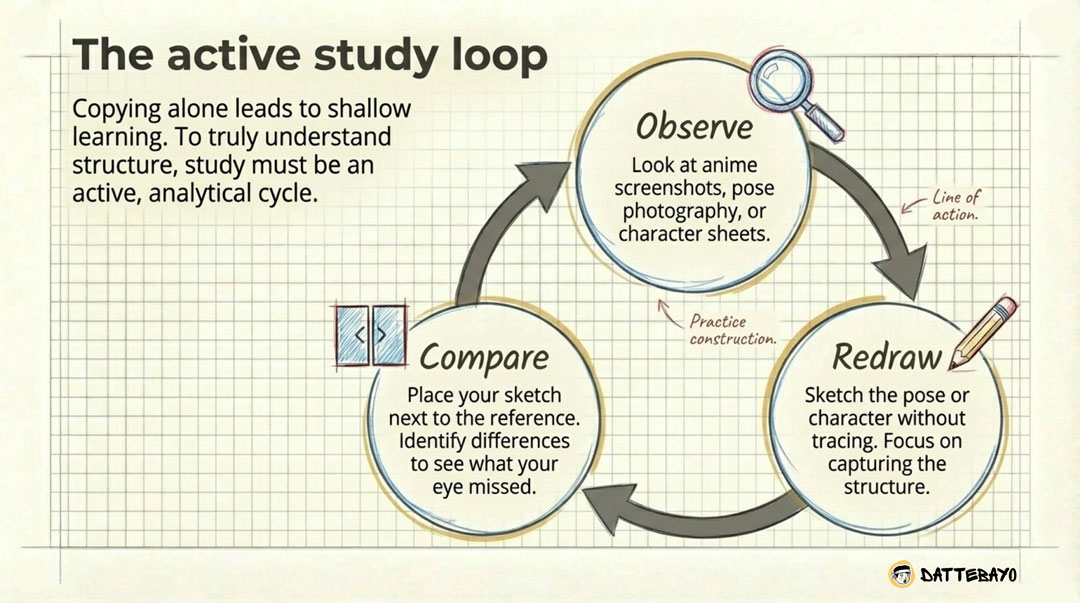
The most effective way to study anime art is to analyze references, redraw them yourself, and compare the results.
Copying alone often leads to shallow learning. You may reproduce the lines but still not understand the structure.
A more useful approach focuses on observation and analysis.
How do references reveal pose and proportion?
References answer important visual questions, such as:
Anime screenshots, character sheets, and pose photography can all be valuable study material.
- how the body bends during a pose
- how clothing reacts to movement
- where artists place facial features
Anime screenshots, character sheets, and pose photography can all be valuable study material.
Anime screenshots, character sheets, and pose photography can all be valuable study material.
What’s a simple way to analyze a reference?
A common study method artists use is:
The goal isn’t perfection. The goal is understanding what your eye missed.
- Observe the reference carefully
- Redraw the pose or character without tracing
- Compare the results to identify differences
The goal isn’t perfection. The goal is understanding what your eye missed.
Can tracing ever help beginners?
Tracing can be useful when treated as a learning tool rather than finished artwork.
For example, it can help you study:
The important part is analyzing what you trace, not presenting it as original work.
- line flow
- proportions
- how shapes are simplified
The important part is analyzing what you trace, not presenting it as original work.
What should beginners practice first when learning anime drawing?
Beginners improve fastest by focusing on a few repeatable practice areas—especially heads, poses, and consistent character proportions.
Trying to practice everything at once often leads to frustration. A smaller focus usually leads to faster progress.
Why is head drawing such useful practice?
Head drawing appears in almost every anime illustration.
Practicing it repeatedly helps you understand:
- face placement
- head angles
- hairstyle structure
Over time, rotating the head and placing features becomes much more natural.
How does pose sketching improve characters?
Sketching poses from references trains your ability to capture movement quickly.
These drawings are usually loose and simple, focusing on motion rather than detail.
Regular pose practice helps your characters feel less stiff and more natural.
Why repeat simple character drawings?
Redrawing the same character multiple times improves consistency.
With repetition, you naturally develop:
- more stable proportions
- better line confidence
- stronger visual memory
Structured programs—like the learning paths at Dattebayo—often organize these types of exercises so beginners can build skills step by step.
What mistakes do beginners commonly make in anime drawing?
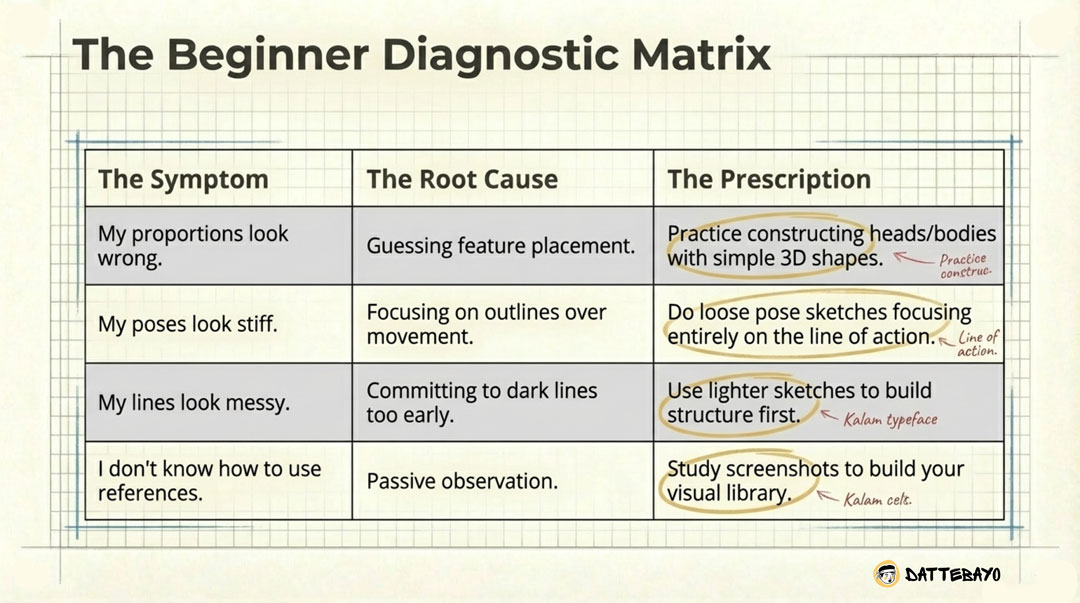
The most common mistakes include focusing on details too early, ignoring gesture, drawing with heavy lines immediately, and letting proportions drift.
Recognizing these habits early makes improvement much easier.
Why starting with eyes and hair causes problems
Eyes are often the most exciting part of anime characters, but they rely heavily on the head’s structure.
Without a solid head shape first, facial features often become misaligned.
Why do beginner poses look stiff?
Stiff poses usually happen when the drawing focuses on outlines instead of movement.
Gesture helps introduce flow, weight, and direction into the character’s body.
Why are dark lines early in the sketch limiting?
Dark lines make changes harder.
Lighter sketches allow you to adjust proportions and explore ideas before committing to the final outline.
Why do proportions sometimes change between drawings?
Beginners often redraw characters without a consistent construction method.
Practicing simple structural frameworks helps stabilize proportions across multiple drawings.
How long does it take to get better at anime drawing?
Many beginners start noticing improvement within a few months if they practice consistently and follow a structured learning approach.
Drawing progress rarely happens overnight, but steady practice produces visible results surprisingly quickly.
What does consistent practice look like?
Consistency doesn’t mean drawing for hours every day.
Short sessions can still help if they include:
- regular sketching
- studying references
- reviewing previous drawings
Many artists keep sketchbooks or digital folders so they can see their progress over time.
Why does structured learning speed things up?
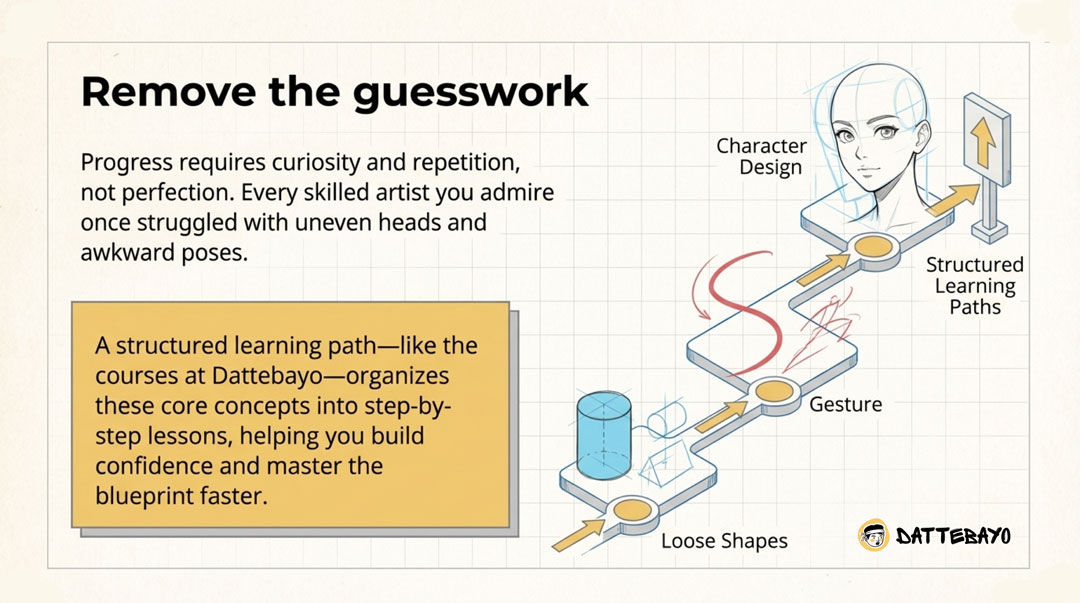
A structured learning path removes guesswork.
Instead of wondering what to practice next, you move through skills in a logical order.
For example, the course Drawing Anime and Manga from Scratch organizes beginner concepts into lessons designed to build confidence gradually.
How do you stay motivated during early stages?
Early drawings often feel disappointing—and that’s completely normal.
Every skilled anime artist you admire once struggled with uneven heads and awkward poses.
Progress comes from curiosity and repetition, not perfection.
How do artists eventually develop their own anime style?
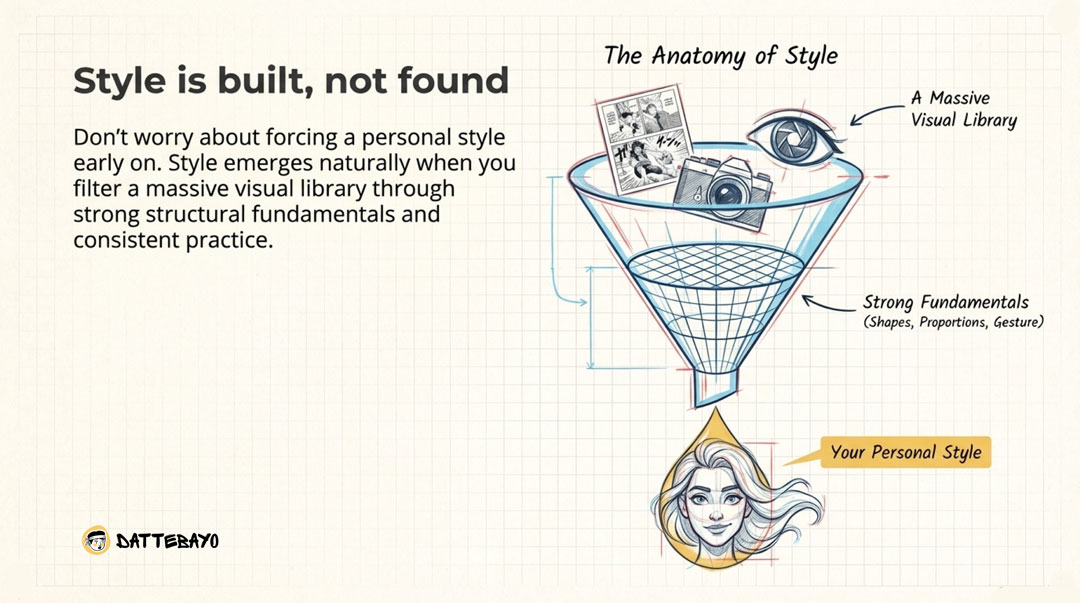
A personal anime style develops gradually through studying many artists, building strong fundamentals, and combining influences over time.
Most beginners worry about “finding their style” too early. In reality, style tends to emerge naturally as your skills grow.
Why studying other anime artists helps
Looking at different artists exposes you to new ideas about:
- character design
- line quality
- facial expressions
- costume design
Anime creators themselves learn this way—by absorbing inspiration from many sources.
What is a visual library in drawing?
A visual library is the collection of shapes, poses, faces, and design ideas stored in your memory.
The more artwork you observe and analyze, the larger this library becomes.
That makes it easier to invent original characters later.
How do influences turn into your own style?
Over time, you naturally mix inspirations:
- hairstyle ideas from one artist
- pose concepts from another
- clothing designs from manga, games, or animation
Eventually those influences blend into something uniquely yours.
Learning environments like Dattebayo often emphasize this progression: build strong fundamentals first, then explore personal character design with confidence.
FAQ: Anime Drawing for Beginners
What should I learn first when starting anime drawing?
Start with construction shapes, basic proportions, and loose sketches. Understanding how characters are structured makes every other drawing skill easier.
Can you learn anime drawing without going to art school?
Yes. Many artists learn through self-study, references, and structured online courses. Consistent practice and feedback matter more than formal education.
Should beginners copy anime characters to learn?
Studying and redrawing characters can help you learn, but relying only on copying may slow progress. Try analyzing references and recreating them in your own sketches.
Why do my anime drawings look stiff?
Stiffness usually happens when gesture and body movement are ignored. Practicing pose sketches from references helps your characters feel more natural.
Is anime drawing easier than realistic drawing?
Anime simplifies many details, but it still relies on core drawing skills like structure and proportions. The style changes, but the underlying principles remain similar.
What should I practice every day to improve anime drawing?
Good daily practice often includes:
- drawing heads from different angles
- sketching poses from references
- repeating simple character drawings
Is it too late to start learning anime drawing?
Not at all. People begin learning art at every age. Curiosity and consistent practice matter far more than when you start.
How long does it take to get good at anime drawing?
Many beginners notice improvement within a few months of regular practice. Long‑term mastery develops gradually through continued drawing.
Do you need a drawing tablet to start anime art?
No. Pencil and paper are perfectly fine for learning anime drawing fundamentals. Digital tools can be helpful, but they aren’t required.