If you’re getting into anime and manga drawing, the hardest part isn’t drawing—it’s figuring out what actually matters first. There’s a lot of noise out there: tools, styles, tutorials, “perfect” methods. Most of it overwhelms beginners before they even build momentum.
This guide cuts through that. You’ll learn what anime and manga drawing really involves, which skills actually move the needle early on, and how to practice in a way that leads to real improvement—not just more sketches.
What is anime and manga drawing, really?
Anime and manga drawing is stylized character art built on real fundamentals—simplified anatomy, clear proportions, and expressive design.
It’s easy to think anime is just “big eyes + cool hair,” but that’s surface-level. Strong drawings rely on structure underneath: how the head is built, how the body balances, and how features align.
Anime and manga aren’t separate skillsets—they’re different uses of the same core ideas:
- Manga leans on black-and-white linework and visual storytelling
- Anime focuses on color, motion, and clarity in animation
But both depend on the same foundation: proportion, structure, and readable design
The goal isn’t to copy a style—it’s to create characters that feel intentional and believable, even when stylized.
Style grabs attention. Structure makes it work.
If your drawings feel “off” even when you copy well, this is usually what’s missing.
What’s the difference between anime and manga styles?
Mostly presentation—not fundamentals.
Manga often:
- Uses clean, controlled linework
- Prioritizes contrast and readability
- Keeps shading simple
Anime often:
- Uses color and lighting
- Emphasizes movement and expression
- Simplifies designs for animation efficiency
Strip those away, and the underlying drawing skills are the same.
Do beginners need to pick one?
No—learning both actually helps.
Since they share the same foundation, switching between them builds a broader understanding. You’re not locking into a path—you’re building flexibility.
What should you actually draw first?
Start with simple heads, faces, and basic poses—not full detailed characters.
Trying to draw complete characters too early is like trying to write a novel before you’re comfortable with sentences. It slows you down and makes progress harder to see.
You want smaller, repeatable wins.
Why start with heads and faces?
They give fast feedback and visible improvement.
You naturally practice:
- Proportions (eye placement, spacing)
- Symmetry
- Expression
And because faces are familiar, you’ll notice progress quickly—which keeps you motivated.
How should you approach poses early on?
Think structure first, detail later.
Instead of focusing on muscles or clothing, reduce poses to:
- Simple lines for movement
- Basic shapes for volume
This builds your sense of balance and gesture without overwhelming you.
What are good beginner practice habits?
Keep it simple and repeatable:
- Draw multiple heads from reference, focusing on placement—not perfection
- Break poses into stick figures and basic shapes
- Practice clean lines over rough sketches to build control
You don’t need a complex system yet. You just need consistency.
Which fundamentals actually improve your drawings?
Proportions, simplified anatomy, and line control have the biggest early impact.
These three do most of the heavy lifting:
- Proportions → whether your drawing looks “right”
- Anatomy (simplified) → gives structure and believability
- Line control → affects clarity and confidence
Detail can’t fix weak fundamentals. You can render hair beautifully, but if the eyes are misaligned, it’ll still feel off.
Why do your drawings look wrong even when you copy?
Because you’re copying the surface, not the structure.
When copying, it’s easy to match outlines while missing:
- Distances between features
- Underlying shapes
- Subtle proportions
So your drawing looks similar—but doesn’t feel the same.
This is one of the most common sticking points in anime and manga drawing.
What’s the difference between line control, line art, and inking?
These get mixed up a lot, but they’re not the same:
- Line control: your ability to draw smooth, confident lines
- Line art: the cleaned-up version of your sketch
- Inking: final, intentional linework (common in manga workflows)
If your line control is shaky, your line art won’t feel clean—no matter what tools you use.
What should you prioritize first?
If you keep it focused, aim for:
- Accurate proportions
- Confident lines
- Smart use of references
That combination drives most early improvement.
Here’s a quick way to decide what to focus on next:
How do you use references without getting stuck copying?
Use references to understand structure, then recombine instead of copying one image exactly.
References aren’t a crutch—they’re how you train your eye.
The shift looks like this:
- Beginners copy one image closely
- Improving artists study several and simplify what they see
Is it okay to copy or trace when learning?
Yes—if you use it deliberately.
Copying helps you notice:
- Proportions
- Shape decisions
- Line choices
Tracing can help you understand structure briefly, but it doesn’t build real skill on its own.
If it becomes your main method, progress stalls.
Why can’t you draw from imagination yet?
Because you haven’t built a visual library.
Your brain needs stored references for:
- Head angles
- Eye placement in perspective
- Body balance
Without that, you’re guessing—and guessing leads to inconsistency.
Learning platforms like Dattebayo emphasize breaking references into simple, understandable parts so you can actually retain and reuse what you study.
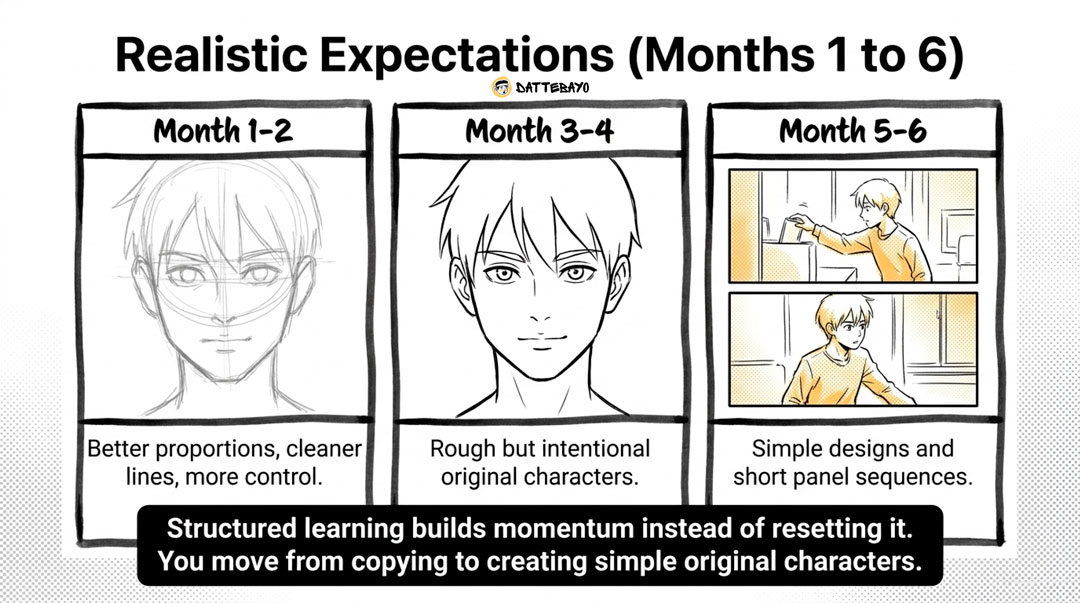
What does a simple learning roadmap look like?
You improve faster when you focus on the right things at the right time.
You don’t need a perfect plan—just a clear direction.
Early stage: shapes, faces, proportions
Focus on:
- Head structure
- Facial placement
- Simple forms
This builds your foundation.
Next stage: poses and cleaner lines
Add:
- Gesture and movement
- Basic body structure
- Line confidence
Your drawings start to feel more natural and alive.
Later stage: inking and character creation
Now you:
- Make more intentional line choices
- Start designing original characters
- Combine skills instead of isolating them
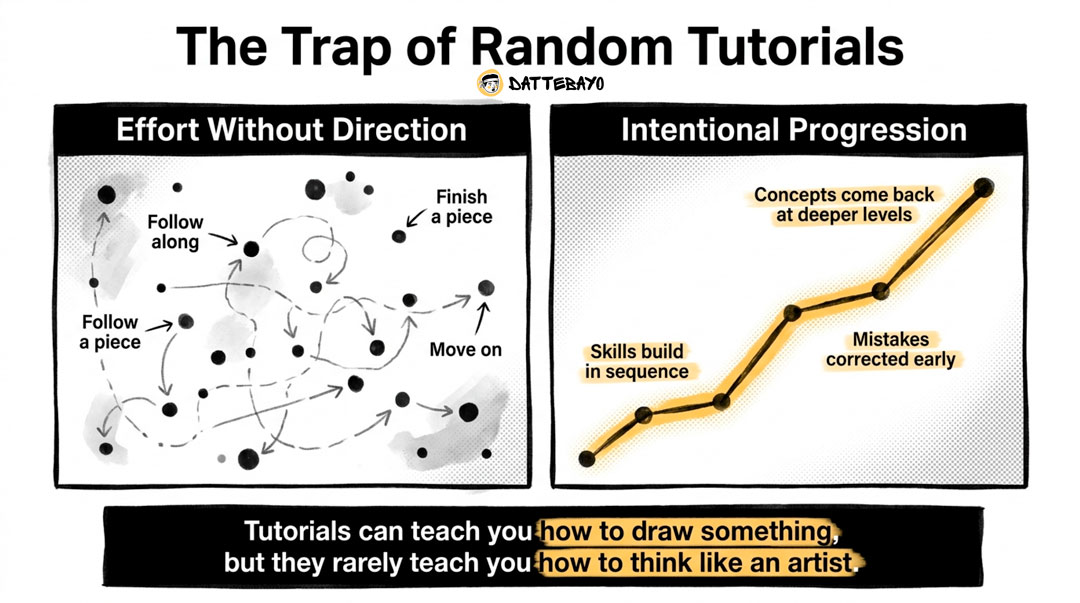
A structured path like Dattebayo’s beginner course follows this kind of progression, which helps reduce overwhelm compared to random tutorials.
What tools do you actually need?
Very little—your skill matters far more than your setup.
It’s easy to overthink tools early on, but they’re not the limiting factor.
What’s enough to get started?
You only need:
- Pencil
- Eraser
- Paper or a sketchbook
- Optional fineliner
That’s enough for months of real progress.
Do expensive tools help?
Not at the beginning.
Things like Copic markers or premium brushes:
- Won’t fix proportions
- Won’t improve line control
- Won’t teach structure
They’re great later—but early on, they’re mostly a distraction.
Digital vs traditional drawing: which is better?
The better option is the one you’ll stick with consistently.
Both have advantages, and neither blocks your progress.
When does digital make more sense?
- You want to create webtoons or online content
- You care about coloring and editing
- You want flexibility (layers, undo, etc.)
Digital art aligns well with how art is shared in 2026—especially for comics and social platforms.
Why is traditional still great?
- Fewer distractions
- Stronger focus on fundamentals
- Helps build confident line control
For many beginners, a sketchbook leads to more consistent practice.
How do you start creating your own anime characters?
Start earlier than you think—by combining references and keeping designs simple.
You don’t need to “wait until you’re good.”
What makes a simple character design work?
Think in three parts:
- Shape: overall silhouette
- Features: eyes, hair, expression
- Outfit: hints at personality
Even simple designs can feel strong if they’re clear and intentional.
How do you move from copying to creating?
Use a remix mindset.
Instead of copying one character:
- Take hair from one reference
- Eyes from another
- Outfit inspiration from somewhere else
Then simplify and adjust.
That’s how originality actually starts—not from nothing, but from combining ideas.
Dattebayo encourages this early, so you’re not stuck copying for too long before creating your own work.
What beginner mistakes slow progress the most?
Most people stall by focusing on details, avoiding fundamentals, or practicing without direction.
Common patterns:
- Adding detail too early
- Avoiding full-body practice
- Following tutorials passively
- Restarting instead of finishing
- Practicing inconsistently
Why doesn’t “drawing more” always help?
Because unfocused practice reinforces mistakes.
If you’re:
- Guessing proportions
- Skipping references
- Repeating the same errors
You’re not improving—you’re just repeating.
Practice doesn’t make perfect. Practice makes permanent.
What you practice matters more than how long you practice.
How can you practice without feeling overwhelmed?
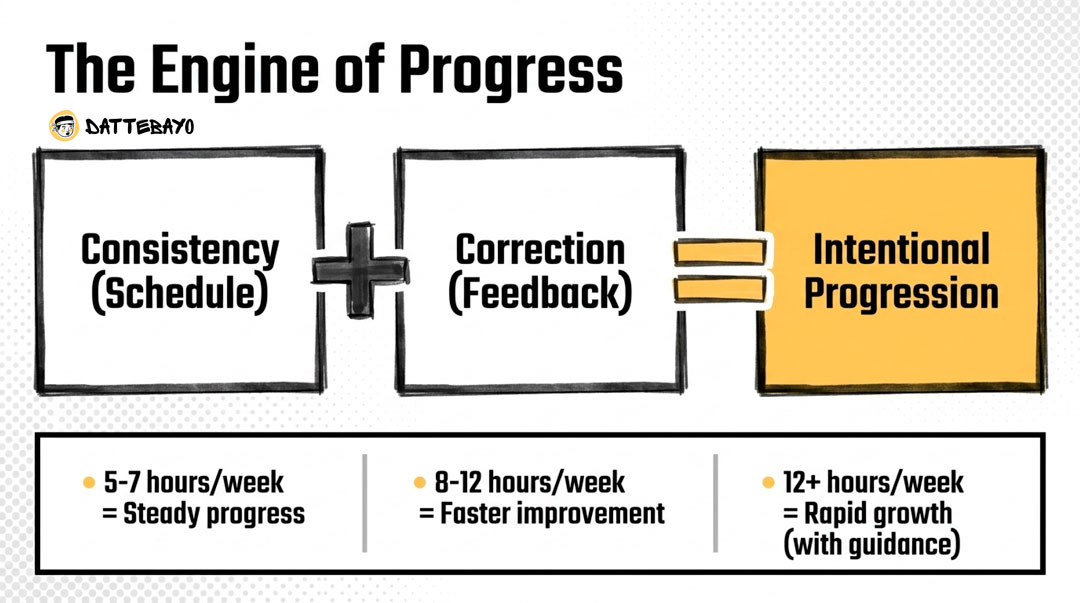
Keep your focus narrow and your routine simple.
You don’t need a complicated system—you need something sustainable.
What does a simple routine look like?
A balanced approach:
- Faces (proportions, expressions)
- Poses (basic gestures)
- Line practice (control and clarity)
- Free drawing (apply what you learned)
Even 20–30 minutes a day is enough if you stay consistent.
What can you ignore for now?
You can safely deprioritize:
- Advanced anatomy
- Complex coloring
- Expensive tools
These matter later—but early on, they just split your focus.
FAQ: Quick answers beginners actually need
Should you learn anatomy before drawing anime?
No. Learn simplified anatomy alongside anime drawing, not before it.
Is tracing okay?
Yes, occasionally for understanding—not as your main practice.
Why can’t you draw from imagination yet?
Because your visual library is still developing.
What’s the easiest style to start with?
Simpler styles with clear shapes and minimal detail.
Do you need realism first?
No—but observing real proportions helps your stylized work feel better.
Pencil or tablet?
Pencil is simpler. Digital is fine if it helps you stay consistent.
Why do copied drawings still look off?
Structural issues—usually proportions.
How long does it take to improve?
With focused, consistent practice, you can see noticeable changes within weeks.
How often should you practice?
Short, regular sessions beat long, inconsistent ones.
Can beginners create original characters?
Yes—by combining references and simplifying ideas. That’s something Dattebayo supports early on.
Final thoughts: how do you actually make progress?
Keep it simple, focused, and consistent.
Anime and manga drawing feels overwhelming when you try to learn everything at once. It becomes manageable when you focus on:
- Simple subjects (faces, basic poses)
- Core fundamentals (proportions, line control
- Consistent, intentional practice
You don’t need perfect tools or advanced knowledge to start improving. You just need direction—and the patience to stick with it.
Do that, and your drawings will start changing in ways you can actually see and feel.