
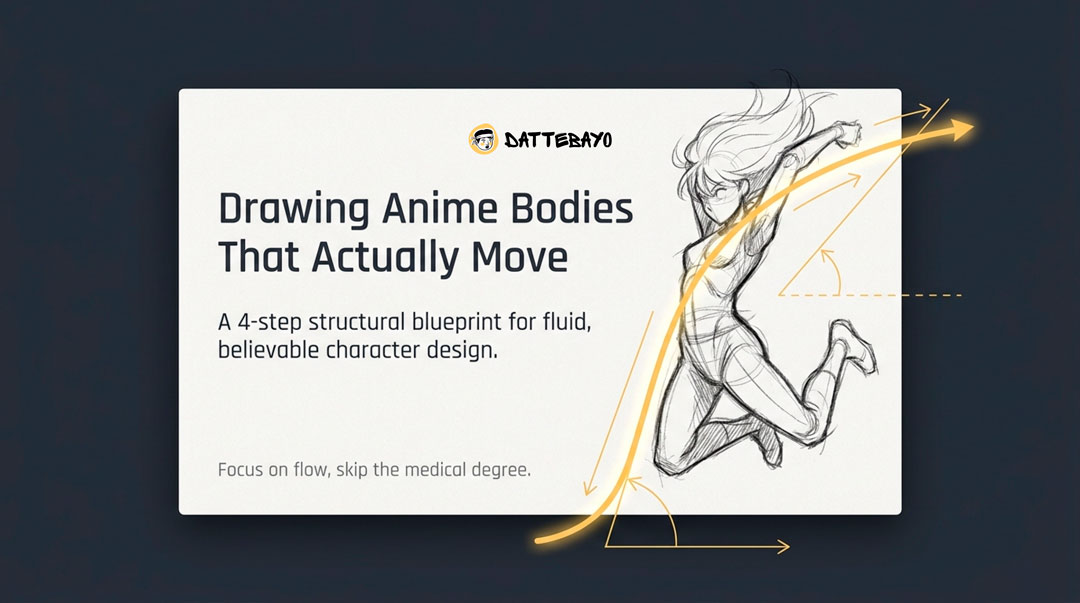
Anime anatomy feels confusing at first—not because it’s complicated, but because it’s often explained in a way that overcomplicates it. What you actually need isn’t more information. You need a clear, usable system.
This guide gives you that.
What is anime anatomy (and why it’s not “wrong” anatomy)?
Anime anatomy is a simplified, stylized version of real human anatomy that keeps structure and balance while changing proportions and details for visual appeal.
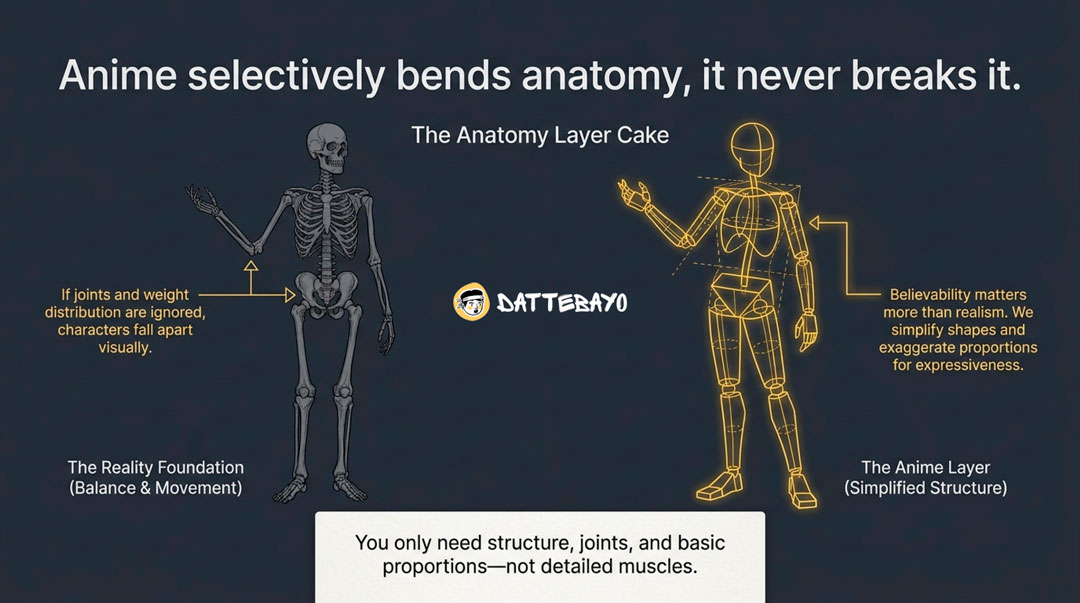
A common misconception is that anime “breaks” anatomy rules. It doesn’t—it selectively bends them.
Think of real anatomy as the foundation, and anime as the stylistic layer built on top. The way bodies move, balance, and connect still comes from reality. What changes is how that structure is shown.
That’s why some highly stylized characters feel believable, while others feel off even when they look more realistic.
Believability matters more than realism. If the structure works, the style can stretch.
Anime anatomy also ties directly into character design. The way you simplify or exaggerate a body says a lot about personality, role, and tone.
Why anime still follows real structure
Because movement, balance, and joints come from reality—without them, characters fall apart visually.
Even the most stylized designs still rely on:
- A spine that supports movement
- Joints that bend in natural directions
- Weight that feels grounded
Ignore these, and you’ll see:
- Floating or unstable poses
- Limbs that don’t connect properly
- Stiff or awkward figures
What gets simplified or exaggerated
Anime adjusts proportions and removes detail to make characters clearer and more expressive.
Common changes:
- Larger eyes and simplified faces
- Longer legs or shorter torsos
- Smaller hands and feet (depending on style)
- Minimal muscle definition
Different genres push this in different directions:
- Shonen: more grounded and athletic
- Shojo: longer limbs, softer forms
- Modern styles (2020s–2026): often blend realism with stylization
The only anatomy basics you actually need (as a beginner)
You only need structure, joints, and basic proportions—not detailed muscles.
This is where many beginners get stuck: trying to learn everything at once.
Instead, focus on:
- The spine and overall body flow
- Ribcage and pelvis
- Limbs as simple forms
- Basic proportions
That’s enough to create convincing characters.
Structure first, details later
Structure determines whether your drawing works—details just refine it.
If structure is off:
- Clean lines won’t save it
- The pose will feel wrong
If structure is solid:
- Even rough sketches feel right
This is why artists at Dattebayo prioritize construction—it replaces guesswork with control.
Why overlearning anatomy can slow you down
Too much detail too early leads to stiff, overthought drawings.
You might notice:
- Hesitation with every line
- Rigid poses
- Obsessing over muscles instead of movement
You don’t need medical-level anatomy. You need functional understanding.
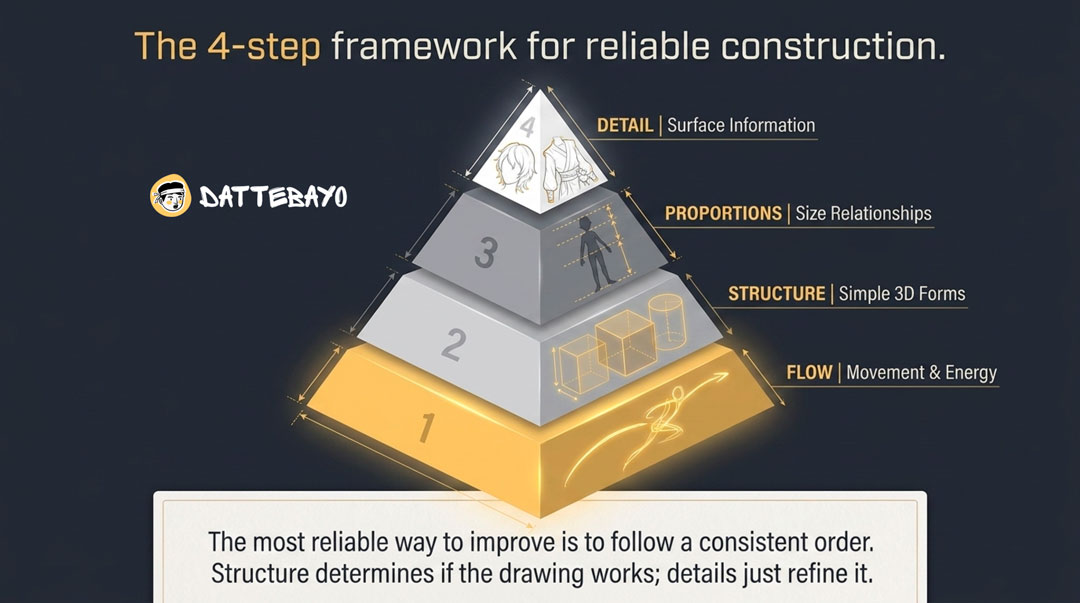
A simple system for drawing anime bodies (flow → structure → proportions → detail)
The most reliable way to improve is to follow a consistent order: movement first, then structure, then proportions, then detail.
Instead of guessing, you build in layers:
- Flow (movement)
- Structure (construction)
- Proportions (size relationships)
- Detail (surface information)
Flow (line of action)
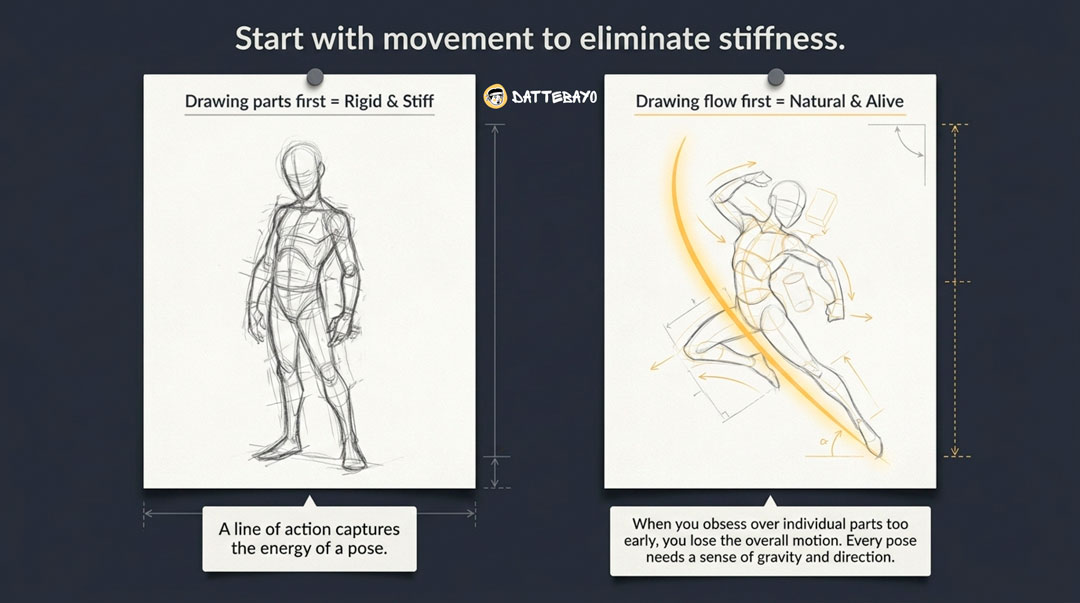
Start with movement—this is what prevents stiffness right away.
A line of action captures the energy of a pose. Without it, drawings feel rigid. With it, even simple sketches feel alive.
Structure (simple forms)
Build the body using simple 3D shapes.
Think in:
- Boxes for the torso
- Cylinders for limbs
- Spheres for joints
The torso matters most:
- Ribcage + pelvis = the core of the pose
Proportions (head-count system)
Apply proportions after structure is in place.
This helps you avoid constant resizing and guesswork. You’re aiming for consistency, not perfection.
Detail (only at the end)
Details enhance—they don’t fix.
Hair, clothing, and facial features come last. Adding them too early makes your drawing harder to adjust.
How to build anime bodies from simple shapes (without overthinking)
Breaking the body into simple 3D forms makes anatomy easier to understand, adjust, and pose.
This approach keeps things manageable.
The torso: ribcage + pelvis relationship
The torso is two main forms that tilt and rotate relative to each other.
This relationship creates:
- Movement
- Balance
- Natural-looking poses
If both stay stiff and aligned, the whole figure feels rigid. Even a slight tilt or twist adds life.
Limbs: cylinders, joints, and tapering
Limbs change thickness and direction—they’re not straight tubes.
Keep in mind:
- Limbs taper (thicker near the body, thinner toward the ends)
- Joints connect forms—they don’t break them
- Slight curves feel more natural than straight lines
Connecting everything into one figure
The body should feel like one connected system—not separate parts.
A common issue is drawing each part in isolation. Instead, think about how everything links together:
- Where does this limb attach?
- Where is the weight going?
What are the basic proportions in anime anatomy?
Anime uses head-count proportions, but consistency matters more than picking a “perfect” ratio.
The head-count system measures height using the size of the head.
Common head-count ratios (and what they feel like)
- 5–6 heads: cute, highly stylized
- 6–7 heads: balanced and beginner-friendly
- 7–8 heads: more realistic and mature
Why consistency matters more than accuracy
Consistency makes your style feel intentional—even if it’s not realistic.
If proportions shift randomly, characters feel unstable. If they stay consistent, your drawings start to look cohesive.
Why your anime characters look stiff (and how to fix it)
Stiffness usually comes from ignoring movement and focusing too early on parts.
The “drawing parts instead of flow” mistake
When you focus on individual parts, you lose the overall motion.
Everything might look fine on its own—but together, the pose feels off.
Ignoring balance and weight
Every pose needs a sense of gravity.
Ask:
- Where is the weight?
- Would this pose actually stand?
If the answer isn’t clear, the drawing will feel unstable.
Fixing stiffness with one change: start with movement
Focusing on movement first can immediately improve your poses.
This shift alone:
- Loosens your drawings
- Makes poses feel natural
If this is a recurring issue, it’s something platforms like Dattebayo focus on—helping you move from stiff copying to confident construction.
Common anime anatomy mistakes (and quick fixes)
Most problems come from a few repeatable issues—not a lack of ability.
Arms and legs look “off”
Usually caused by inconsistent length or no taper.
Think in simple forms and keep proportions steady.
Torso feels flat or broken
Happens when ribcage and pelvis aren’t clearly defined.
Separating them—even mentally—adds structure and flexibility.
Heads don’t match the body
A consistency issue.
Stick to one proportion system per drawing.
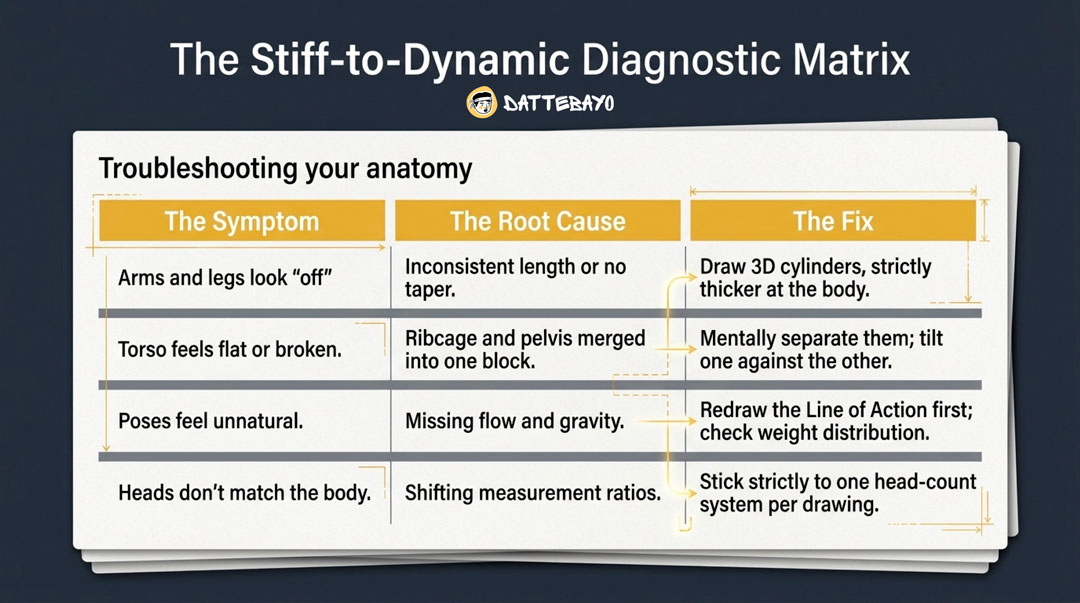
Poses feel unnatural
Missing flow and balance.
Reintroduce movement and check weight distribution.
Anime body types: beyond male vs female
Anime body design is about shape language and intent—not just gender.
Modern anime (especially into 2026) shows more variety than ever.
Common body type patterns
- Hero type: balanced, athletic
- Soft type: rounded, gentle
- Comedic type: exaggerated proportions
- Stylized extremes: very long limbs or compact bodies
When and how to break proportion rules
Breaking rules works when it’s intentional and consistent.
Exaggeration should:
- Stay consistent across the character
- Reflect personality or role
How to practice anime anatomy (without wasting time)
Focused, structured practice beats random drawing every time.
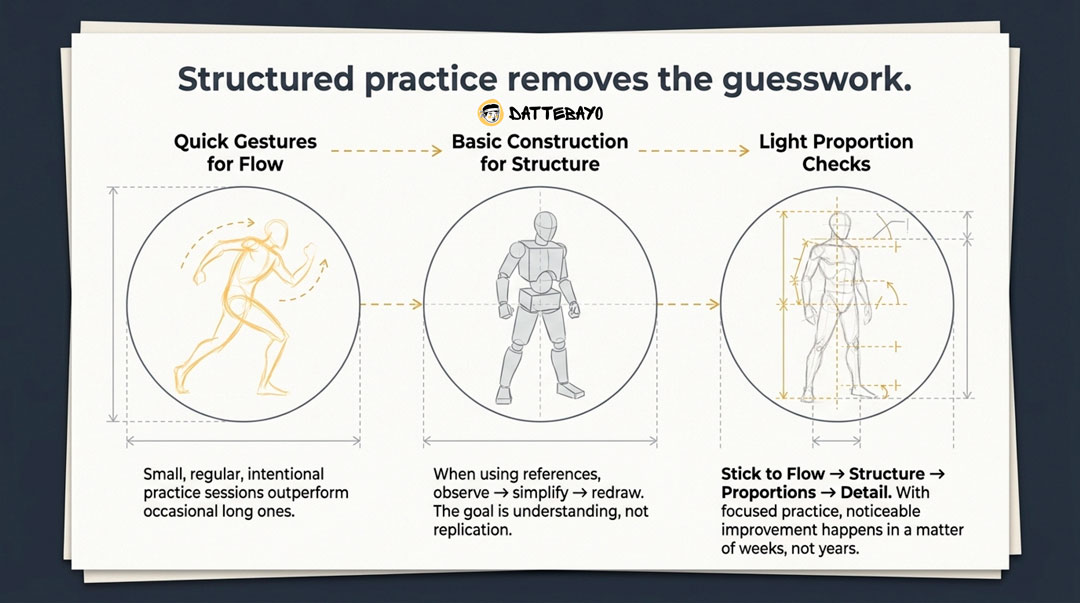
A simple daily approach
- Quick gesture sketches (movement)
- Basic construction sketches (structure)
- Light proportion checks
Even short sessions add up when they’re intentional.
How to use references without copying
The goal is understanding, not replication.
Use this mindset:
- Observe → simplify → redraw
Helpful tools:
Why structured learning speeds things up
A clear path removes guesswork and keeps you progressing.
That’s the idea behind programs like Dattebayo’s anime drawing course: building skills step by step so you don’t stall or feel lost.
How long does it take to improve at anime anatomy?
With consistent, focused practice, you can see improvement within a few weeks.
Not perfection—progress.
What early progress looks like
- Less stiffness in poses
- More consistent proportions
- Less reliance on guessing
Why consistency beats talent
Small, regular practice sessions outperform occasional long ones.
Even in 2026—where references and AI tools are everywhere—your ability to understand and construct anatomy is what really sets you apart.
Stick to:
- Flow → structure → proportions → detail
And improvement becomes predictable.
FAQ: Anime Anatomy
What is anime anatomy and how is it different from real anatomy?
Anime anatomy is stylized but based on real structure. It simplifies and exaggerates features while keeping movement believable.
Do I need to learn full human anatomy before drawing anime?
No. Focus on structure, joints, and proportions first. Details can come later.
What’s the best head-to-body ratio for beginners?
Around 6–7 heads—balanced and versatile.
Why do my anime arms and legs look wrong?
Usually inconsistent proportions or lack of structure. Think in simple 3D forms.
What is the easiest way to practice anime anatomy daily?
Combine gesture drawing, simple construction, and proportion checks.
How do you draw anime bodies from different angles?
By using simple 3D forms and understanding how the torso rotates in space.
Why do my poses look stiff even when proportions are correct?
Because flow is missing—movement comes first.
Should I use references or draw from imagination?
Both, but references will speed up your learning significantly.
How long does it take to get better at anime anatomy?
With consistent practice, noticeable improvement can happen in a few weeks.
If you take one thing from this: don’t overcomplicate anime anatomy. Keep it simple, structured, and consistent—and your progress will come faster than you expect.